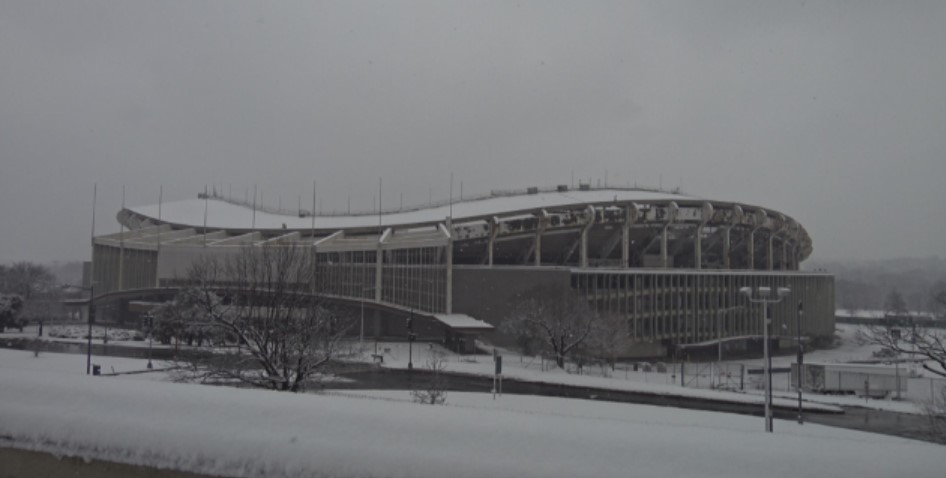
RFK Campus: 190 acres in Anacostia Park, partly in a flood plain. Current uses: RFK Stadium (being demolished), Fields at RFK Campus: (27 acres- 3 playing fields), RFK Festival Grounds. Image from EventsDC live camera: https://eventsdc.com/venue/rfk-stadium/live-demolition-camera
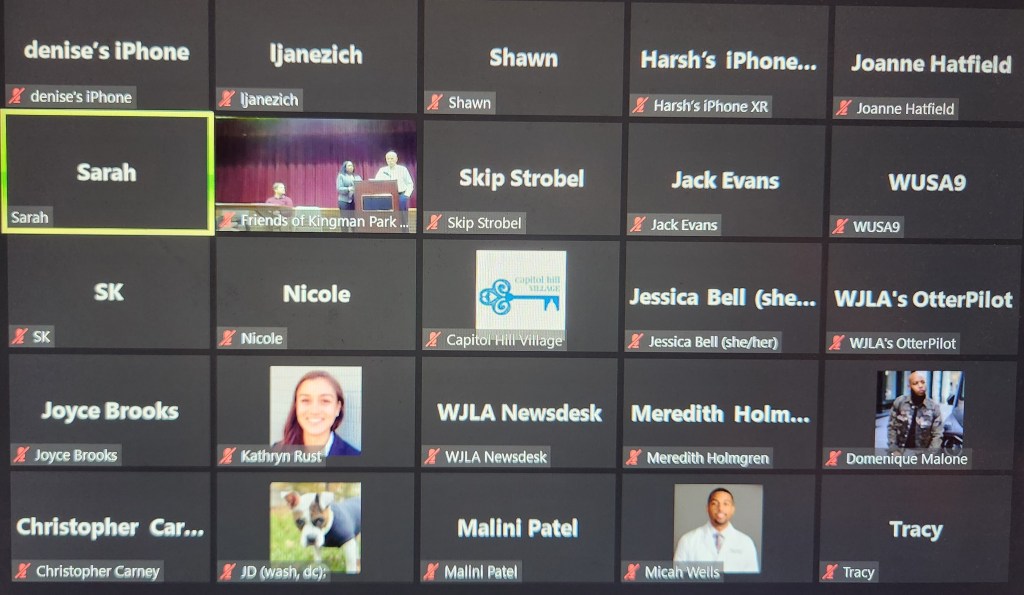
The meeting of Friends of Kingman Park Thursday night was both in person and virtual. Mendelson in is at podium in second row.
Mendelson’s Candid Talk on Stadium
By Larry Janezich
Posted January 19, 2024
Thursday night, City Council chair Phil Mendelson spoke candidly about the prospects and process for a new football stadium on the RFK campus. The venue was a meeting sponsored by the Friends of Kingman Park, the neighborhood which lies just east of RFK. Prior to Mendelson taking the podium, Hill East resident Beth Purcell presented the key points of a Whitepaper on the RFK Stadium Campus commissioned by the Committee of 100 on the Federal City. See here: https://committeeof100.net/what-we-do/planning/rfk-stadium-site/
During the meeting, Mendelson stated his position on a new stadium: “On the record, I do not support public financing for a stadium. I think a majority of city council agrees….My position is I could accept a stadium but I don’t want any public financing. The reality is, if there isn’t any public financing, Maryland and Virginia – who also want a stadium – may prevail.”
Purcell noted earlier in her presentation that the average cost of a new NFL stadium is $ 1.2 billion and that all NFL stadiums built between the 1970s and 2010s had some public financing.
Public Financing. Meldelson said both the Mayor and the team’s owners want the Commanders to be in the city, but “if it involves city financing there is going to be a fight in the council. If the mayor … starts negotiating with the Commanders, I can tell you the political dynamic will shift … There will be tremendous pressure on the council to approve some financing for the stadium.”
“I don’t see a stadium as an economic benefit to the city. If the Commanders fund 100% of the cost, there might be a plan with economic benefits to the city. If the Commanders…get development rights around it and put up stuff to make money to help pay for building the stadium, I see that as a possibility.” Mendelson later alluded to housing with a substantial portion affordable as being a potential component of such a development of the site.
Related to this issue, one of the key points raised by Purcell in her presentation was directly related to potential development. She noted that all 29 NFL stadiums provide surface parking and allow tailgating on some lots. Tailgating, she said, is part of the NFL experience, and its popularity at games requires a large area of surface parking which would likely crowd out other uses such as community recreation and housing.
Mendelson talked about the lack of the city’s funding and ability to finance a stadium. He said, “Financing comes from borrowing. We have a $250 million hole in budget. We don’t have funds sitting around idly for a stadium. We pay debt service of $1billion a year – ten years ago it was $.5 billion.” By law, the city’s interest on debt payment is limited to 12% of revenues. Mendelson said that last year we were at 12% and “couldn’t borrow another penny.” Refinancing provided $.5 billion for the offer to Monumental Sports to upgrade the Penn Quarter Arena if the Virginia deal falls through. He put the likelihood of that happening at less than 10%.
Purcell noted during her presentation that public financing for Nationals Park was $535 million in bonds, to be paid by rent from the Nationals, sales taxes on items sold at stadium, gross receipts tax on large businesses, and a share of utility taxes paid by all businesses. Audi Field’s public financing was $32 million in District capital funds and $106 million in new debt. Rent payable to the District is $1 per year for 30 years.
Economic Benefits. Mendelson said that economic benefits from a stadium “in my view are nonexistent or made up.” He cited:
- Nats Park – 80 games plus concerts.
- Arena – 250 games plus concerts.
- A stadium – 9 games a year plus other events.
The Process. “In order for a football stadium to come here” … Mendelson said, “a number of things have to happen.”
- Congressional legislation providing leasing the land to the city for 99 years.
- Negotiations between the Deputy Mayor for Planning and Economic Development (DMPED) and, in case of a football team, the owners of the Commanders.
- Reaching an agreement which will go to the council for approval.
- The likelihood of the agreement going through the zoning process.
Congressional Legislation. Mendelson said, “Here’s what I know about what’s going on.”
- “One reason legislation has gone as far as it has, I think, is that the NFL wants a football stadium in the city. This is important because the NFL is like the big kahuna and I think that’s why Congress is being supportive. That means they can find ways to pressure the council and negotiate a deal the Mayor will agree to.”
- The legislation gives huge latitude to city regarding what happens to the land.
- It is currently hung up in the House. The bill was referred to the House Oversight Committee where the chairman supports it. It was also referred to the Transportation Subcommittee where the chair opposes it.
- The bill is being rewritten so the land will be transferred from the National Park Service instead of the General Services Administration and will be referred to the Committee on the Environment which appears to be favorable to the bill.
- The bill will probably get through the House and the Senate and the city will have the land with some constraints.
Community Input. “During the process there will be opportunities for the community to weigh in,” Mendelson said, “but that often means simple sessions as opposed to something meaningful.”
His advice to the community was, “Never trust completely the speaker, because the speaker can say things – and if you’re concerned with the football stadium and what will be done to protect the community, unless you have something in writing don’t trust it. And that’s not trying to throw shade on anybody, but folks trying to sell something are going to put the best spin on it; ‘Of course we’re going to mitigate traffic’ – what does that actually mean unless it’s in writing?
To a question from a community member, he said, “The opposition of the community is more important to the council than anybody else. The Mayor wants a stadium. She will stand before you and say ‘I appreciate what the community sentiment is’ – but she wants a stadium…. A stadium is seen as much more of a city wide issue.”
Timeline. To another question regarding the best time for opponents to engage, Mendelson said it’s timely to share concerns with members of the council and “At the point of land transfer step it up. A lot will be going on inside DMPED none of us will see. Begin organizing even though there still won’t be a plan.”
 CAPITOL HILL CORNER
Thank you for this, very interesting and informative! I hope he’s wrong about the odds of the Wizards/Caps move to VA falling through, but I bet anything close to 10% odds would be generous.
“She noted that all 29 NFL stadiums provide surface parking and allow tailgating on some lots. Tailgating, she said, is part of the NFL experience, and its popularity at games requires a large area of surface parking which would likely crowd out other uses such as community recreation and housing.”
The Purcell paper and report gets a lot of details like this extremely wrong about both the design and layout of current NFL stadiums as well as the goals for the Commanders.
For example, the paper gets the current capacity of FedEx field wrong – they’ve consistently reduced it, down to just 58,000 now.
The claim that all 29 stadiums have extensive surface parking and all allow tailgating is also kind of bizarre. Yes, many stadiums have acres and acres of surface parking lots like FedEx does, but lots of them do not. Charlotte, Atlanta, Seattle, Minneapolis, Chicago, New Orleans, and many others.
Likewise, the paper asserts that any new NFL stadium will need to be just as big as FedEx’s former capacity and have just as much surface parking – neither of those things are likely true. The previous ownership’s concept plans included no surface parking at all and a stadium capacity more in the 60,000 seat range.
The whole thing reads like something written by people who don’t pay much attention to football or football stadiums.
Where are you finding this? Appendix A of The Purcell paper lists the Fedex Field capacity as 67,717 (which is 100 more than what the wiki page shows)
Also, a quick Google search shows that Soldier Field, Bank of America Stadium, and Lumen Field (Chicago, Charlotte, and Seattle, respectively) do allow tailgating. That is as far as I bothered to look…
Please check you facts before you throw shade.
Page 15: “To bring the Commanders back to DC would require a stadium similar in size to FedEx Field,
(football capacity 82,000 in 2021) compared to RFK’s football capacity of 56,000.”
Also, I didn’t say that Chicago, Seattle, and Charlotte don’t allow tailgating, I said those stadiums are not surrounded by acres of surface parking lots.
Soldier Field in Chicago: famously has the tagline “a stadium in the park”
Seattle: there is one tiny surface parking lot north of the stadium, much of which has been recently redeveloped.
Charlotte: the stadium is right adjacent to downtown; there are no surface parking lots, but there are some grassy fields.
FWIW, there are also NFL stadiums that do not allow tailgating on lots they control – Detroit is one. https://www.fordfield.com/plan-your-visit/parking
Likewise, US Bank Stadium in Minneapolis ‘allows’ tailgating – for the small number of cars that have permits to park at one of the few surface lots near the stadium.
The broader point remains: there is an assertion that any NFL stadium MUST have tons of surface parking, as if that element is as important as the football field itself, or the lockerroom for the team or something. And that’s simply not the case – a cursory look at the existing NFL stadiums would reveal that.
Beth Purcell, one of Capitol Hill’s best leaders, is always solid so I am hoping Beth will address the criticisms of her arguments from Alex B.