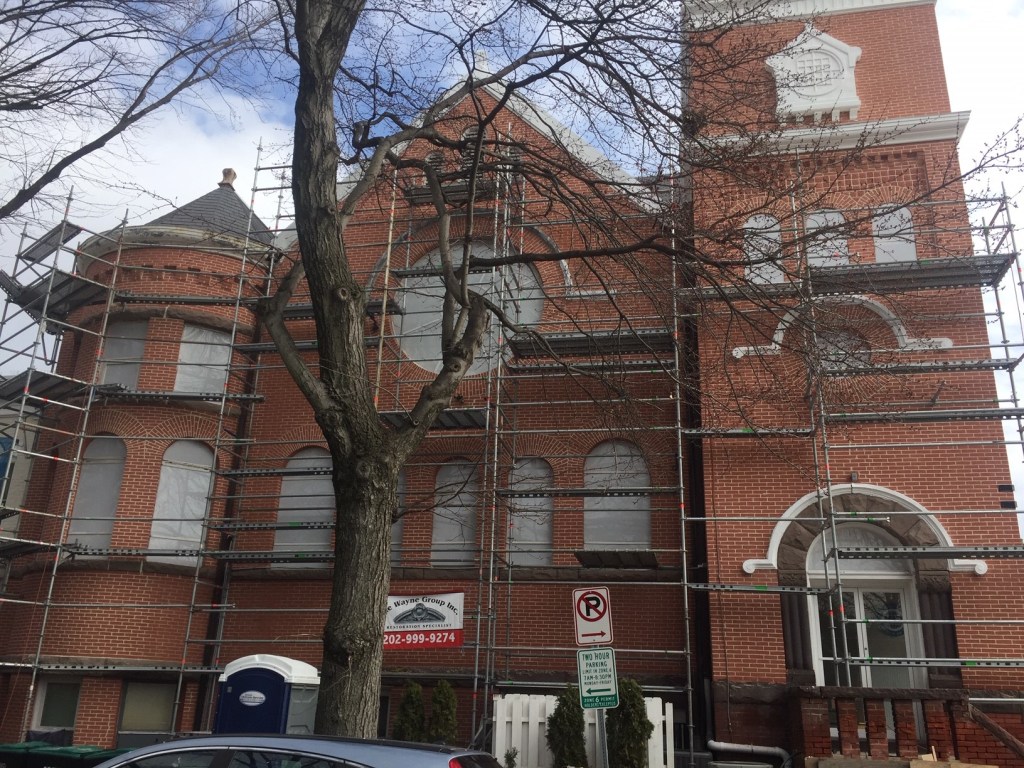
The covered stained glass windows of the Church of God at 700 A Street, NE.
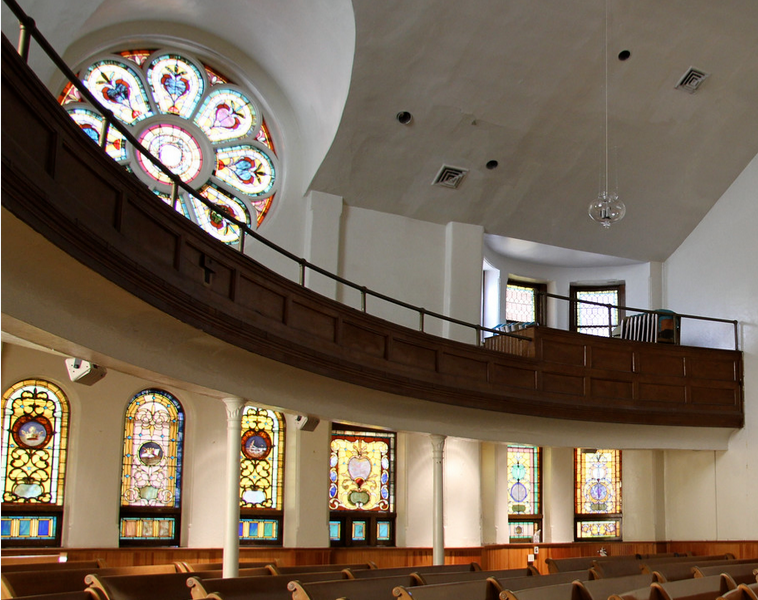
A view of the interior of the church from circa 2011.
Covering Stained Glass of Capitol Hill Church Prompts Neighbor Outrage
by Larry Janezich
Posted February 13, 2024
Neighbors of the World Mission Society, Inc. (Church of God), at 700 A Street, NE, are up in arms again over the issue of preservation of the stained glass windows of the Romanesque Revival Capitol Hill church at 700 A Street, NE.
The backstory: A tenet of the current owners of the Church of God is that they cannot worship in the presence of images such those in the church’s numerous stained glass windows. To that end, they attempted to remove the windows in 2012, but were blocked by the city’s enforcement of the Historic Preservation Act.
Recently, the church applied for a permit to install acrylic glass over the stained glass and staff in the Historic Preservation Office found that the regulations did not prohibit that and that a permit was not required for installation of storm windows. The project description on the application says regarding the Exterior Alteration nature of the project: “We would like to add acrylic glass to the exterior of the windows.” The church cited options of differing opacity and stated their preference was a white option. With no objection from the city, the church proceeded to install the opaque plastic over the stained glass, prompting neighbors to cry foul, accusing church officials of misrepresenting the installation and the Historic Preservation Office of not exercising due diligence to protect the historic structure.
Last Wednesday, ANC6C’s Planning and Zoning Committee, chaired by Mark Eckenweiler, met and heard from outraged nearby neighbors over the covering of the windows.
The committee considered and passed a motion by Eckenweiler to recommend that the full ANC send a letter to the Historic Preservation Office that would:
- Set forth the facts of the installation and ask for clarification from the Chief Building Officer (CBO) regarding the designation of the action as installation of storm windows, including an invitation to the meet on site with representatives of the ANC to discuss the decision;
- Express the committee’s concern about the adverse impact on the building;
- And to ask the CBO to provide a written explanation of why the CBO believes what has been installed qualifies as storm windows.
The motion was agreed to 5 – 0 and the recommendation will come before the full ANC at the meeting of the full commission on Wednesday, February 14.
 CAPITOL HILL CORNER
Fascinating to learn the Historic Preservation Act applies to places of worship. Seems like a potential First Amendment issue to tell a church how to religion. The obvious solution to the garish white window covers would have been to allow the church to remove the stained glass windows in lieu of normal ones, but I guess a lack of common sense took us here. (Ed. Note: See here: https://repository.library.georgetown.edu/static/html/dc-historic-definitions.html#Windows )
Why do people constantly buy places that are unsuitable for their use and then cry foul when they are told it is against (long established) regulations when they try to dismantle or drastically alter the building because they are changing an historical edifice to its detriment and the neighborhood’s detriment.
Why don’t people buy a place that fits their needs to begin with?
Because they did not know about them. Do you know every zoning law?
There a lot of vacant churches in CH. I for one and happy this one is still being used for worship. Better than having it converted to condos.
Why do people prefer an empty but historic ruin to a functioning church?
As a member of ANC 6B, I believe that ANC 6C’s P&Z Committee is taking an unjust approach. Forcing a new owner to preserve the religious iconography of the old owner is un-American.
They have owned the church for over 10 years.
They could have owned it for 1,000 years, and my answer would be the same. It’s their building, not Unity Church’s, and not the neighborhood’s. No one should be forced to display someone else’s religious images.
I told the ANC that windows are the eyes of a building and now the church has cataracts. It doesn’t appear to solve their ‘religious’ objection to pictured windows. How duplicitous.
Concur Dave…if the images are objectionable, the opaque plexiglass can be installed interior rather than exterior, marring the exterior of the building.
When the church bought the property it clearly knew of the stained glass. It knew the property was in a historic district. The fact that it attempted to remove the stained glass despite the law is a sin of arrogance and disrespect.
From all accounts, the church is not a particularly good neighbor. Neighbors undergoing a renovation complained because in the dead of night the church filled up a neighbors dumpster with sofas, chairs, and other furniture of which it was getting rid.
Regardless of any Constitutional issues, of which in this case there are none (e.g. “render under Ceasar that which is Caesar’s and unto God that which is God’s) a church has an obligation to be a good neighbor, not become a neighborhood nuisance, and be aware of and obey the laws that everyone else is required to be aware and obey.
So where is this going — will the Congregation decide that it cannot use the property, and put it up for sale? As has been done sooo many times on CH, a developer will buy it, and turn it into condos. You can kiss another beautiful, historic church, with public spaces to rent, goodbye.
I happen to know of a Jewish Congregation that was recently looking for a building. But they would not buy this truly handsome building, due to the window restrictions.
These are NOT storm windows. It is outrageous that DC is permitting this.
I would respectfully ask people not to post falsehoods. Information is available.The property owners were informed multiple times in multiple ways by multiple proceedings, beginning in 2011.
The religious freedom issue was adjudicated on May 18, 2012, with the ruling coming down in a Decision and Order by the Mayor’s Agent on June 13, 2013, quoted directly below and summarized by Georgetown Law below that.Thank you very much for your kind consideration.
************************XIII. Historic District (Contributing Building)
The District of Columbia Historic Landmark and Historic District Protection Act of 1978 1 (“the Act”) authorizes the creation of historic districts to “safeguard the city�s historic, aesthetic and cultural heritage.” 2 A historic district is an area of the city comprised of properties that are thought to be culturally, historically or architecturally significant, worthy of protection and designated as such by the DC State Historic Preservation Officer (SHPO) after a public hearing before the Historic Preservation Review Board (HPRB). 3 The Act protects those properties that contribute to the character of a historic district, by strictly limiting demolition. 4 The Act also encourages their current use, and ensures that alterations and new construction within the historic district are compatible with the character of the district as a whole. 5 The act of historic district designation imposes a framework of historic preservation regulations on owners of contributing properties in the district. A contributing property is one that adds to the district�s sense of time and place and historical development. 6 Owners of contributing properties must apply to the Mayor for a permit to alter, demolish, subdivide, or build new construction within the district. 7 Even front yard fences that impede the “rhythm and character of the historic district” by obstructing clear vistas and open views could fall victim to the Act. 8 Not every building within the district may contribute to its architectural, historical, or cultural fabric. Buildings that add “to the district�s sense of time and place and historical development” are called “contributing buildings”; those that do not are called “non-contributing buildings.” 9 ****************************excerpts from the Mayor’s Agent Decision and Order June 13, 2013.
Pages 1-2:
HPO concluded that the windows should be considered “historic windows” and “special windows” under the regulations, imposing more stringent requirements for alteration than for ordinary windows. The staff also found that the windows “are undeniably a character-defining feature of this century-old-place of worship.” HPO Rep. at 5. Moreover, the staff report found that the church building is a ‘major building’ in the historic district. Id. at 4-5.. . . .
The testimony established that the windows were historic, that they were visible from the public street, and that minor past alterations to the building had not undermined its integrity.Page 4:The evidence clearly establishes that the windows are important visual features of the exterior of the church building, even with the plexiglass coverings on some of the windows. (MA Tr. 213.)
************************* https://repository.library.georgetown.edu/static/html/dc-historic-definitions.html#Windows
….When character-defining windows are considered “historic” and “special” windows in a “major” contributing building, the review of window replacement is quite stringent. 12 The regulations define a “major” contributing building as one “individually distinguished by characteristics like symbolic value, visual prominence, substantial size, architectural elaboration, or historical association”�in other words, a building that in all likelihood would be eligible for landmark status on its own. 13 In World Mission Society, Inc. (Church of God), 14 the Mayor�s Agent denied a church�s request to remove the stained glass windows in its recently-purchased Romanesque Revival Capitol Hill church. The World Mission Society�s core beliefs held that its members cannot worship in spaces whose windows depict shapes in stained glass. 15 The Mayor�s Agent first ruled that keeping the windows would not be a substantial burden on religious exercise under the First Amendment to the U.S. Constitution or the Religious Land Use and Institutionalized Persons Act (RLUIPA). 16 Then he concluded that the windows were an important exterior feature whose removal would not be consistent with the Act and that the church should have engaged in a bare minimum of due diligence before buying such an obviously contributing property in the Capitol Hill historic district. 17
So they bought the property in 2011, attempted to remove the windows in 2012, but were informed in 2013 that they couldn’t do that — as indicated by the date on the decision you posted.
Unfortunately, this undermines your contention, that they were fully informed of the restriction when they bought the property.
The property owners actually did remove the windows in January 2012, AFTER they were repeated informed that would be illegal, but they believed and stated that the law did not apply to them, and it took all that time to adjudicate their rights of religious freedom under RLUIPA laws, at the ANC meeting December 13, 2011, at HPRB on March 22,2012, and then on appeal to the Mayor’s Agent on May 18, 2012. It took the Mayor’s Agent 13 months to issue his final Decision and Order. At every opportunity to be informed the owners refuted settled law, based only on the fact that they have done this all over the world. The courts heard these appeals.
Your narrative shows it quite well, that WMSCOG Congregation was informed of the restriction only after they bought the property.
So they were determined to get rid of the windows, and have been working on it, ever since they were first informed they were not allowed to remove them. So now, some ten years later, they arrived at a compromise that satisfies the law. You have to admire the cleverness of their solution — opaque storm windows.
Aside from this, they have been doing a good job in maintaining the property, unlike so many other once beautiful but now falling-down church buildings on CH. Should they decide to sell the property, take heart — the stained glass windows will still be there.
WMSCOG believes they have the right to remove stained glass windows precisely BECAUSE they are doing precisely this all over the world. It is an outrage because there is a finite and very small inventory of such historic antique stained glass windows and on the other hand, there are loads of buildings which do not have any stained glass windows, nor indeed any ornamentation at all, which they could freely choose for their purposes instead. I am wondering whether UNESCO would have an opinion on this.
NB: The images in the stained glass windows are all of botanicals–there are no representations which would indicate any particular religious beliefs.
Put these ‘storm windows’ on the inside… not the outside – they’ll diffuse the shaped stained glass from view inside and the exterior remains preserved?
Absolutely! So many ways to block the windows from INSIDE the structure. Imagine how the city would respond if I covered all the windows on my alley house (a few doors down from the church) with white plastic and called it “storm windows.”
To be clear, in most of America, you have the right to do whatever you want with your home’s windows. DC is the anomaly.
For more information, please see the related posts above:
Related
SAVED? City Orders Preservation of Epworth’s Stained Glass Windows – Photos
June 19, 2013
Neighbors Rally to Save Historic Church Windows – Historic Preservation Runs Up Against Religious Freedom
March 20, 2012
HPO Issues Order to Epworth Church To Act on Windows by October 18
October 10, 2013
Contracts for the sale of real property are proprietary to the parties. The identity of any potential purchaser is not disclosed, to the neighbors or to the government. There is no such opportunity to advise or counsel any potential purchaser prior to execution of sale and transfer, therefore it is incumbent upon such a purchaser to perform its own due diligence, seek any advice or counsel, and conduct any investigations, inspections or feasibility studies. Inclusion in and contributing to a historic district are matters of real property public record.
Excerpted from the transcript of the hearing before the Mayor’s Agent May 18, 2013 page 71: “We knew it was in the district area, but we have heard that it was not a historic building.” The Mayor’s Agent concluded “that the church should have engaged in a bare minimum of due diligence before buying such an obviously contributing property in the Capitol Hill historic district.”
There is so much misinformation being posted here I don’t know where to begin, but DC is not an anomaly. There are protected historic districts all over the country, and indeed, all over the world. The Capitol Hill Restoration Society https://chrs.org/, DC Preservation League https://dcpreservation.org/, and the National Trust for Historic Preservation https://savingplaces.org/ are good places to start educating yourselves.
For every home I’ve purchased in DC, it was readily apparent that it was in a designated historic district, but I had to do the due diligence to find out if it was a contributing structure to that designation.
Covering up the windows like that makes it look like it has been closed up and abandoned. Hope they are prepared for people to treat it as such.