
Larger images of images of the Hine project and some new ones are now available on the emmcablogs Facebook page. Please click the link on our homepage.
Larger images of images of the Hine project and some new ones are now available on the emmcablogs Facebook page. Please click the link on our homepage.
Comments Off on Hine Project – Larger Images and Some New Ones Available
Filed under Uncategorized
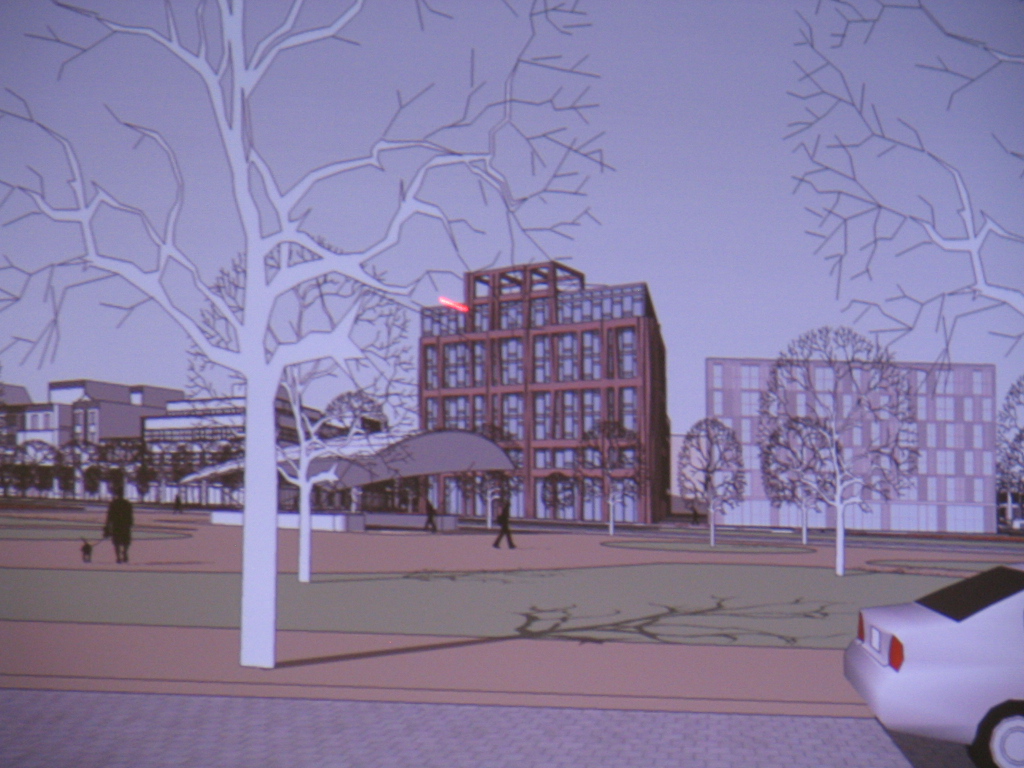
View from Hill's Kitchen - Residential Building on Right
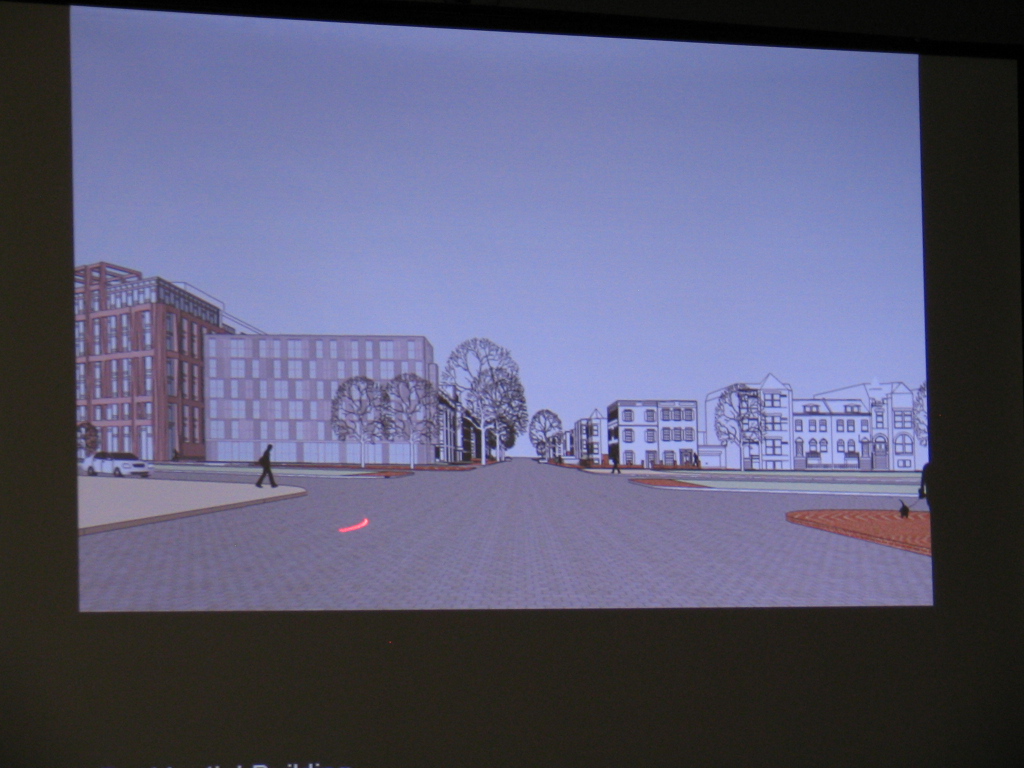
8th and D Streets Looking North
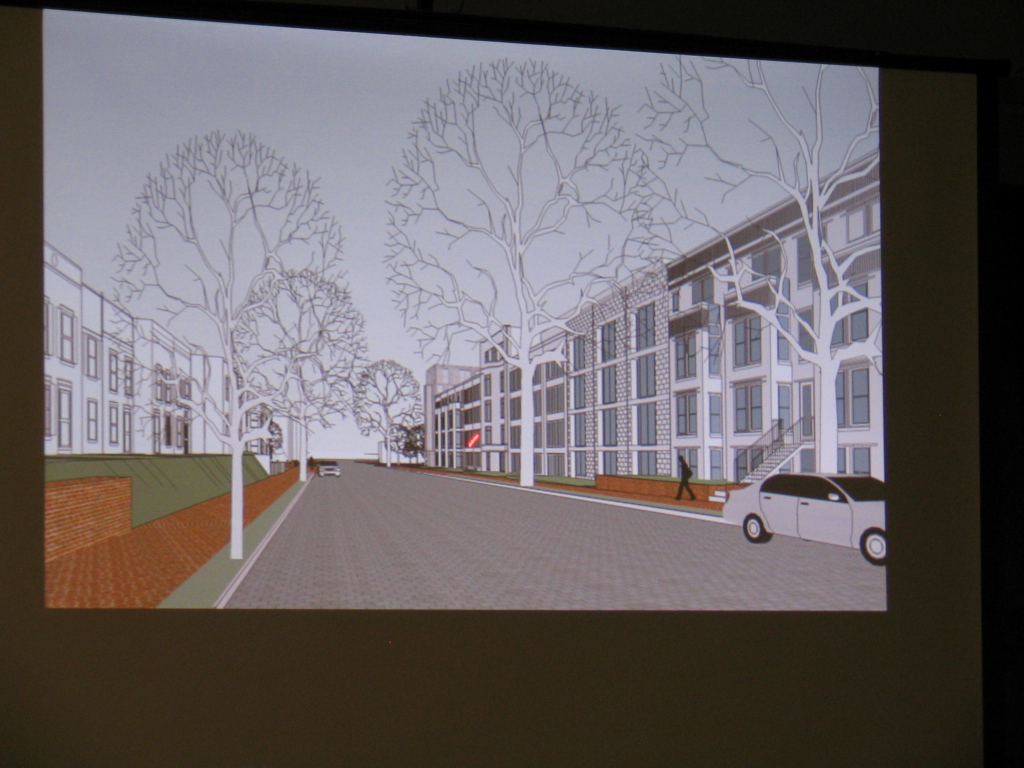
8th Street Looking South
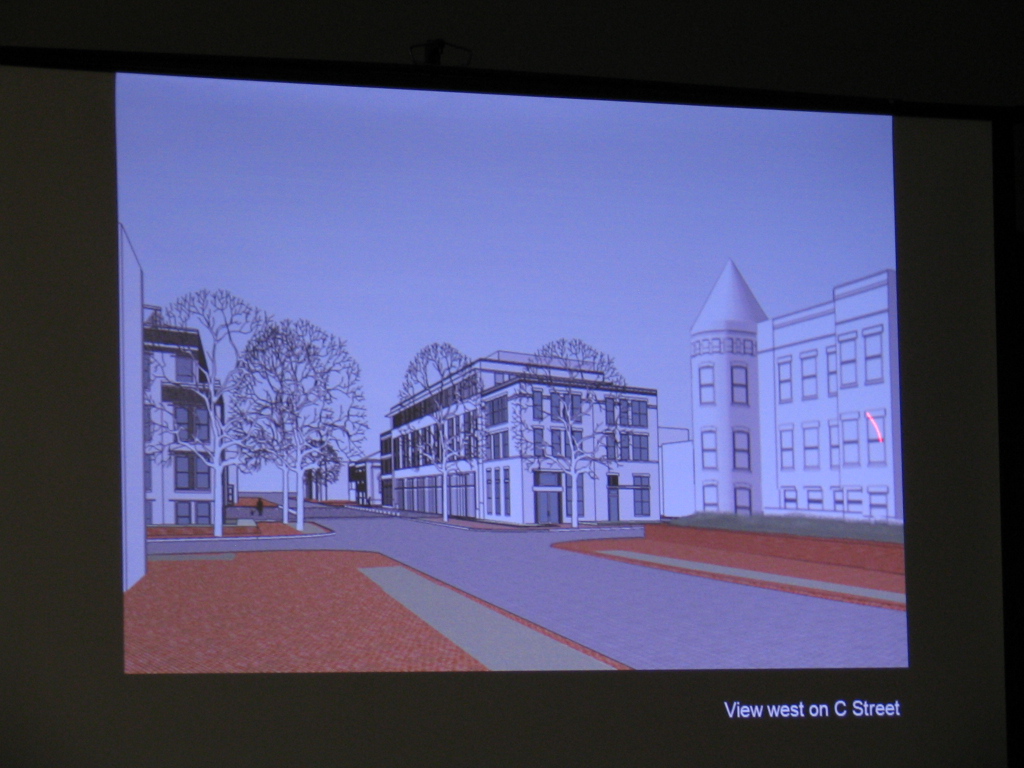
North Residential Building on C Street, Looking West from 8th Street

North Residential Building - C Street View

North Residential Building on C Street from 7th Street
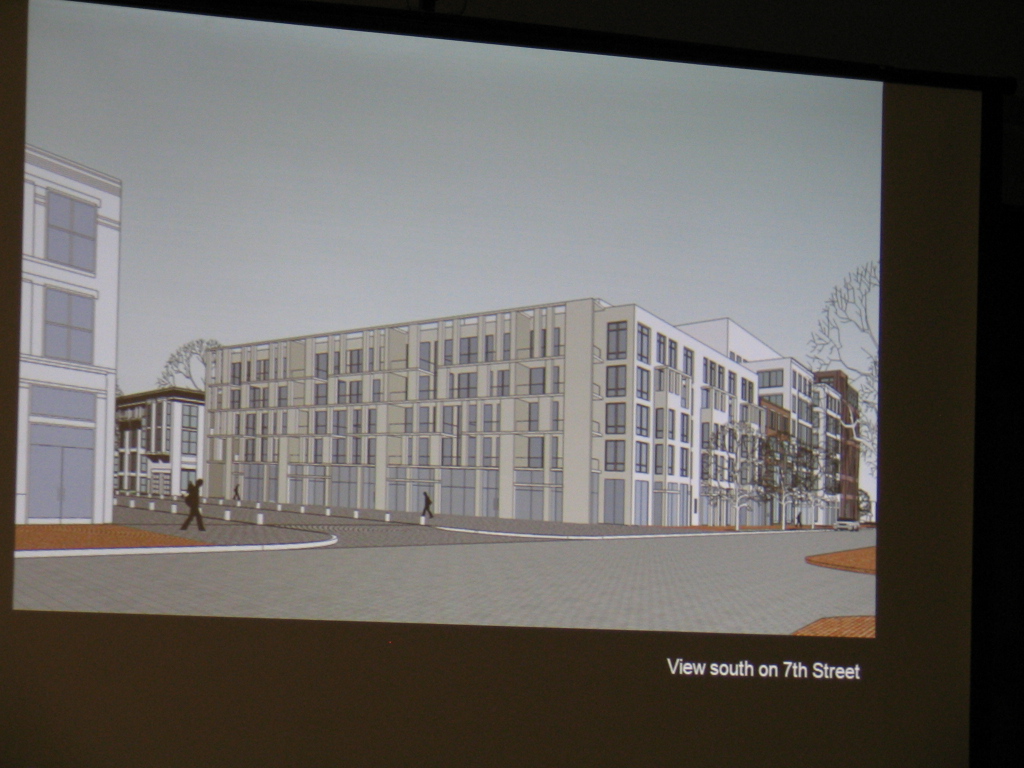
Residential Building or Hotel on 7th Street, from Eastern Market Looking SE
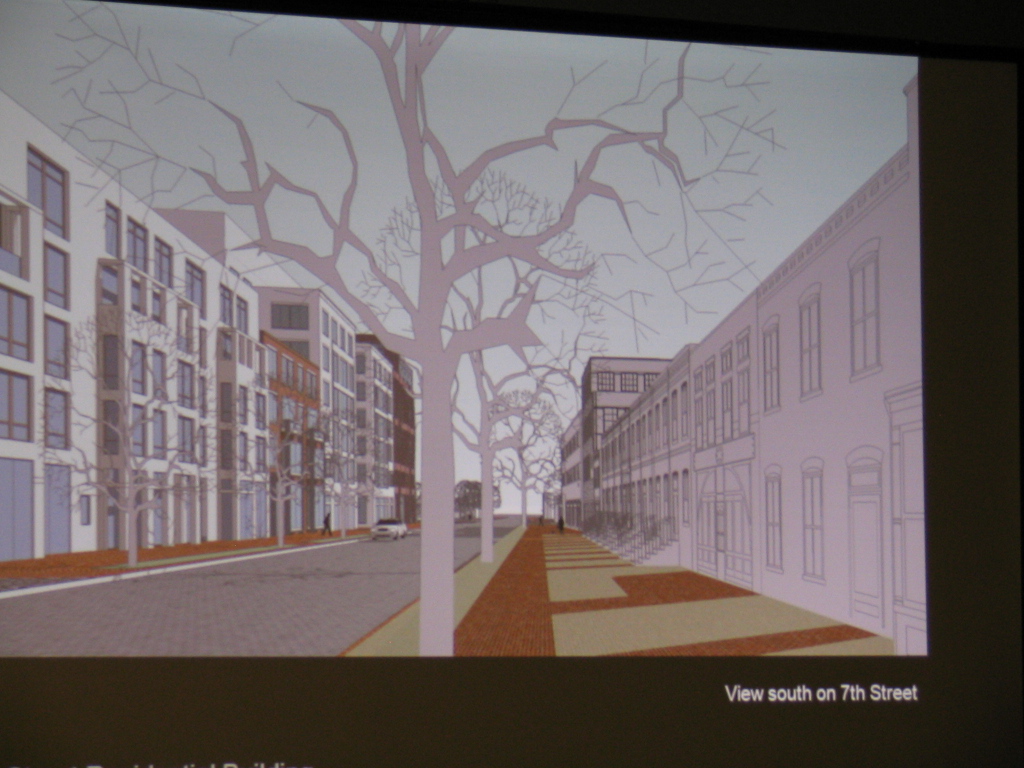
7th Street Looking South
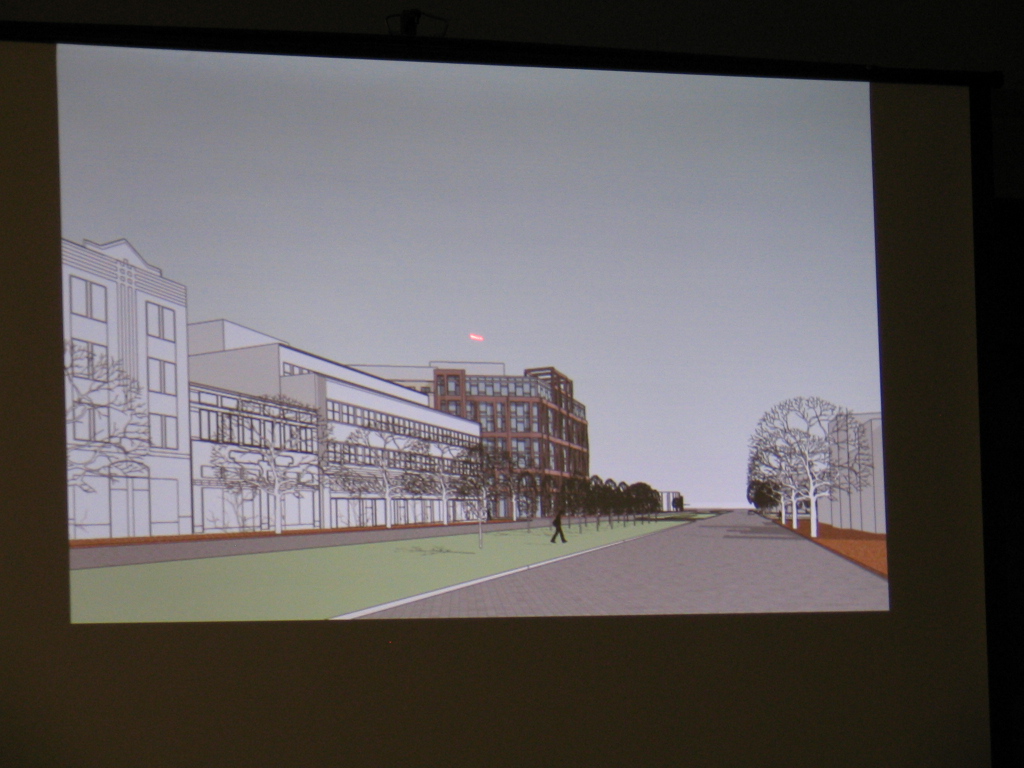
Pennsylvania Avenue Looking East
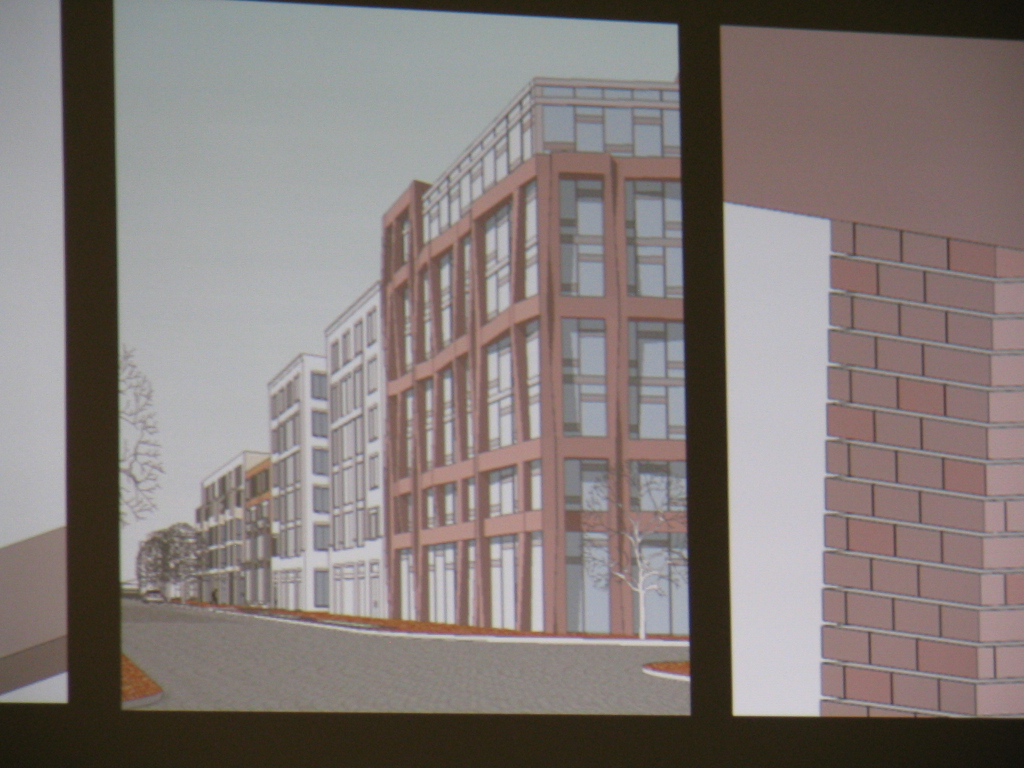
7th Street Looking North
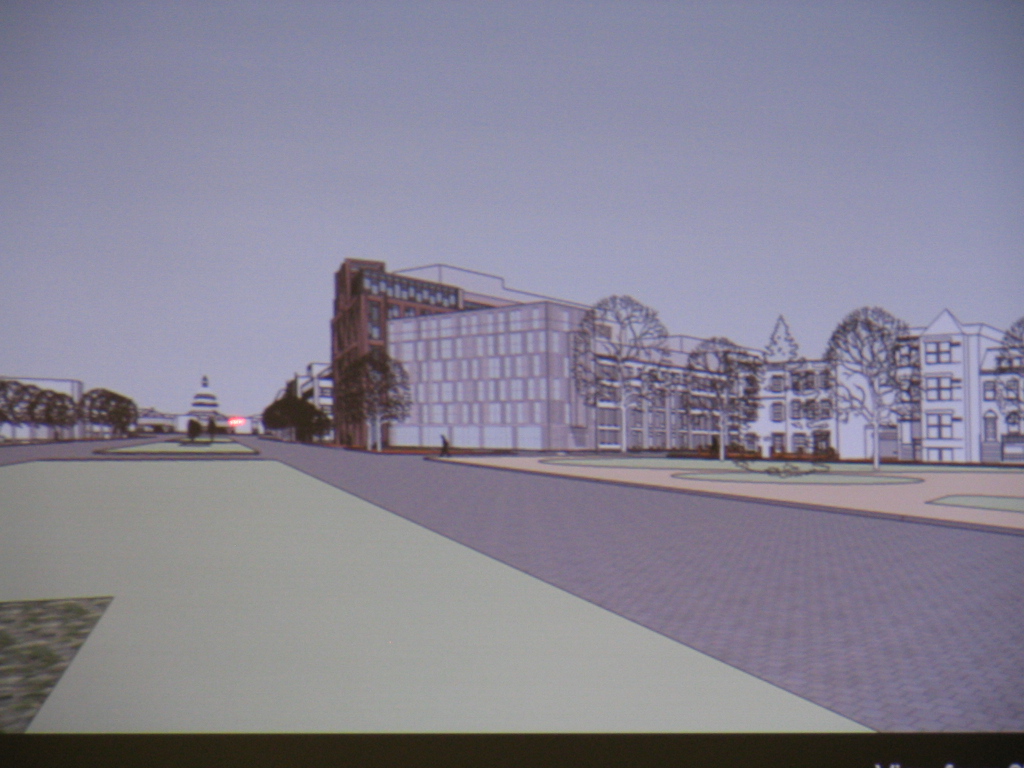
Pennsylvania Avenue Looking West
New Conceptual Drawings of Hine Redevelopment Project Unveiled
Time Issues Force ANC to Alter Schedule for Consideration
by Larry Janezich
Tuesday night, Stanton-Eastbanc unveiled their latest concept drawings for the Hine project to the ANC6b Planning and Zoning Committee, Chaired by Commissioner Francis Campbell. This is the first step toward consideration of their Historic Preservation Application (HPA) for massing and height by the Historic Preservation Review Board (HPRB) on March 24th. As additional details are finalized, the plans will go back to HPRB for additional review in late spring or early summer.
It’s unlikely that the 20 or so near-by residents who turned out for the meeting liked what they saw and several the ANC6b Commissioners appeared skeptical of the proposal and the amount of information they were given. One was overheard to say, “This building is too damn big,” and that sentiment seemed to express the feelings of several commissioners.
Because of logistical time constraints on the meeting, Stanton’s architect, Amy Weinstein, rushed through a 20-plus minute power point presentation which was long on images and necessarily short on details.
The major changes in the design since Stanton’s last public presentation February 3 include elimination of the bridge between the commercial and residential buildings on the Pennsylvania Avenue face, thus effectively separating the two buildings; elimination of some ground floor residential space on 8th Street in favor of “quiet retail,” and the addition of a sixth floor to the residential building on the Pennsylvania Avenue side to accommodate larger residential units. Ms. Weinstein said Stanton was still unsure whether a boutique hotel would become part of the plan.
In architectural design terms, the concept for the office building on 7th Street and fronting on Pennsylvania Avenue will be a contemporary combination of red brick and pier and glass construction. The façade of the residential building will feature corbelled brick, similar to the concept employed in the façade of the Hospice Association Building on 7th Street, across from Eastern Market, also designed by Weinstein. Clay tile or slate will be employed in the façade of the north residential building facing a newly-reopened C Street.
The full ANC6b had been scheduled to hear a Stanton Eastbanc presentation and take final action on their Historical Preservation Application on March 8th. Since there was no time for questions from the commissioners or statements and questions from the community on Tuesday night, the Commission decided to hear those statements and questions at the full ANC6b meeting on March 8. A Special Call Meeting has been announced for Tuesday, March 15, at a place and time to be determined, at which Stanton Eastbanc will make another presentation for the community at large and answer questions and concerns raised by commissioners and members of the community. The Commission will then decide what recommendation to make to the Historic Preservation Office for consideration by the HPRB on March 24.
For now, the position of ANC6b Planning and Zoning on the HPA is to “take no position,” and to request additional information from Stanton. ANC6b Chair Glick specifically requested the “HPRB package” and Commissioner Pate insisted on clearly outlined details on the dimensions of the project, particularly regarding height and setbacks.
Stanton will make a separate presentation to the near-by neighbors Wednesday night and post the presentation on their website soon after that. That site can be found at: http://hineschool.com/
Filed under Uncategorized
8th Street Residents List Objections to Hine Redevelopment and Request Changes
by Larry Janezich
The neighborhood organization “Eyes on Hine” (EOH) – residents who live on 8th Street opposite the Hine site – have written to ANC6b Planning and Zoning Committee Chair Francis Campbell and Vice Chair Kirsten Oldenburg to protest that the proposed Hine Development will damage the historic character of the neighborhood and to request specific design changes.
The ANC6b Planning and Zoning Committee hears from Stanton Development on Tuesday night, regarding their Historic Preservation Application (HPA) on the Hine redevelopment, the first step in moving the plan through the ANC. ANC6b will rule on the HPA at its March 8 meeting and that judgment will go to the Historic Preservation Office and be given great weight when the Historic Preservation Review Board (HPRB) considers Stanton’s HPA for the Hine project. As this blog has noted elsewhere, the HPRB decision is subject to appeal to the Mayor’s office.
EOH’s objections address the proposed design’s size, appearance, density, and economic impact. In summary, the objections are:
From 8th Street, SE, the Hine redevelopment would present a mammoth building filling much of the block with an unbroken façade. The developer’s justification for a height increase beyond 40 feet was flawed, since historic buildings shown for comparison did not fill an entire block and were in juxtaposition to two and three story rowhouses. The five story corner tower at 8th and D Streets, and the five story entrance to the apartment complex mid-block on 8th Street will mar the historic viewscape, block light and air, and “mock” the modest scale of the rowhouses across the street. The proposed heights are not only out of harmony with the neighborhood but also emphasize the building’s massiveness.
The proposed four story bay windows, a response to an EOH request to ensure the frontage comport with the appearance of residential housing, emphasizes rather than mitigates, the building’s monolithic appearance. And the massive size and scale of the proposed development demands deeper and more varied setbacks.
The letter notes that for the first time in history, there will be no open space accessible to the entire neighborhood on the Hine site. And that the result of waiving current R4 residential zoning limits and the attendant 40 foot height limit will degrade the quality of life of the neighborhood by encouraging and enabling vastly increased traffic.
EOH states that the economic consequences of the project include the danger that overdevelopment will threaten an historic neighborhood that, by its charm and scale, has attracted new residents and businesses. The letter notes that as taxes and rents soar, small and locally owned businesses are already being driven away from the vicinity of Eastern Market.
EOH proposes a number of changes to help make the current Hine development harmonize with the neighborhood. They include the following:
A maximum 40 foot height limit for the residential building on 8th Street, with no five story segments for the SE corner or on Pennsylvania Avenue.
A recessed 8th Street entrance to the project mid-block rather than using additional height to designate the entrance.
More variation in height of the rooflines of the buildings.
More variation in the setbacks of the buildings along 8th Street as opposed to an unbroken stretch of bay windows.
A set back from the curb for the entire building further than that proposed.
Two or three separate structures along 8th Street, rather than a single long structure.
The letter ends with a statement defining what the group sees as being at stake:
“The land of the Hine School site belongs to all of us, the citizens and taxpayers of the District of Columbia. The developers were awarded the right to propose how to develop that public land, but we believe that the current concept design is not congruent with, does not harmonize with, and potentially threatens the historic character of Capitol Hill. The massive, block-sized building plan evokes corporate standardization, anonymity and conformity, and, per the changes outlined at the beginning of this letter, we call upon the developers to create an alternative concept more responsive to the neighborhood in which it will sit for decades to come.”
The Planning and Zoning Committee will meet at 6:30pm on Tuesday, March 1, at Caesar Chavez Public Charter School, located at 714-722 11th Street, SE.
ANC6b will meet at 6:30pm on Wednesday, March 8, at the Church of Jesus Christ of LDS at 522 7th Street, SE
Filed under Uncategorized
 Bavarian Beer Garden Advances – One Small Step
by Larry Janezich
Yesterday, the Historic Preservation Review Board (HPRB) considered the historic preservation aspects of the design for the proposed Bavarian Beer Garden at the corner of 8th and L Streets, SE, and gave a qualified endorsement to the project. They want several issues raised by Historic Preservation Office (HPO) staff addressed before giving final approval.
Amanda Molson of the HPO staff outlined the traditional character defining features of American and European beer gardens, which include “lush, loose, landscaping,” ample lighting, signage inviting patrons inside, views from the street into the garden, and long tables for communal seating. She reported that there were three unusual elements to the project that made achieving a design compatible with the historic district challenging.
HPO staff had three areas of concern:
1) Cohesiveness of the design. The use of so many finishes gives the project a chaotic, unfinished appearance. Staff recommends selecting a few key ideas to streamline the design. They urged re-studying the door and window size and urged more clearly defining the roof deck railing through the addition of a double cornice.
2) Proportion and scale. Staff recommends study of the elements of the roof deck railing extending beyond the roof deck vertically, paying careful attention to the corner element and rain screens on L Street and north end of 8th Street elevation.
3) Openness of the streetscape design to 8th Street. Staff recommends opening the venue to 8th Street rather than “turning its back” on it. They would like to see further detailing on landscaping of public space on L Street, sidewalk seating, planter boxes on 8th Street, better lighting, and larger openings into the garden from L Street.
Ms. Molson felt that despite these concerns, the design was very close to approval, and recommended approving plan as consistent with the Historic Preservation Act after re-study of project, delegating final approval to HPO staff.
Co-owner Matt Brody responded that he was happy to eliminate rain screens above the first floor and to address number of materials, the roofline and lighting. He said a sidewalk café is planned for the next phase of the proposal. He noted that windows that open out to the street are expensive but responded positively to a suggestion from one HPRB architect about the use of garage doors to replace windows. He noted that the doors were actually 8 feet tall, and wondered if the Board was saying that they are too small.
With the general recommendation that the design be formalized, simplified and streamlined, HPRB agreed unanimously that the applicants come back for a final review after addressing the issues raised in the staff report. Chair Catherine Buell said she hoped it would be “on consent,” meaning for pro forma approval.
Next: Retail Mix Update
Filed under Uncategorized
ANC6b Plans Special Call Meeting on Hine PUD Process
Appointment of Taskforce on Hine Redevelopment Likely
by Larry Janezich
ANC6b is planning a Special Call meeting in April or May to inform the community on details of how the Public Unit Development (PUD) process will unfold for the Hine Redevelopment. The PUD process could be the final opportunity for public and community input into the design of the project and one which often involves tradeoffs, or “public amenities.” Commissioners Frishberg and Pate are pushing to appoint a special Taskforce made up of commissioners and representatives of community organizations, including EMMCA and Eyes on Hine, to provide input for the ANC’s participation in the PUD process. The Zoning Commission can require changes to the design as the result of the PUD review.
The Special Call meeting and Taskforce issues will likely come up when Commissioner Pate (SMD05) hosts an open house to discuss community issues on Saturday, February 26, at the Corner Store, 900 South Carolina Avenue, SE, between 1:00pm and 2:30pm.
Stanton Development was scheduled to send their massing and concept design for the Hine project to the Historic Preservation Office (HPO) on Thursday, February 24, but did not do so. They have until today – Friday – to file to meet the deadline to be scheduled for a Historic Preservation Review Board (HPRB) hearing on March 24.
Stanton will make a presentation regarding its Historic Preservation Application (HPA) to the ANC Planning and Zoning Committee meeting at Caesar Chavez Charter School, next Tuesday, March 1, at 6:30pm. The Committee will make a recommendation on the application and pass it to the full ANC which will consider it at their March 8 meeting. That meeting will occur at 6:30pm at the Church of Jesus Christ of LDS at 522 7th Street, SE. The ANC recommendation on the massing and concept design will, in turn, be forwarded to the HPO and HPRB for the March 24 hearing.
According to HPO, there are at least three historic preservation related public hearings at which the public may provide testimony. First, the ANC Planning and Zoning Committee, second, the full ANC meeting, and finally, the HPRB meeting. HPO also welcomes written comments in lieu of testimony. Those are forwarded to the HPRB as part of the review process.
Some large projects – e.g., Friendship House on Capitol Hill – go through the HPRB in two phases. HPRB looks first at height and massing, and then at the details at a later hearing. Stanton anticipates following this scenario, which will provide three additional opportunities for public input. Stanton hopes to go back before HPRB in late spring or early summer, depending on the outcome of the hearing in March.
The developer can make minor changes to the plan after the HPRB review, in consultation with HPO. HPO evaluates proposed changes and judges if they are major or minor or if they relate to concerns raised during the review process.
The Capitol Hill Restoration Society (CHRS) will also weigh in on the design, but their review process seems to be more cursory than the ANC’s. The CHRS Historic Preservation Committee will take a look at the designs Stanton submits to HPRB and make a recommendation. A more formal presentation to the Committee will depend upon a request from Stanton to appear before the committee or the CHRS Board. Stanton briefed the committee in February, but did not formally submit anything and the committee did not write an “official” report, preferring instead to treat the meeting as a dialogue with the architect/developer.
Stanton also appeared before ANC6b and the Hine neighbors in February to reveal their massing and design concepts and changes which reoriented the project toward a residential development as opposed to a primarily commercial development. For information on those meetings, please refer to the emmcablog postings on February 2nd and 3rd.
Next up: Update on the Two Tracks on Retail Mix
Comments Off on ANC6b Plans Special Call Meeting on Hine PUD Process – Appointment of Taskforce on Hine Redevelopment Likely
Filed under Uncategorized

Asphalt Patch in Cobblestone Paving Led to Plan to Replace Gas Line
Gas Leaks Will Mean 7th Street Excavation at Eastern Market
by Larry Janezich
The Eastern Market Community Advisory Committee (EMCAC) heard tonight that Washington Gas will excavate much of 7th Street, SE, between Pennsylvania Avenue and North Carolina Avenue, SE, to replace gas service lines which have required numerous repairs in the past two years.
Monte Edwards, Chair of the Capital Improvements Subcommittee, reported to EMCAC that two gas lines underneath 7th Street, SE, outside Eastern Market will have to be capped and abandoned, and service to those businesses on 7th Street not already served by a newer line will have to be established.
The problem – and safety issue – came to light as the result of EMCAC’s complaint to city officials on February 11, 2011, about the frequency which Washington Gas had been repairing leaks in its gas lines outside the market, and botching the replacement of the unique differentiated colonial cobblestone pavers.
DDOT arranged a meeting on February 17th attended by Washington Gas, DDOT, Ft. Myer Construction, Market Row Merchants, EMCAC and staff from Councilmember Wells’ office.
The modern high pressure gas line under 7th Street serves the Hine site and businesses on the west side of 7th Street, SE: Marvelous Market, Montmartre, etc. A few businesses on the east side of the 200 block, opposite the Market, appear to be served from the high pressure line. According to Edwards’ report, “It is unclear whether Eastern market is receiving service from one of the old low-pressure lines or from the four inch high pressure gas line.”
It is also unclear, why Washington Gas, when required to replace, upgrade, or confirm reliability of their gas lines in 2008, did not replace all of the services in the 200 block of 7th Street, SE.
Remedying the problem will require, 1) capping and abandoning the two low pressure lines, 2) connecting services in the 200 block of 7th Street, SE, to the new high pressure line. This will require nine or more excavations along 7th Street, SE, to access the high pressure line and make the connections, which, in turn, will require excavations from the center of the street to the to each building’s line or meter location – or running a high pressure line to the property through the old connection if it is big enough.
DDOT will not authorize the work to begin until Washington Gas conducts a survey to confirm which services need to be replaced and how the replacements will be accomplished. Washington Gas will bear the cost of the replacement, which will be conducted in a way to minimize the impact on 7th Street weekend vendors. The time frame will depend on the results of the survey to determine the scope of the problem.
Comments Off on Gas Leaks Will Mean 7th Street Excavation at Eastern Market
Filed under Uncategorized

Capitol Hill Restoration Board Goes to Court Over City Decision To Allow New Third Floor On 1887 Victorian Building
by Larry Janezich
In a case which could have broad implications for development in the city, the DC Court of Appeals heard oral arguments on Thursday over whether the city erred in approving a third story addition to a 1887 Victorian building in the Capitol Hill Historic District.
On June 17, 2008, the Capitol Hill Restoration Society (CHRS) Board voted unanimously to oppose the Heritage Foundation’s planned third floor addition to the former Trover’s Books building at 227 Pennsylvania Avenue, SE. The concerns were that the addition would detract from the appearance of the historic building, draw attention away from the historic details, greatly alter the basic character and appearance of the historic building and set a precedent for the entire Historic District. The Historic Preservation Review Board (HPRB) agreed, approving the third story only with a 25 foot setback from the building’s façade. The Heritage Foundation appealed the HPRB decision to the Mayor’s Agent, who overturned the HPRB recommendation, allowing construction to proceed. The structure was subsequently completed.
At issue is whether the Mayor’s Agent – in this case, DC’s Office of Planning Director Harriet Tregonning – acted in accordance with proper procedure in ignoring the recommendation of the HPRB against the proposed third story addition without a 25 foot setback.
Tregonning authorized the construction with a “slight” set back of a few inches at the bottom of the addition which slopes back to a several-foot setback at the roofline, saying that since Pennsylvania Avenue is so wide at this point that even a 25 foot set back would not make the addition invisible.
The Restoration Board’s attorney, Andrea Ferster, who has represented non-profit organizations in land use and historic preservation cases, argued the question was whether the Mayor’s Agent can disregard an HPRB recommendation as unpersuasive and not explain why. “The Mayor’s Agent just can’t say, ‘my judgment prevails.’”
The Mayor’s Agent was represented by Stacy L. Anderson, who under questioning by the court, admitted that the record did not show Tregonning rejected the HPRB recommendation on a rational basis, other than referencing the width of Pennsylvania Avenue. .
The discussion embraced the larger question of what the role of the HPRB and its guidelines are for prospective alterations to historic buildings. The position of the Mayor’s Agent is that each should be considered on its merits and that the recommendation of HPRB should be given no greater weight than experts testifying on behalf of the developer. “The statute gives it no special status, so the Mayor’s Agent owes it no special consideration.”
The Heritage Foundation was represented by Deborah B. Baum, of Pillsbury Winthrop Shaw Pitman, one of the city’s largest land-use firms. She pointed out that the then-sitting ANC had approved the proposed addition and that the project’s approval by the Commission on Fine Arts addressed the question of compatibility.
Under questioning, she admitted that there had been no testimony whether the setback was a strong financial disincentive, though she claimed that the disincentive was implied because the third floor space would have been reduced by 50%. This claim was disputed by Ferster, who said the space would have been reduced by less than 25%.
A favorable ruling by the Court of Appeals could result in dismantling the addition. As the court noted near the end of the arguments today, that since the third floor has been built, “we’re in don’t tear it down territory.”
The question of jurisdiction and whether the CHRS petition was filed in a timely manner accounted for considerable discussion, but the ambiguity of the statute on this point seemed to weigh in favor of the CHRS.
The CHRS raised $6,000 in contributions for a legal defense fund to fight Tregonning’s decision. The non-profit preservation organization has spent nearly $20,000 so far on this case.
Filed under Uncategorized
Restoration Society Hears Recommendations for Major Expansion of Capitol Hill Historic District
by Larry Janezich
EHT Traceries, a local architectural history firm hired by the Board of Directors of the Capitol Hill Restoration Society, has endorsed incorporation of two areas into the Capitol Hill Historic District and on March 8, and is likely to endorse a third.
On January 19, the firm made a public presentation on their survey of the near-Northeast area lying just outside the historic district. This was the second of three presentations, all part of the Society’s Beyond the Boundaries program, which “seeks to promote the appreciation of neighborhood history and support historic preservation efforts outside the boundaries of the Capitol Hill Historic District.” The project is funded by a settlement reached several years ago with the Louis Dreyfuss Property Group (some $83,000), as mitigation for the demolition of twelve historic buildings in the way of the new Dreyfuss development between H and G and 2nd and 3rd Streets, NE,.
The near-Northeast survey included the area adjacent to the H Street commercial corridor, roughly between 2nd and 15th Streets, and from H to F Streets, NE.
In the presentation, Traceries presented a strong case for inclusion of an almost four block area adjacent to the north boundary of the Historic District – bounded by 2nd and 4th and F and H Streets, NE – though only parts of the blocks fronting H Street commercial corridor would be included.
“…the expanded area most closely parallels the late-nineteenth- and early-twentieth-century development of Capitol Hill and especially the progression of the squares that form the northern boundary of the current Capitol Hill Historic District.
The original justification for terminating the Capitol Hill Historic District along F Street, N.E. was purely for topographical reasons because F Street is representative as the bottom of Capitol Hill. However, it is clearly illustrated that the Historic District and Boundary Increase share a common architectural thread, demonstrated by two- and three-story rowhouses, with varying rectangular and canted projecting bays and designed in the popular Victorian-era architectural styles of the day. Because the residential architecture of Capitol Hill is its most visible identifier and strong characteristic, it can be determined that the Boundary Increase clearly belongs as part of the current Capitol Hill Historic District.” (emphasis mine)
Traceries notes that their survey is limited to the architecture, allowing for understanding neighborhood development. The firm recommends completion of all survey phases and that a historic context study be prepared before any final recommendation is made for extending the Capitol Hill Historic District.
Similarly, on November 10, 2010, in a public presentation on a survey of the area outside the Historic District to the Southeast, bounded by East Capitol and L Streets and 13th and 19th Streets, SE, Traceries noted their study allowed for an understanding of neighborhood development but not the historic context. “Thus it is recommended that a historic context study be prepared before any recommendations for an historic district can be made.
Yet, based on the architectural development and its current physical integrity, the preliminary determination is that an historic district can and should be created that represents the Capitol Hill Southeast neighborhood.” (emphasis mine)
The aforementioned historic context study incorporation for both the Northeast and Southeast survey areas will be done in March 2011.
The third and final Traceries presentation will focus on the Northeast area between 15th and 19th Streets and Benning Road and East Capitol Street. Rosedale lies within these boundaries and the upcoming March 8th presentation will be co-sponsored by the Rosedale Citizens’ Alliance and CHRS. If past is precedent, it’s likely the presentation will include an endorsement for extending the Historic Distract to encompass part or all of this area.
The meeting will be on Tuesday, March 8, 2011, from 6:15pm – 8:00pm at the Rosedale Recreation Center, 500 19th Street, NE.
PDF versions of both the previous presentations are on the CHRS website at http://www.chrs.org.
Filed under Uncategorized
 CAPITOL HILL CORNER