Tag Archives: cemeteries

Building Community at Congressional Cemetery

Building Community at Congressional Cemetery

Building Community at Congressional Cemetery

by Larry Janezich

Posted:  Tuesday, September 2, 2025
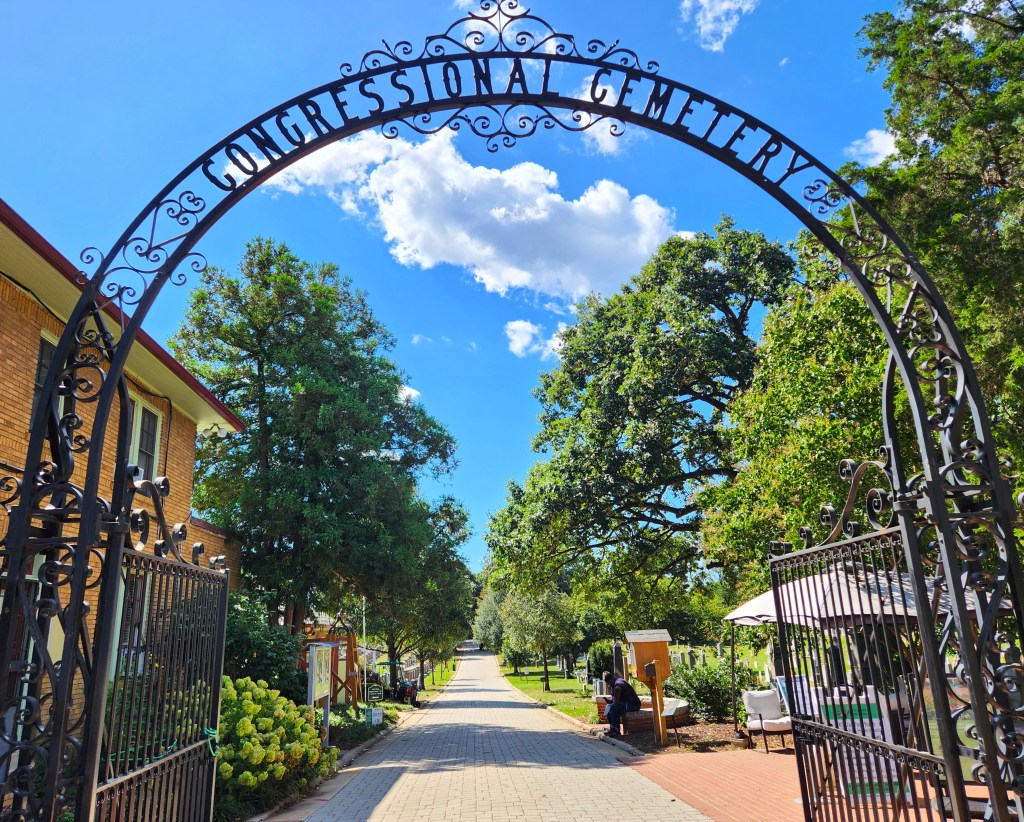
The wrought iron entrance to Congressional Cemetery, 1801 E Street, SE. The gate house is at left.
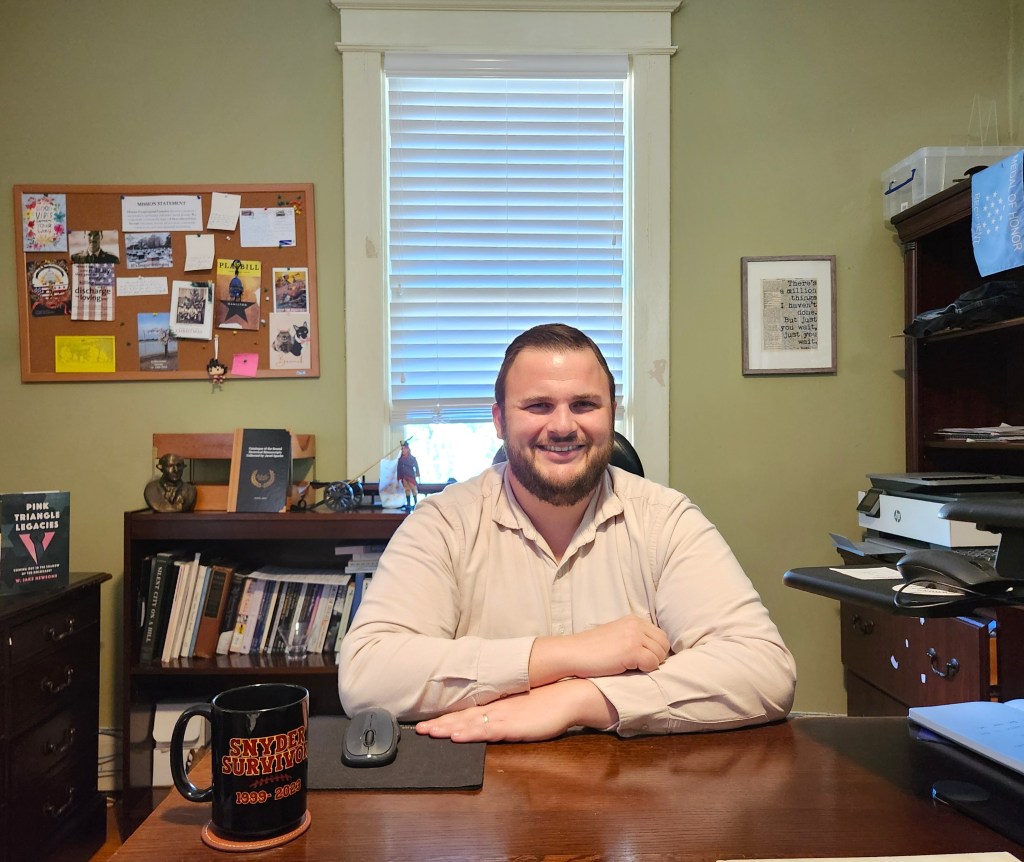
Anthony “A.J.” Orlikoff, Interim Director of the Association for the Preservation of Historic Congressional Cemetery

It’s easy to overlook the community building attributes of Congressional Cemetery.  In truth, the cemetery is powerful unifying force on Capitol Hill. 

CHC interviewed Anthony “A.J.” Orlikoff, Interim Director of the Association for the Preservation of Historic Congressional Cemetery:  “Cemeteries need to be places of solemn contemplation of grief or mourning – they need to be that space – but what we’re seeing now across North America is cemeteries more as places of community, engaging people in different ways.  There are a lot of reasons for that and it comes out of communities themselves organizing and using these places.”  

We take cemeteries for granted until they fill up and are taken for granted.  Their fortunes wax and wane, driven by demographics and other factors, and Congressional Cemetery’s history has been one of periods of prominence and affluence and then periods of decline. 

Orlikoff says, “Congressional cemetery was in decline in the 1980s and when you look at the cemetery as a community building organization it really starts with a group of neighbors who lived nearby in the late 1980s that began walking their dogs here and they realized, ‘Hey, this amazing historic place that I’m walking my dog in is really overgrown and it’s dangerous and there’s open-air crime.’”

Asserting that this was not something they wanted in the neighborhood, neighbors began organizing the first group of community dog walkers and started thinking about raising money to hire a landscaper and about alerting MPD on some of the criminal activity on the grounds.  As the conditions improved, the cemetery started filling with people who appreciated the green space and cared about the community.  Orlikoff said, “And so it really was from this kernel of community that you can chart the activity that led to calls to Congress to save the cemetery and the later appropriation of funds.”  Congress now provides matching funds for the Congressional Cemetery Endowment administered by the National Trust for Historic Preservation. 

And the dog walkers are now organized as the K-9 Corps.  They have a committee made up of K-9 members which oversees the dog walkers’ use of the cemetery by the Corp’s 700 families and 1,000 dogs.  Those families constitute the core of the Congressional Cemetery community, but equally important (though more loosely organized) are the component parts of the community within the larger community.  This includes the large number of residents and visitors who attend and participate in the cemetery’s programs.  Some of these programs are the Cinamatery (the outdoor summer movie screenings), 5k races (including the upcoming Dead Man’s Run), tours (including the upcoming historically theatrical outdoor Soul Stroll Tours), the Death Awareness program, the Bee Keeping program and the Book Club.  In addition to the attendees, there are hundreds of community volunteers ranging from tour guides to Adopt-A- Plot volunteers to Association Board members.

There’s considerable overlap with respect to the contributions of volunteers and Orlikoff says, “You need to have harmony – you need everybody in the symphony kind of playing together or it’s just going to be 21 notes.“
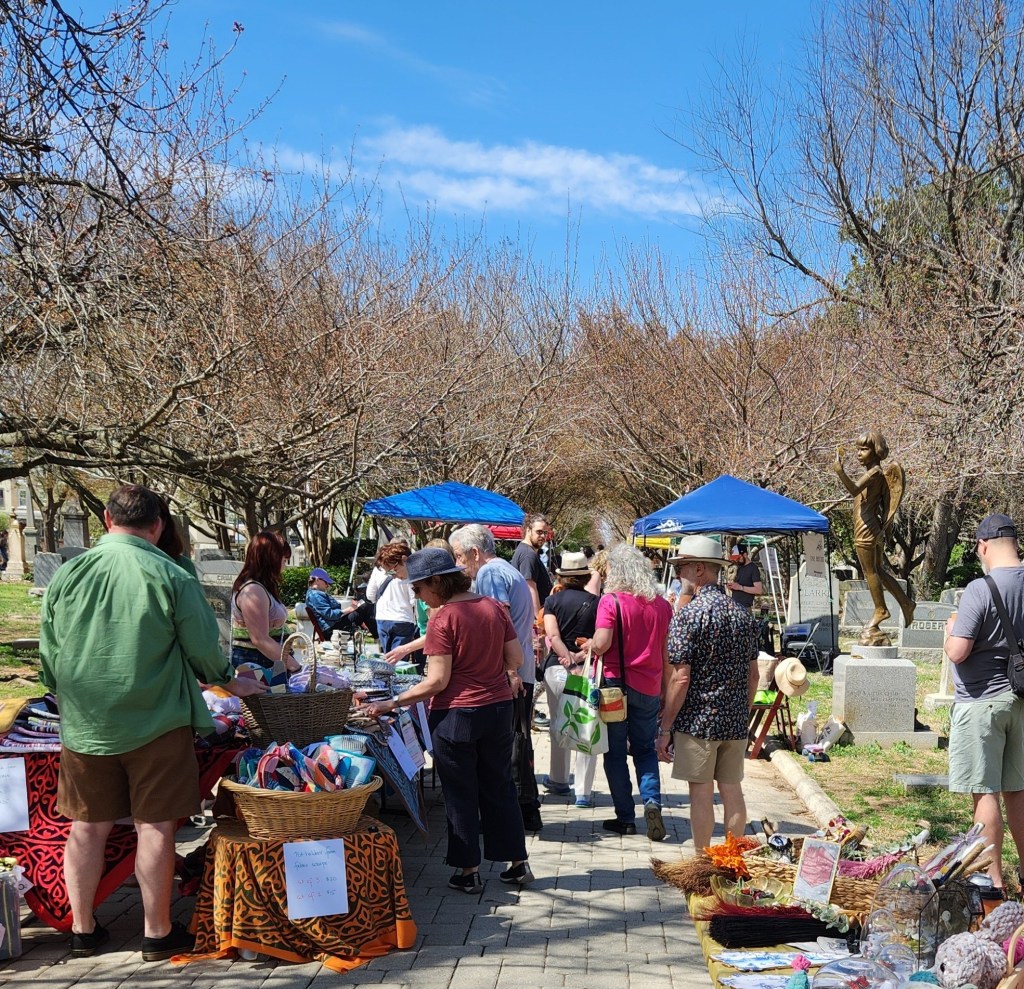
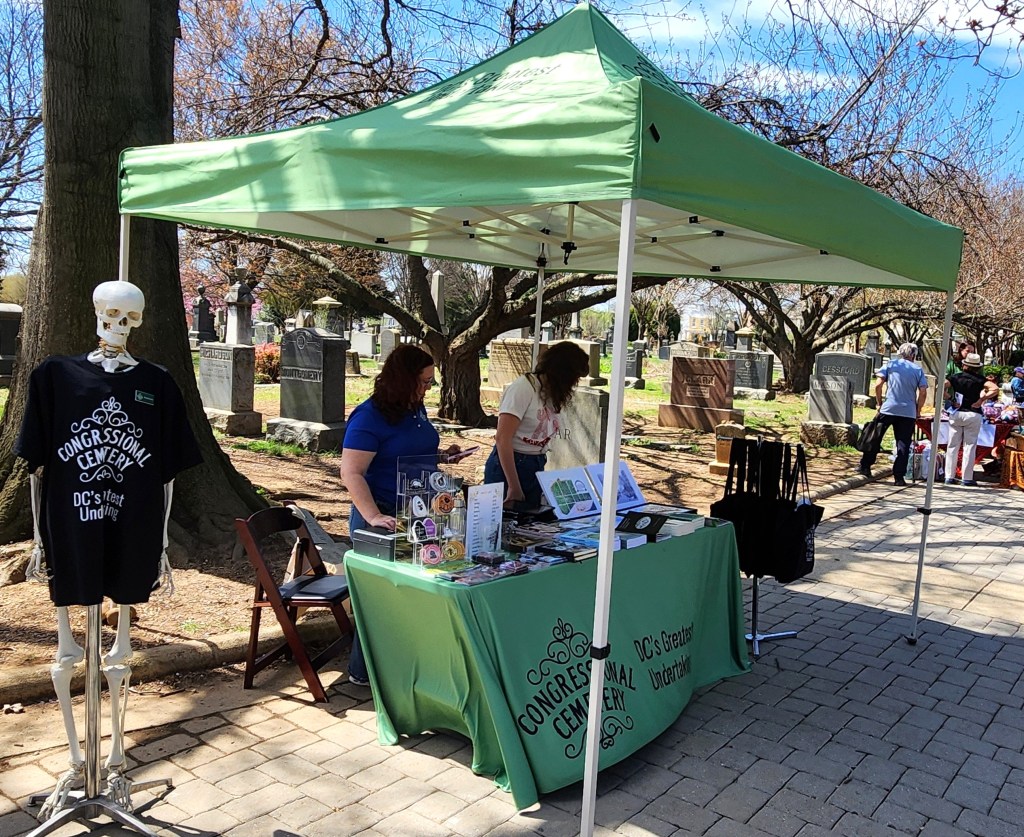
Congressional Cemetery held its Spring Fair on Sunday, March 30, featuring more than two dozen vendors, an Introduction to Green Burial in the Chapel, a tour of historical trees and grave sites, and a presentation on Equinox Gardening. 

Orlikoff is a historian by profession and came to Congressional Cemetery after working as a contractor for both the Navy and Army at several military museums.  He says, “I see myself as a history translator – someone who can help people find the meaning in those things that maybe otherwise could be inaccessible, and you do that through programming and education.  So when I heard about the opportunity here at Congressional Cemetery for a Director of Programming position it was a perfect fit for me.”  That was three years ago.  When the then-Director of the Association Jackie Spainhour left last January, Orlikoff was named Interim Director by the Association’s Board.  He says he is proud of his work since then, including supporting the team of professionals working at the cemetery even in areas outside of his expertise.  He also counts the collective effort of the team in the World Pride programming this year, and especially becoming part of and getting up to speed on the newly initiated Master Plan – an expansive project to chart the next two decades of the cemetery’s future which had just launched when he took the job of Interim Director.    

The Master Plan Initiative came about because one of the major issues facing Congressional Cemetery is the question of how to sustain the cemetery after running out of space – how to make it a place people will continue to want to support. 

Orlikoff says that many cemeteries have to figure out how to keep the cemetery going with a model that is ultimately unsustainable once capacity for full casket site burial is reached:   “How do you pivot – how do you change those revenues?   What we’re trying to do is pivot and become more of a nonprofit model.  And the strategy is to find ways to maximize what site space is left – because there’s not much (hundreds but not thousands of burial sites) – and then really adopt a nonprofit model that relies on programming and institutional giving and development.”   

There are three primary components addressed in the Master Plan:  storm water management (the cemetery has a drainage issue – never good in a cemetery), burial site expansion (including the development of columbariums for the interment of ashes), and enhancing the visitor experience (including things like gatehouse and chapel upgrade, signage, etc.).  

The Board will continue seeking community feedback on the Master Plan throughout the process; the next community meeting will be October 15 at Christ’s Church.  The Board is scheduled to receive a finalized Master Plan in February of 2026.  After that, Orlikoff says, the Board will be undertaking several fundraising initiatives to realize the plan.
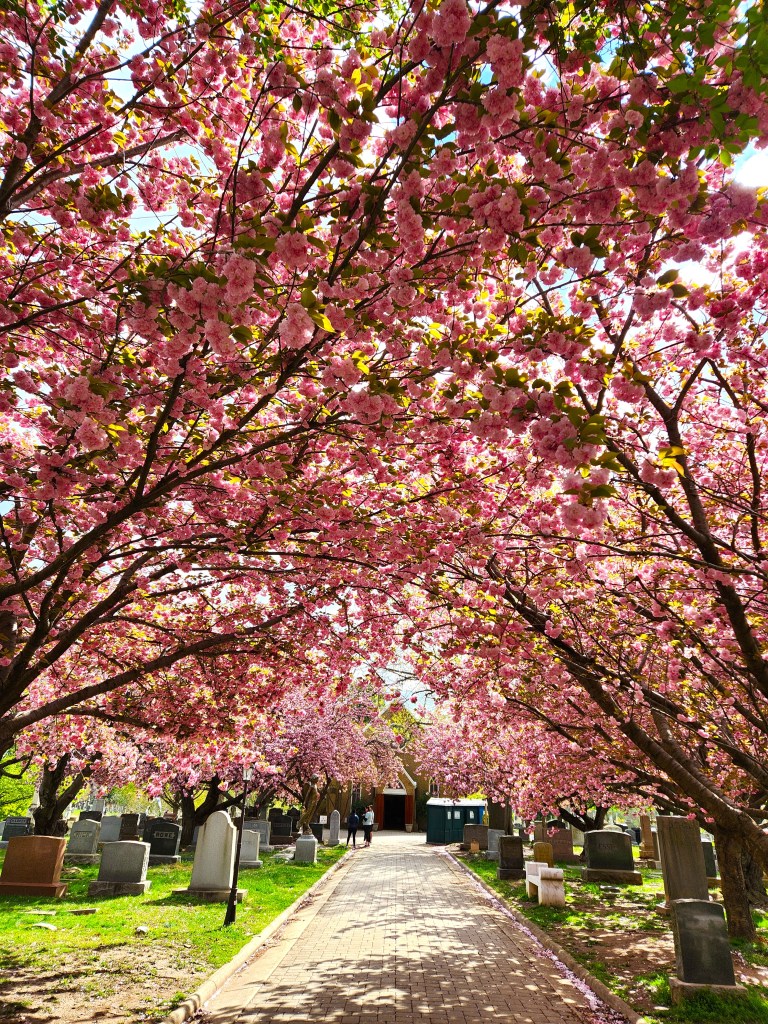
Orlikoff says of the cemetery, “It’s a place for people who love history – it’s a place for people who want to walk their dog.  It’s a people place for people who love nature – it’s a place for people who want to attend our programs.  But most of all it’s a place where living people want to come and gather.  And we’re always going to be taking care of our first mission as a place of grief and solemn contemplation in mourning.  We always have to remember that we still serve families.  It’s our original mission.  But cemeteries can be so much more than just that and I think that’s something that we’re really helping chart for North American cemeteries.”

The Association for the Preservation of Historic Congressional Cemetery is a registered 501(c)(3) non-profit who realizes its mission in large part through charitable donations from individuals, foundations, and corporations.  For more, including a calendar of events and programs and how to support, go here:  https://congressionalcemetery.org/
1 Comment

Filed under Uncategorized

The Week Ahead…& Some Photos from the Past Week

The Week Ahead…& Some Photos from the Past Week

by Larry Janezich

Posted March 30, 2025

Congressional Cemetery held its Spring Fair on Sunday, March 30, featuring more than two dozen vendors, an Introduction to Green Burial in the Chapel, a tour of historical trees and grave sites, and a presentation on Equinox Gardening. 

Vendors included HCC Gift Shop, Adopt-A-Plot at HCC, The Roving Hare, Republic Restoratives, Chippin Pet, From Here to Home Essentials, Catalyst Hot Dogs, Second Story Honey, Black Radish Handmade, The Witch Wife Crafts & Treasures, Open to Being, Green Garden Vintage, Earth-Worker, Hands Along the Nile, Rough Seas Productions, Slow Drip Refashions, Paloma Vintage Designs, Amaya Accessories, Amethyst Alchemist Art, One Seed Designs, D’Bohomama, Necos Boutique, Great Mothers Garden, Solutions, and Folger Theatre. 

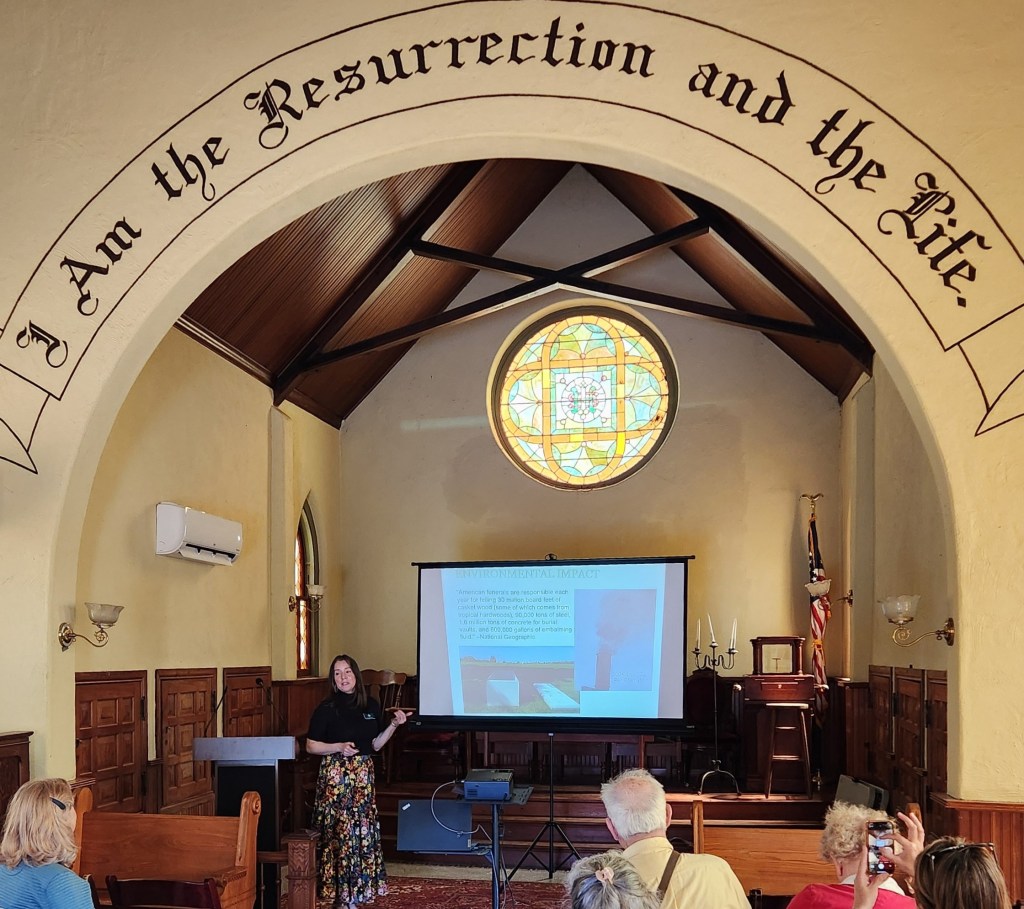
Congressional Cemetery Associate Lily Buerkle presented the introduction to green burial.  It involves, no embalming, body shrouded or placed in a casket of natural material, no grave liner or vault, lowering by hand or by device, a natural marker or a traditional head stone.  This is an alternative burial for those not wanting a typical American funeral.  Those funerals are – according to National Geographic – responsible each year for felling 30 million board feet of casket wood, 90,000 tons of steel, 1.6 million tons of concrete for burial vaults and 800,000 gallons of embalming fluid.  The average cost in the DMV area is around $2000 to $4000.  Green burials are allowed in any plot in the cemetery which is the only cemetery in DC which offers green burials.  A helpful resource is the Green Burial Council:  https://www.greenburialcouncil.org/

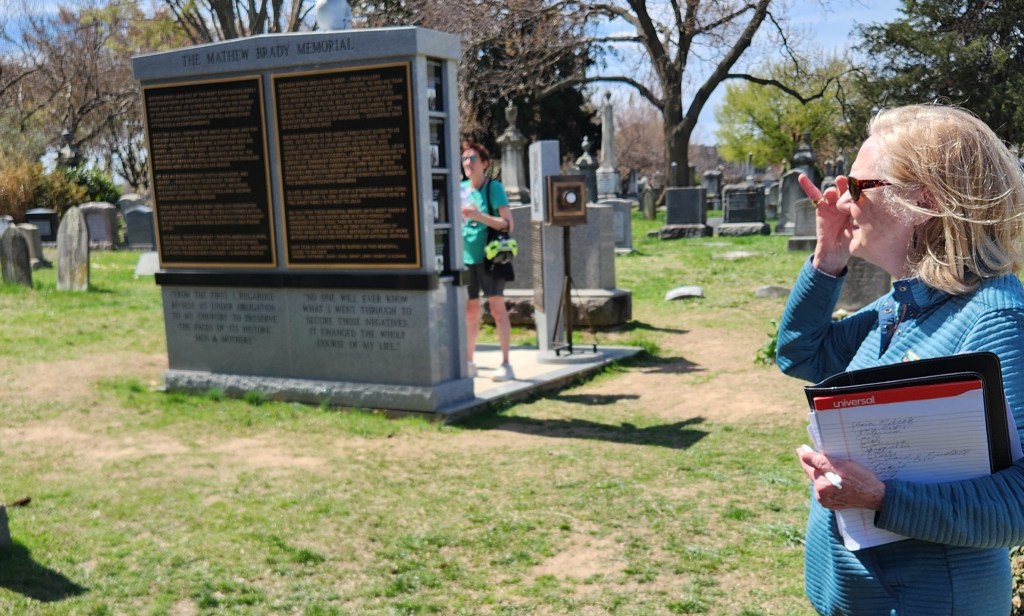
Sharon Metcalf, also an Associate, conducted a tour of historical trees and sites of the cemetery.  One of the stops on the tour was at the memorial for Civil War photographer Matthew Brady, dedicated on September 17, 2022.  This is of the back of the Memorial. 

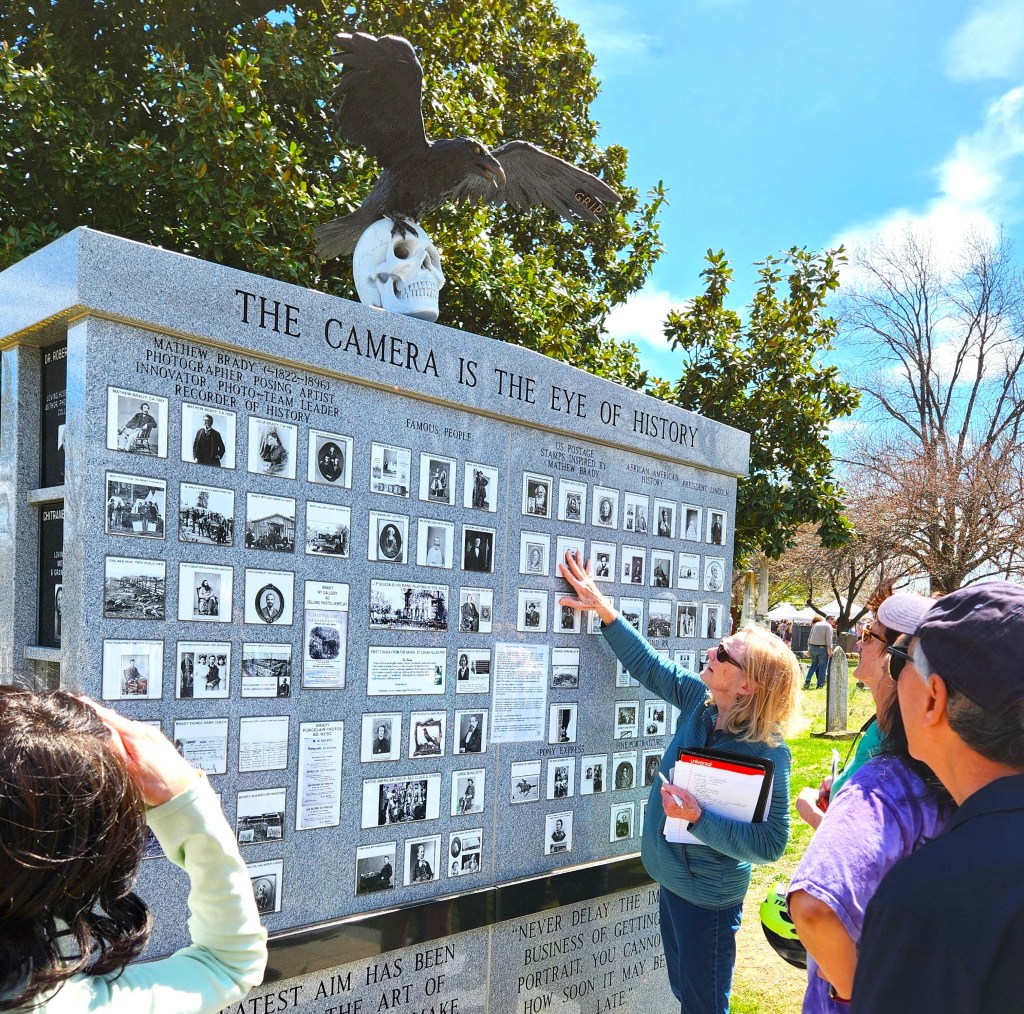
And here’s a photo of the monument’s striking front, surmounted by a sculptured raven and skull, referencing Brady’s photo of Edgar Allen Poe and featuring a selection of Brady’s photos.

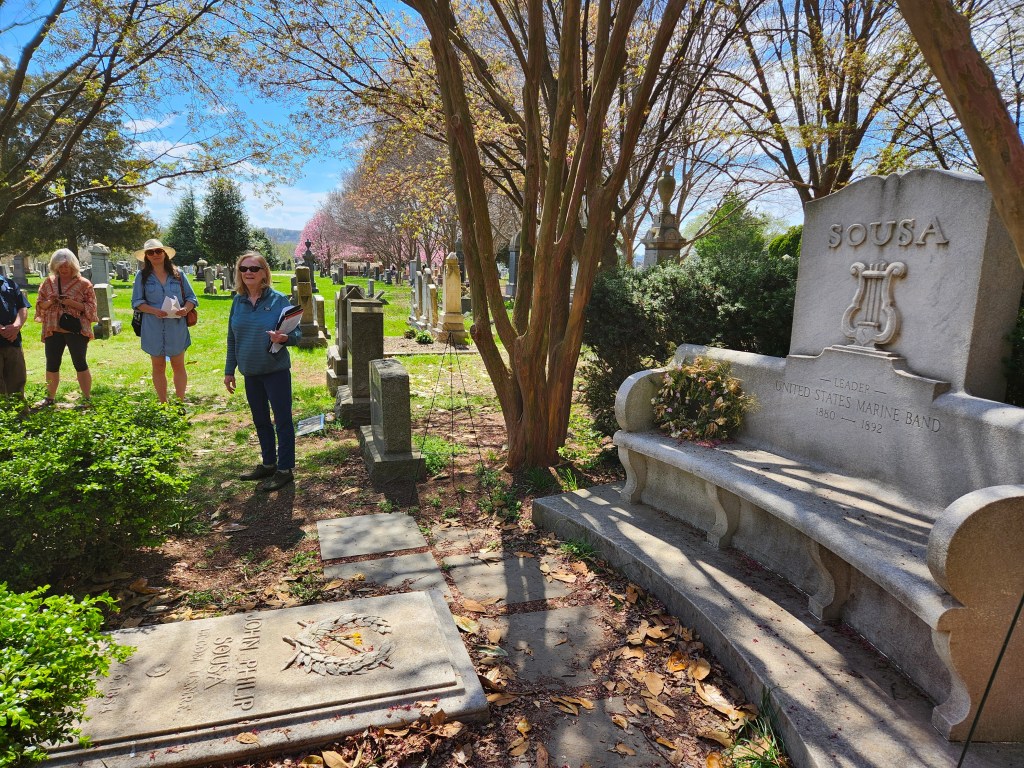
A photo of the stop at John Philip Sousa grave.  Sousa, known as the March King, became U.S. Marine Band leader in 1880 and served in that position for 12 years.  He wrote over 100 marches (including the “Washington Post” and “Stars and Stripes Forever”), 10 light operas, and other works.  Bands from around the world come to play at his grave.

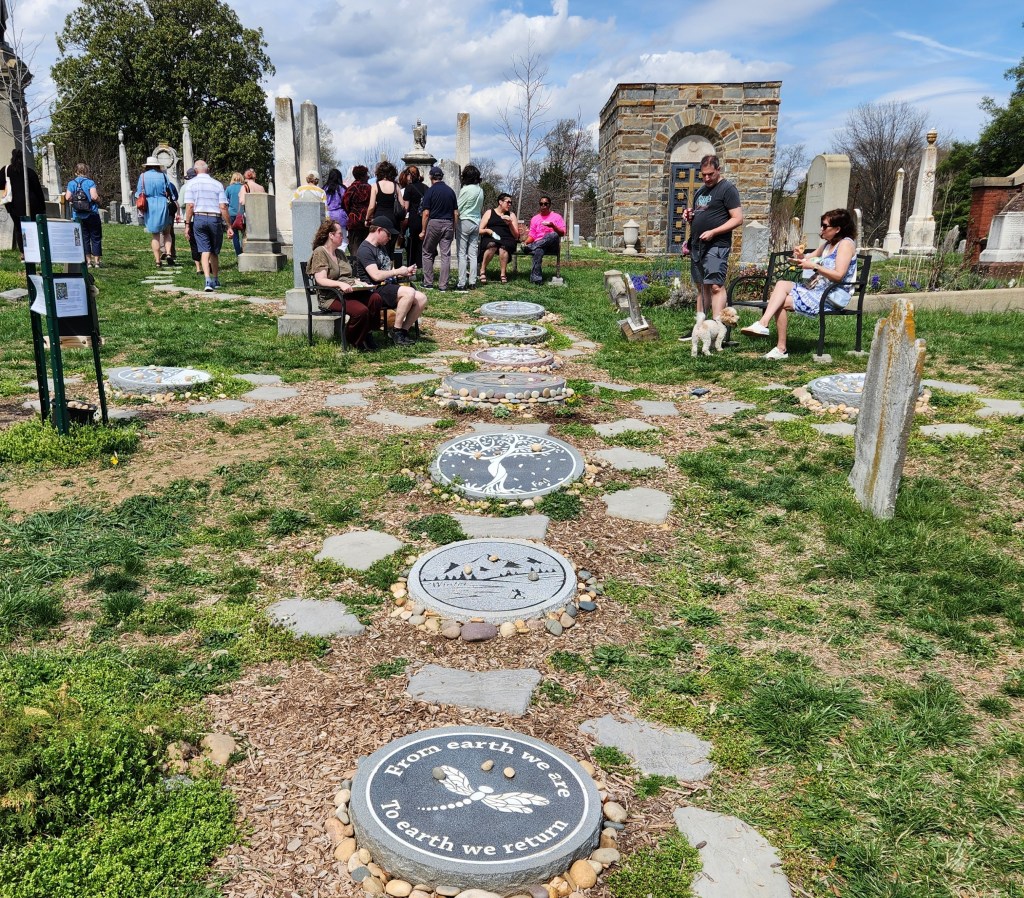
The Circle of Life Tree-henge.  The Circle of Life is a recent installation of land art or earth art which celebrates nature’s perseverance.  The site comprises a 60 foot circle of linden trees aligned with the points of a compass and serves as an observation site of the sun’s path during solstices and equinoxes.  It celebrates and pays tribute the natural environment, invites meditation and reflection, and offers an opportunity to record those thoughts in a journal kept on site.  It was created by a group of friends interested in Congressional Cemetery and green burial in partnership with Congressional Cemetery and a testimony to those who choose green burial as a simple and sustainable end to their existence.  For more, go here:  https://bit.ly/42c1D2O

The Association for the Preservation of Historic Congressional Cemetery is a private nonprofit organization established in 1976 and dedicated to the restoration interpretation and management of Congressional Cemetery.  It is a predominantly volunteer based organization relying on over 400 neighbors, history buffs, conservators, dog walkers, and armed forces personnel each year to help restore and maintain this national treasure.  In 1979 Congressional Cemetery was listed on the National Register of Historic Places and became a National Historic Landmark in 2011.  For info on joining the association or to make a donation to help their cemetery, email staff@congressionalcemetery.org or go here:  www.congressionalcemetery.org

The Week Ahead….

Tuesday, April 1

MPD 1D Community Advisory Committee will hold a virtual meeting at 6:00pm.

Agenda:

  • Safety Briefing and open dialogue with residents, ANCs, businesses, and other civic and professional organization in the First MPD District.

ANC6B Alcoholic Beverage & Cannabis Committee will hold a hybrid meeting at 7:00pm. 

Meeting location will be 700 Pennsylvania Ave SE; Second Floor, Conference Room 1 (entry adjacent to Trader Joe’s).

Among items on the draft agenda:

  • Bombay Street Food 2, 524 8th Street, SE; Renewal of Class C Restaurant.
  • Aatish On The Hill, 609 Pennsylvania Avenue, SE; Renewal of Class C Restaurant.
  • Torai Grill & Sushi Inc t/a Torai Grill & Sushi, 751 8th Street, SE; Renewal of Class D Restaurant’
  • Young Chow Asian Restaurant, 312 Pennsylvania Avenue, SE.
  • The Duck & The Peach/The Wells/La Collina, 300 7th Street, SE; Renewal of Class C Restaurant.
  • I Egg You CH, LLC t/a I Egg You, 517 8th Street, SE; Renewal of Class C Restaurant.
  • Chiko, 423 8th Street, SE; Renewal of Class C Restaurant.
  • 721 8th Street, SE; Renewal of Class C Restaurant.
  • Little Pearl, 921 Pennsylvania Avenue, SE; Renewal of Class C Restaurant.
  • Pineapple and Pearls, 715 8th Street, SE; Renewal of Class C Restaurant.
  • Rose’s Luxury, 717 8th Street, SE; Renewal of Class C Restaurant.
  • Paraiso, 1101 Pennsylvania Avenue, SE; Renewal of Class C Restaurant.
  • Bullfeathers, 410 1st Street, SE; Renewal of Class C Restaurant.
  • Sanpan Thai Cuisine, 653 Pennsylvania Avenue, SE; Renewal of Class C Restaurant.
  • Kenneth H Nash Post 8 t/a Kenneth H Nash Post 8 American Legion, 224 D Street, SE; Renewal of Class C Club.
  • Trattoria Alberto, 504 8th Street SE. Renewal of Class C Restaurant.

Wednesday, April 2

ANC6B Transportation Committee will hold a virtual meeting at 7:00pm. 

Among items on the draft agenda:

  • Pepco Update on the G St Conversion Project and its expected impacts on 6B08 and 6B09 in the coming months.
  • DDOT presentation on the signals design for Potomac & Pennsylvania Avenues intersection rebuild.
  • Watkins Alley: Support Efforts by Residents of Watkins Alley for Bollards or Other Safety Measures to Protect Pedestrians in the Alley.
  • Item from March Full Meeting: letter to DDOT, in collaboration with 6A, regarding Lincoln Park.

ANC6C Planning, Zoning & Economic Development Committee will hold a virtual meeting at 6:30pm. 

Among items on the draft agenda: 

  • 304-308 K Street, NE.  Revised application of 304, 306, 308 K Street, LLC for a special exception for the residential use of an alley lot and an area variance from the requirements for creation of a new alley record lot, and an area variance from the lot dimension requirements and subdivide an alley record lot into two record lots, and to construct two semi-detached, two story, principal dwelling units in the RF-1 zone.
  • 313 2nd Street, NE.  Historic Preservation Application of St. Joseph’s Catholic Church for concept approval for renovation and expansion of an existing carriage house, razing of two structures (the current Parish Center and a single-vehicle garage), and landscape alterations.

Thursday, April 3

ANC6B Planning and Zoning Committee will hold a virtual meeting at 7:00pm. 

Among items on the draft agenda:  TBA

Comments Off on The Week Ahead…& Some Photos from the Past Week

Filed under Uncategorized

Dealing with Death at Congressional Cemetery

Dealing with Death at Congressional Cemetery

By Larry Janezich

Posted March 5, 2025

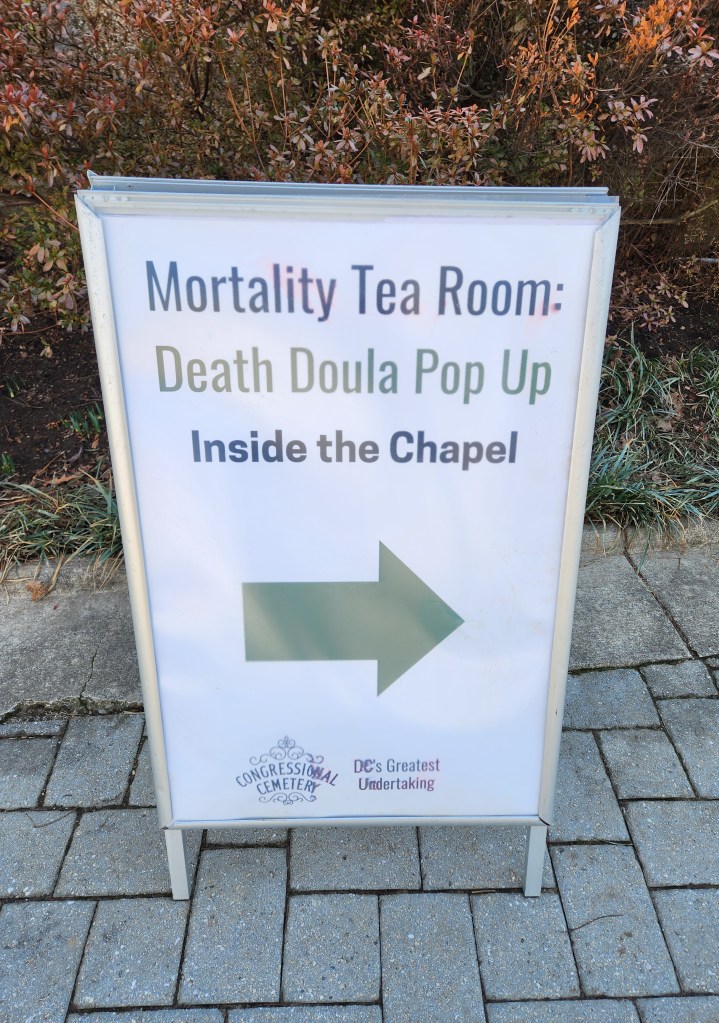
Last week, Congressional Cemetery wrapped up a month long series of Death Doula Pop Ups held inside the cemetery’s chapel.  These “Mortality Tea Rooms” were an extension of the “Death Café” program sponsored by the cemetery.  The “Death Café” is a loose knit international movement to facilitate regular discussions about death over food and drink with a dozen or so participants. 

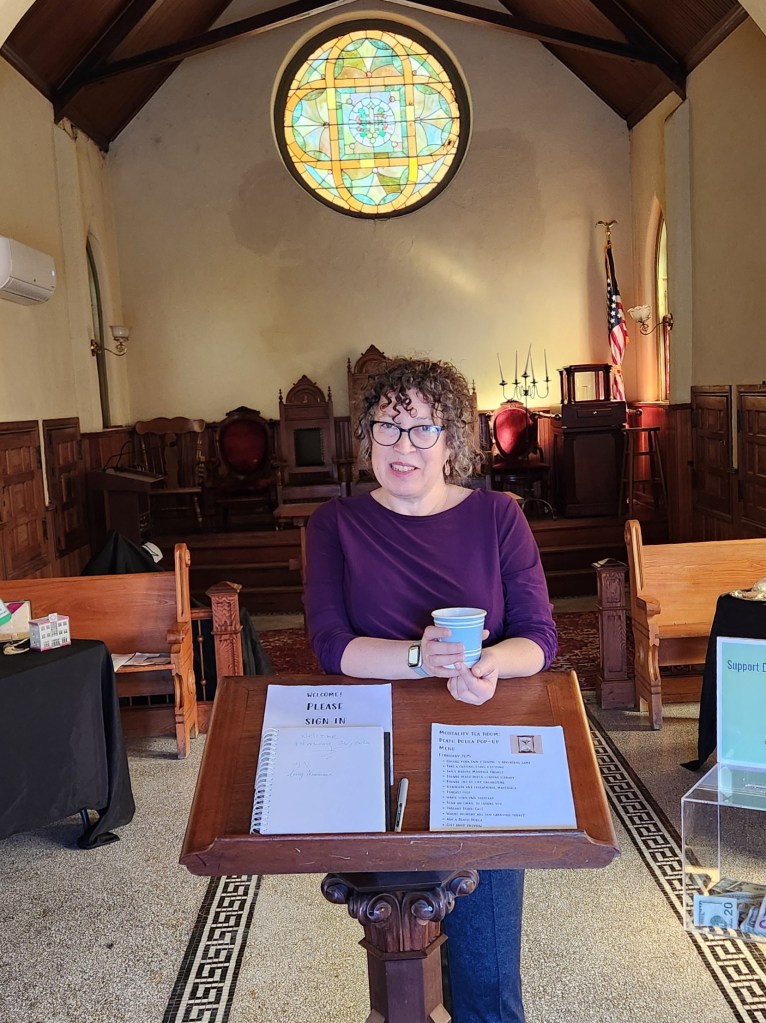
This series was coordinated and hosted by Congressional Cemetery’s Death Doula in Residence, Laura Lyster-Mensh. 

A visit to one on the events last week found Lyster-Mensh offering tea and information through a series of exhibits illustrating a death doula’s mission and her own approach to her practice.

And that’s what death doulas do – provide information about end of life choices both for families and individuals and support for terminally ill persons and their families. 

Lyster-Mensh conducts a tour of her Mortality Tea Room exhibits:  

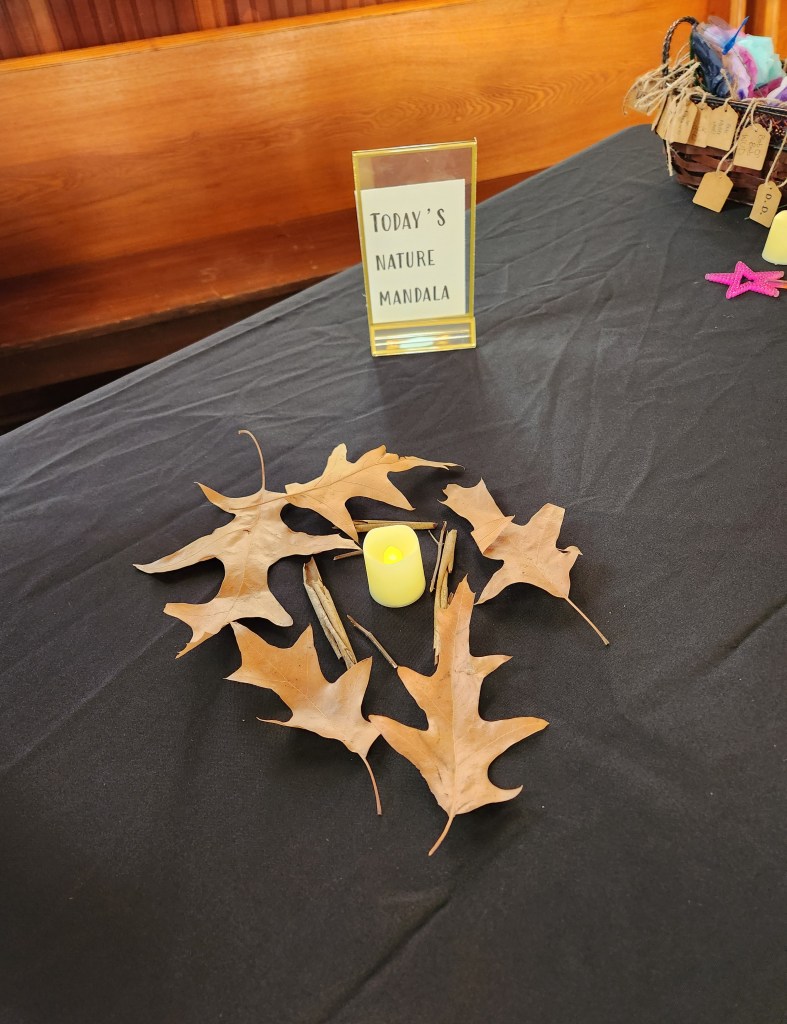
Impermanence

Every day, she starts a new nature mandala – a geometric shape made of things in nature picked up on the cemetery grounds by visitors to the chapel.  She says, “People are shy about things associated with bodies – so I’ve invited people to be part of building this geometric shape as a study of impermanence.  At the end of the day, I wash it away – and we start over the next day. 

Community Mourning

She references the Mexican tradition of Day of the Dead and said that that on the Day of the Dead last year an ofrenda was set up in the chapel.  (Ofrenda means “offering” in Spanish and refers to the colorful altars set up to honor deceased loved ones on the Dia de los Muertos Mexican holiday.)  She says that it displayed “hundreds of objects and photographs and flowers.  It was just splendid – a way of introducing ancestors and a way of talking about the past.” 

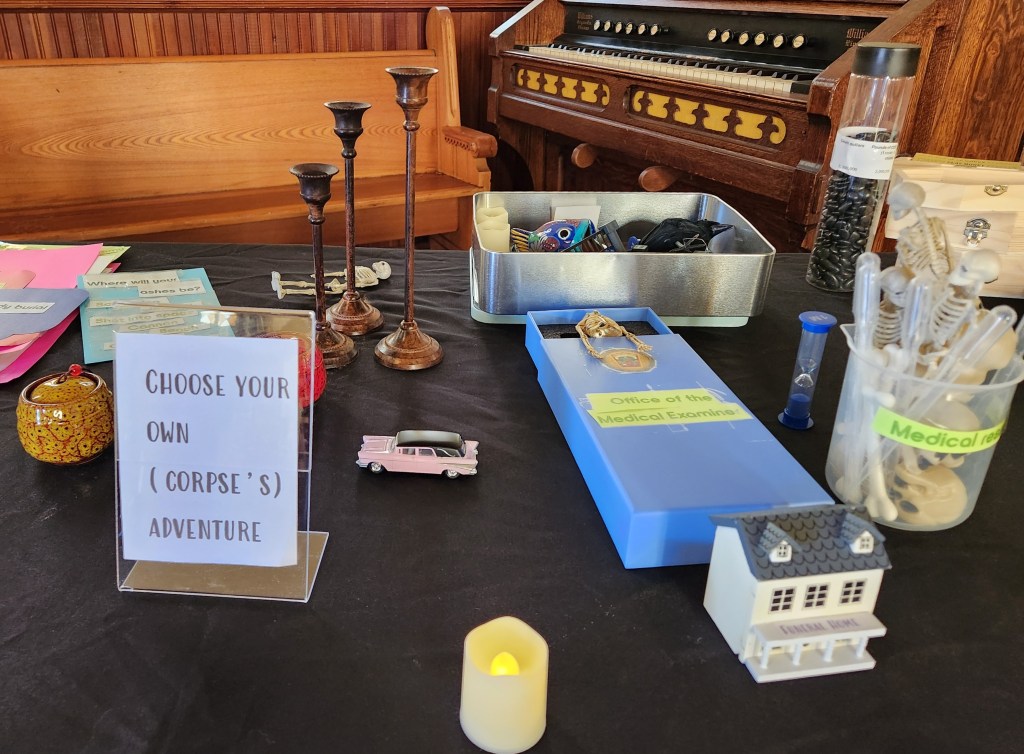
Choose Your Corpse’s Adventure

She moved on to what she called her pet project, a game called Choose Your Corpse’s Adventure.  She says, “Most people don’t think about what happens to their body after they pass – that causes expensive chaos.  So I set up toys to show people their options – how much money will it cost you to die and how much carbon will it take?   I get them to think – if you have as much money as you want and as much carbon as you want, how much do you need?  I ask them to think about that.  Given options such as water cremation, human composting, or fire cremation, what is the actual cost financially and environmentally? And the party – what about the party you might have after you’re gone?  By end of the game, people have gotten a better idea of death’s costs and impacts.  The real thing is the conversation, especially with couples.  That’s my goal – to get people talking and to think about their behavior in these terms.”

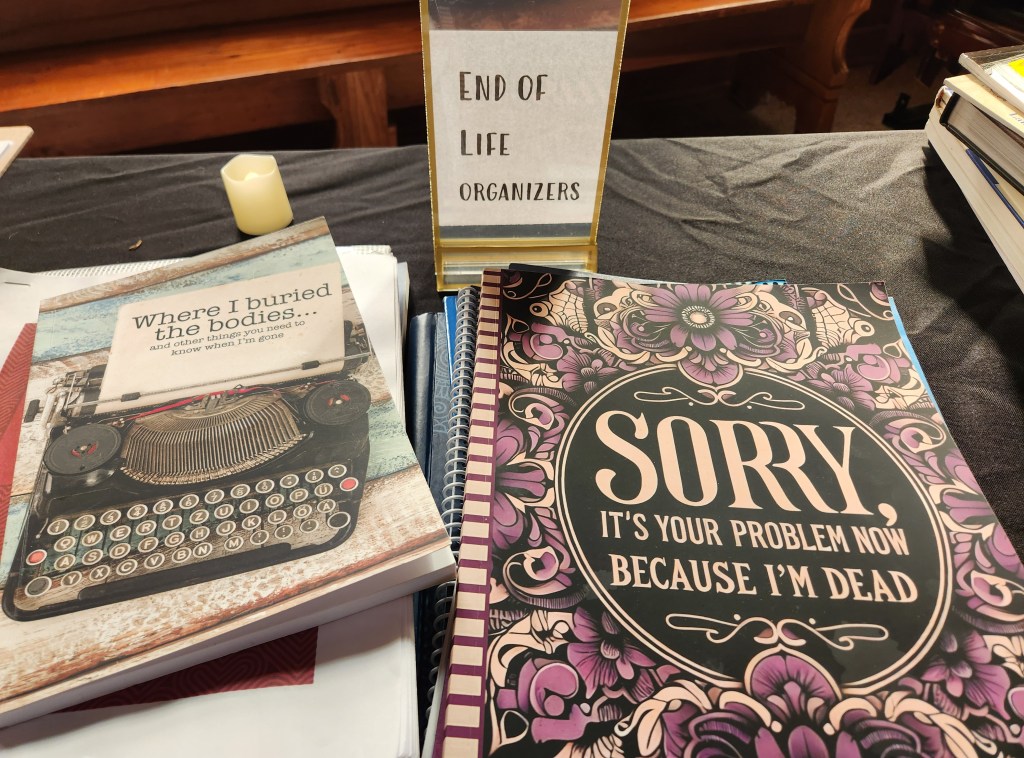
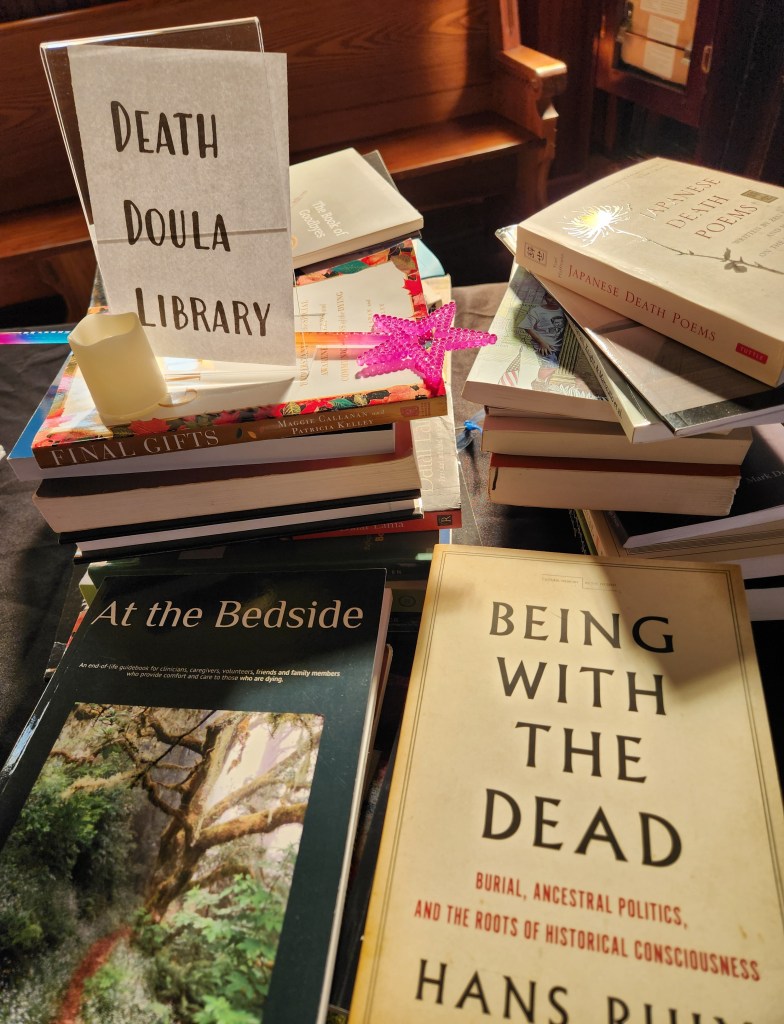
Library and Life Planner Area

Lyster-Mensh has a lending library including books and life planners.  She lends them out and people bring them back.  She wants people to organize and think about the chaos the day after they die.  She adds, “There are so many kinds of organizers – some are funny and some are serious.  I hand them a stack and let them go through them.” 

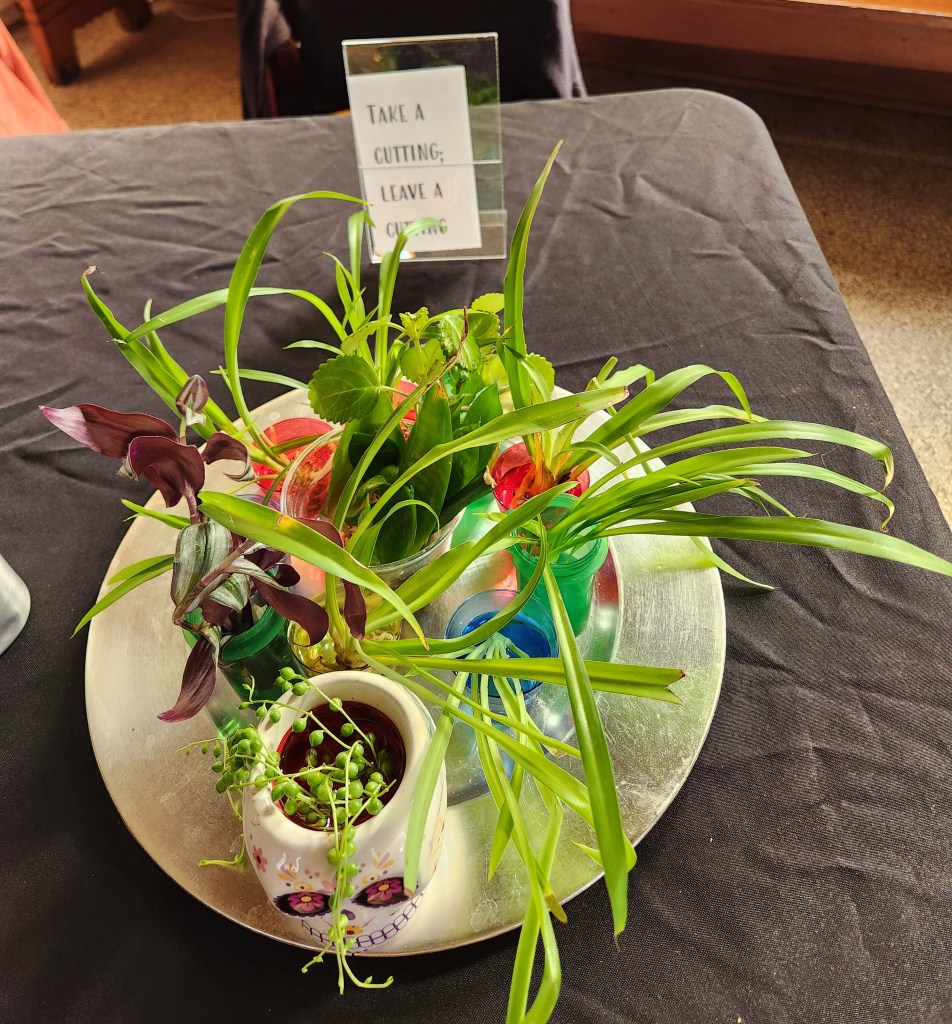
Immortality

Lydia-Mensch doesn’t talk about immortality, but she alludes to it by giving away plant cuttings. 

She says, “All living things come from something that has died.  The cuttings are all from my mom’s plants.  It’s a symbolic thing – I encourage people to think about taking my plants home; they will live or die and all these are coming from my mom’s plants which come from other plants and I like that idea.  Snake plants, Swedish ivy, tradescantia, spider plants – I love the idea that they are going out into the world.” 

Last February was the first month-long mortality workshop – which she says is a completely new way of encouraging contemplation of end of life scenarios – “It happened because the chapel was open for the month of February, and I asked to do it.  Last year, I did individual appointments.  The year before I did weekly gatherings and events.”  She says the cemetery will probably repeat the experience next year. 

Asked what motivated her, Lyster-Mensh says, “I’ve always had an interest even as a kid.  As I get older and lose more people and get closer to death the ‘eye-rolling’ (encountering people’s annoyance or reluctance to take the issue seriously) motivates me.  When I sit with dying people – and I’m with dying people a lot – their families and friends are often too frightened to be there and so they’re alone and that doesn’t have to be.  So I feel that death awareness is a way to bring people back to being more loving and taking care of each other rather than just leaving people to suffer in fear and isolation.” 

For more information and to sign up for a Death Café, go here:  https://bit.ly/3QNeZxb

1 Comment

Filed under Uncategorized