Councilmember Wells Explains New Eastern Market Authority to Market Neighbors and Merchants Wednesday Night
Councilmember Wells Unveils Legislation for New Eastern Market Governing Structure – Vendors Criticize Lack of Grandfather Clause
by Larry Janezich
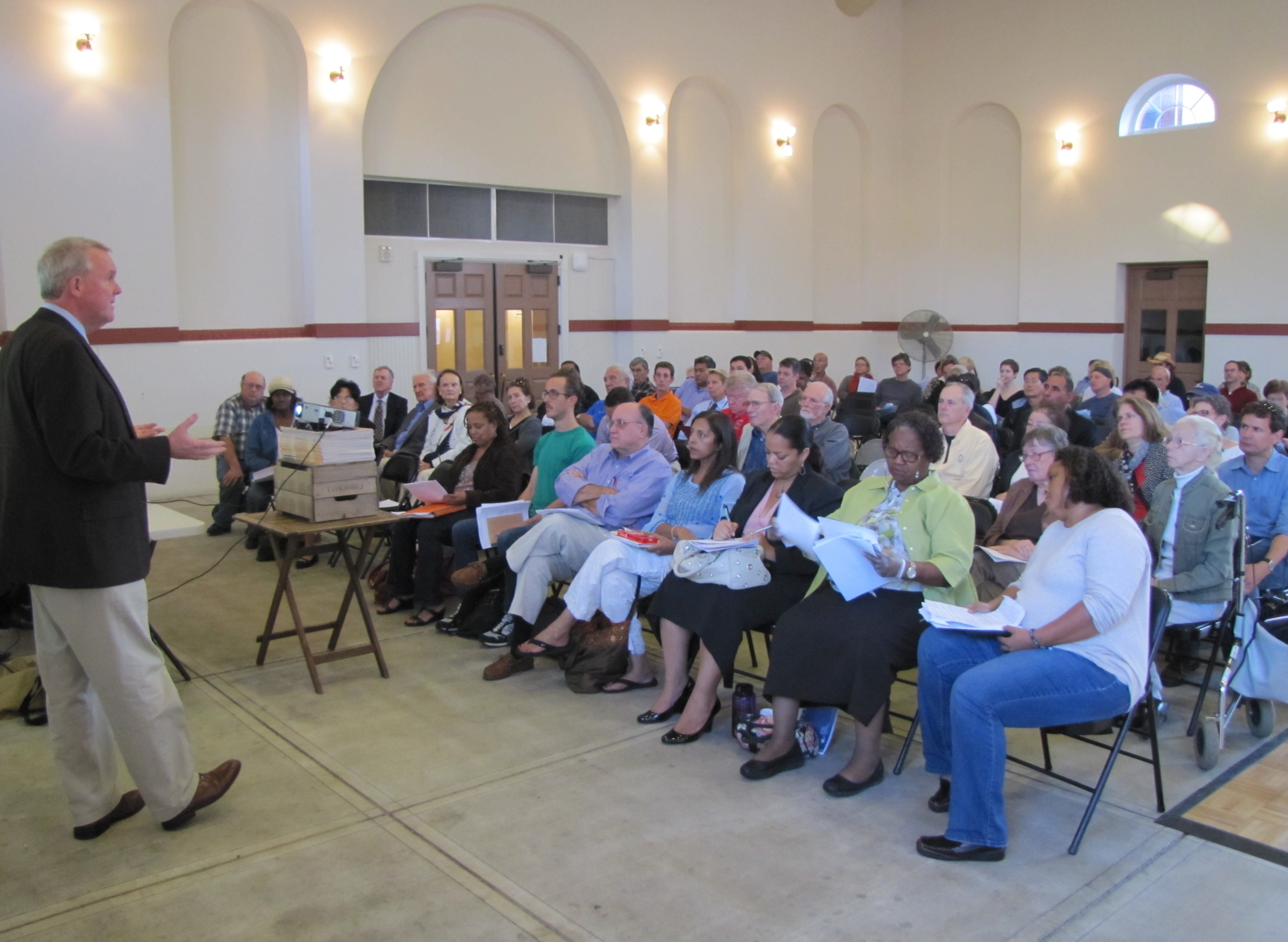
Wells told more than 100 community members and stakeholders Wednesday night in the Market’s North Hall that the new governing structure for Eastern Market will be a nonprofit corporation – the Eastern Market Preservation and Development Trust (EMPDT). A new structure was necessary because the District government wants to get out of its market manager role, and has admitted it is ill suited to run the market. The current structure, Eastern Market Community Advisory Committee (EMCAC), is an advisory body with no authority.
A Board of Directors, comprised of eleven unpaid members initially appointed with staggered terms, would govern the Trust and provide local control of the Market. Three members will be elected by the inside and outside merchants and vendors. The remaining eight will have special expertise in food, arts, business and finance, historic preservation, legal, merchandising or marketing issues. This would seem to exclude the ANC, but not the Restoration Society. Initially, two of the eight will be appointed by the Mayor, one by the Chair of the City Council, and five by the Ward 6 Councilmember. One of the latter would be designated by Wells to be the Chair for the first year. After the initial round of appointed terms, the Board would become self-sustaining and select its own Board members and Chair.
The Board would have the power to appoint and terminate a market manager for the day to day operations of the Market and serve as a non-voting member of the Board.
Strong opposition to the bill came from vendor and merchant representative Angie Brunson. She said they can’t support this legislation, since “everything that protected the merchants and vendors has been taken out.” She referred specifically to the 1997 legislation which gave the right of first refusal of marketing space to certain merchants and vendors who were serving the market at the time. The clause gave them the right to market space indefinitely, allowing them to suspend and resume retailing for long periods, at will.
Wells said that a grandfather clause for the merchants and vendors had been opposed by the Task Force he had appointed to make recommendations, by the city, and by the pro bono attorneys who drew up the legislation. He said that leases will provide normal protection establishing rights to marketing space and that having three tenant representatives on the Board would provide further protection. He went on to say that “grandfathering is not 100 percent consistent with the ability of the market to evolve.”
A member of the community with a copy of the report subsequently pointed out that the grandfathering issue had never been part of the Task Force deliberations.
Wells asserted, “I’m not wedded to this language – we did our best job and are hoping for recommendations tonight. If it fits well, we’ll begin the amending process now.” He said he was open to meeting with the vendors and tenants and discussing the viability of a tenant’s council. One idea that resonated with Wells was expanding the number of Board Members to 13 to provide city wide representation.
Regarding a question from the audience about oversight of the board, Wells said, “It’s partly a leap of faith. Do we trust a selection of our neighbors to run the Market?” Ultimate oversight would be in the hands of City Council, though this would, he said, be by line item in the budget.
The new legislation hints at a solution for the down-sized weekend flea market anticipated by the limited space provided by the current design of the Hine Development. The legislation would give the Trust jurisdiction over 7th Street between North Carolina and Pennsylvania Avenues. Wells said that those concerned were looking at the possibility of using 7th Street between C and Pennsylvania for the weekend flea market, but emphasized this was not definitive. The “brick and mortar” merchants occupying the buildings in that block would have to be consulted and brought into the process. He mentioned other public space (Metro Plaza?) as an option as well.
Wells encouraged those in attendance to provide feedback to improve the bill on forms handed out at the meeting, through his website, and through the ANC. “It may take two years – it may take four months, Wells said, “[w]e would like to prevent the government from contracting the management of the market out with no local control. If it doesn’t work, we can go back to that.”
EMCAC and the ANC will provide opportunities for public participation in the process. A jointly sponsored hearing on the issue is being considered by those organizations. In addition, the City Council will hold a hearing this fall on a date to be determined.
 CAPITOL HILL CORNER
“Currently, outside vendors pay $25 to $40 a month for marketing space”.
This is not accurate. Non-food vendors pay that much per day. Farmers pay according to the size of their space.
I’m conflicted on this – I definitely want to protect the livelihoods of the vendors at the market – inside and out – but would love more local farmers and local food products at the level of a FreshFarm style market, like at Dupont. I know that some of that would overlap with the inside market vendor products (fish, meat, cheese, bread…) and also the outdoor stalls, which are currently a mix of wholesale-with-stickers-on, regional wholesale, and some local farmers. The longer Eastern Market resists the call for more local product, the more hill residents will go to Dupont or the H St. market for that.
I agree with Jon. New vendors sound like a good idea to me, and while I wouldn’t want to forsake every vendor that’s in there now, I wouldn’t mind some turnover. Also like Jon, I would welcome new vendors committed to local and/or organic.