by Larry Janezich
Posted April 14, 2026
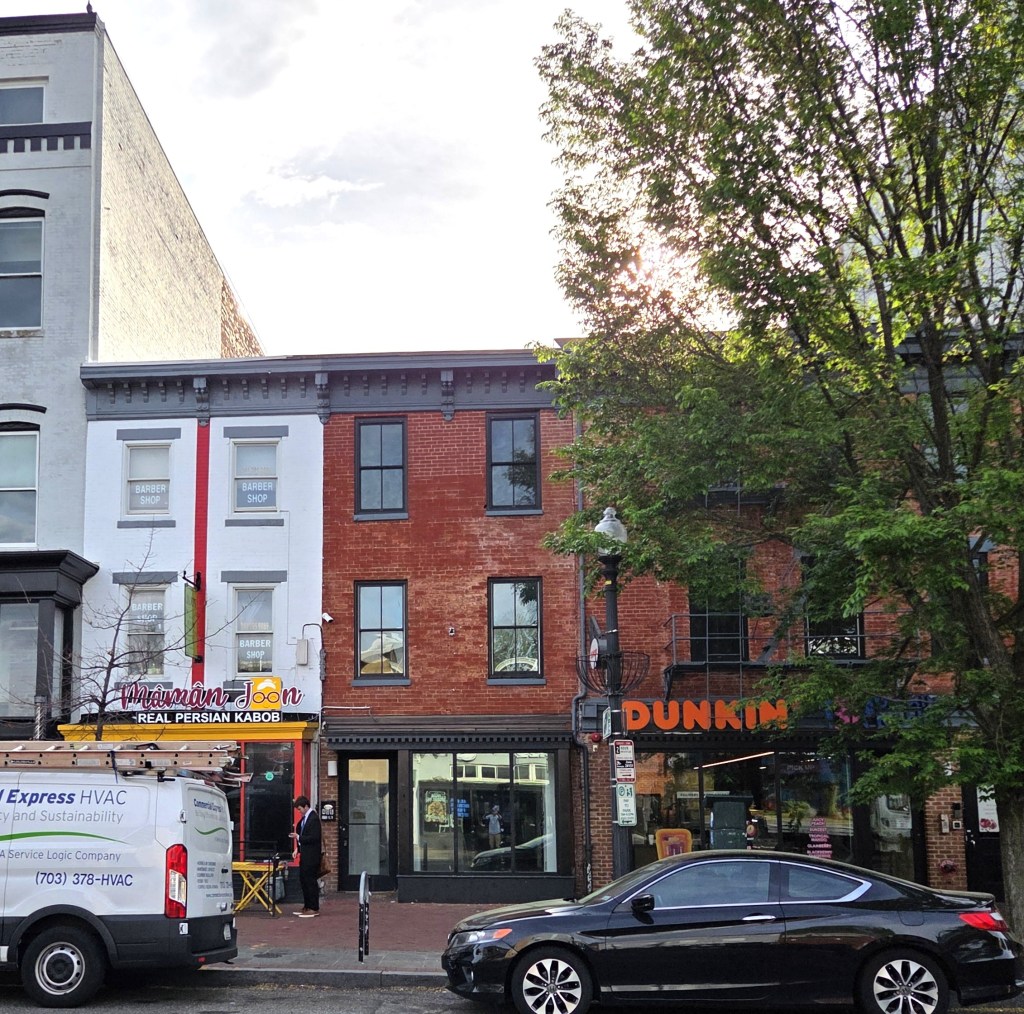
Wingstop wants to open at 406 8th Street. SE, between Dunkin’ and Maman Joon’s Kitchen, in the space formerly occupied by Mother Blossom.
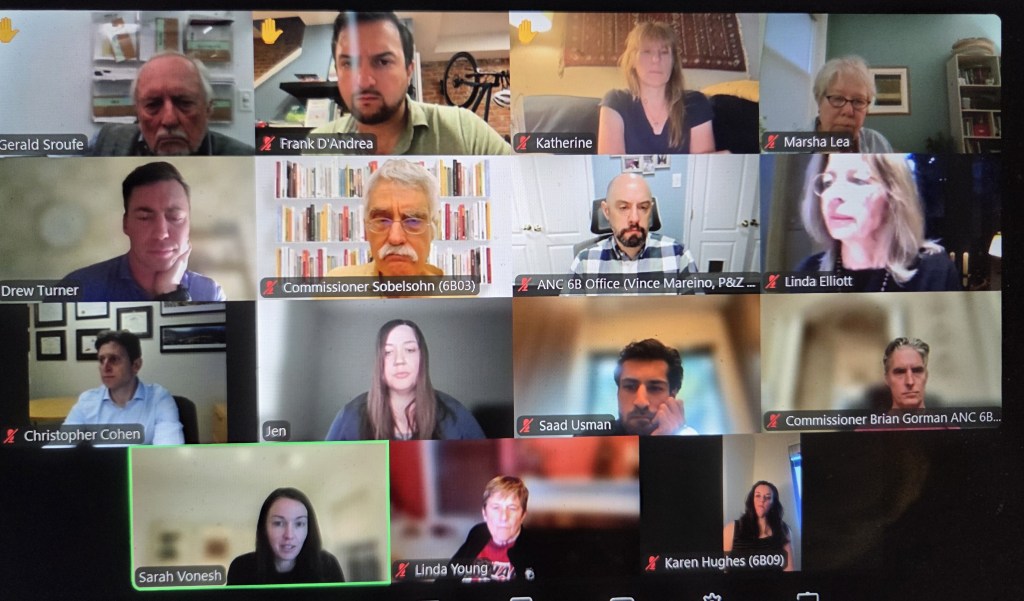
Here’s a photo of last night’s meeting of ANC6B’s Planning and Zoning Committee.
100+ Residents Sign Barracks Row Fast Food Protest Petition
Controversy over fast food outlets surfaced at last night’s meeting of ANC6B’s Planning and Zoning Committee chaired by Commissioner Vince Marino. At issue is the proposed opening of Wingstop, a 100% carryout fast food fried chicken chain seeking to open on the 400 block of Barracks Row. Wingstop has over 2,500 outlets internationally.
A group of 100+ nearby neighbors opposed to more fast food outlets on Barrack Row have submitted a petition to ANC6B opposing fast food outlets and specifically opposing the ANC negotiating a Settlement Agreement that would pave the way for Wingspot to open. Marino noted the number of signatures is not seen for most things and enough to make a difference in ANC elections.
The situation is this: The former weed shop Mother Blossom went out of business after gift shops were made illegal. Building owner Douglas Development leased to Wingstop, but zoning regulations require the proposed business to go through a “special exception” process because zoning regulations restrict the number of fast food restaurants on the street. Wingstop has over 2,500 outlets internationally.
ANC6B received the application for the exception last December. Douglas Development has hired the high-powered legal firm of Holland Knight to help them win the exception – first by gaining the support of ANC6B and then approval by the Bureau of Zoning Adjustment (BZA). There are specific criteria which must be met including a finding by the BZA there will be no adverse effects from trash/rodents, noise, odor, and traffic. If those four criteria are met, the BZA issues the exception.
In this case, the sticking point is odor. Neighbors say Wingspot will pump more unpleasant fried chicken odors into the community to the detriment of their enjoyment of their nearby properties. A Popeye’s across the street already does that. A small group of neighbors is trying to negotiate with Douglas Development to find a way to make everybody happy. A larger group of neighbors who are opposed to fast food in general, are behind the petition, some of them having broken away from the negotiating group, frustrated over that process.
Separately, a Captain of the DC Fire Department’s 8th Street Station has filed a letter with BZA opposing the establishment of another fast food carry out on the block because he says the carryout would make an already heavily trafficked street even worse, hindering the egress of emergency vehicles from the fire house a few doors away.
Here’s the state of play:
Douglas Development has a plan for controlling odors which neighbors say would protect their own 2nd and 3rd floor tenant in the building at the expense of the residential neighbors.
The negotiating neighbors have an alternate plan created by their own expert engineer, which Douglas Development refused to consider when it was presented ten days ago. The negotiating neighbors say Douglass Development has not been negotiating in good faith, referencing Douglas Senior Vice President for Development Drew Turner’s “bait and switch” approach to negotiations. Turner was called out by Marino for his “combativeness” in contrast to the other members of the Douglas team. Turner later offered an apology.
ANC6B’s role is purely advisory, though city regs require BZA and other agencies to give “great weight to the ANC’s opinion. By exercising its right to protest the issuance of a special exception, the ANC can adds months to the approval process and run up legal fees for the applicant – and legal fees for the ANC.
According to Chair Marino, the larger group of neighbors firmly opposed to any new fast food appear to have enough residents with legal standing (being affected by the opening) to file their own protest with BZA which could trigger a BZA protest hearing regardless what the ANC does.
At the end of last night’s meeting, in the face of some skeptical ANC commissioners, Douglas Development agreed to review the negotiating neighbor’s alternate odor mitigation plan. One of the complaints was that Douglas Development had not permitted access to the building for the neighbor’s engineer to take measurements to provide additional data for the alternative plan. The negotiating neighbors tried to pin down a date for access for the engineer, but the best they could get from Chris Cohen, one of the Holland and Knight attorneys, was Douglas would “need a week to review the proposal and we’ll be in touch.”
Marino expressed hope that the postponed BZA hearing would provide an opportunity for continued negotiations. The ANC voted to postpone further consideration of the matter until the next meeting of the Committee in May. Commissioners noted that the topic remains on the full ANC6B Commission meeting agenda for Tuesday night. Negotiating neighbors said that a number of residents are planning on attending the meeting to express their view.
The full ANC6B meets tonight, Tuesday, April 14 at 7:00pm. The meeting is usually hybrid – in person and on line – but the ANC website only indicates a virtual meeting. CHC’s attempts to clarify have not been successful. If it turns out there is an in-person meeting as well, the ANC ordinarily meets in the first floor conference room at 700 Penn Avenue, SE, entrance next to Trader Joe’s.


Here are some questions: 1/ what is the fast-food difference between a spot that offers carry-out chicken wings and one that offers carry-out baguettes and croissants?
(Ed. Note: Probably none. If a baguette shop wanted to open on Barracks Row, they would probably have to get a special exception unlless they opened in a place which had a previous special exception, or they were grandfathered in like Popeyes who was there before the regulations were.
Given the circumstances, a baguette shop would likely have an easier time.
Here’s one reason. The cooking process for wings – frying in oil – produces a far more obnoxious odor and an exhaust which contains a much higher particulate component than the exhaust from a bakery.
(There is a way to mitigate odors – installation of a Pollution Control Unit. Most fast foods do this to meet objecctions regarding odors. Currently, in the case of Wingspot, Douglas Development has refused to install a PCU.)
If the baguette shop wanted to open elsewhere – say 7th Street, SE – they would not need a special exception and would be treated just like a restaurant – as was Little Engine wings – a carryout with indoor seating – which opened across from Eastern Market last month.
2. How can anyone complain about the smell from Wingspot when it has not yet opened?
(Ed. Note: Because the neighbors have experienced Popeye’s inability or failure to control the fried chicken odors which permeate the 7th Street neighborhood and beyond to the west. More than a dozen residents described the impact on their quality of their lives on 7th Street to ANC6B which met in person and on line last Tuesday night. (It would have been instructive to be there. Those who are interested can or will shortly be able to see the videotape on the ANC6B website. Please reach out to me for additional details on how to access the tape.)
3/ What are the differences in “adverse effects from trash/rodents, noise, odor, and traffic” between a fast-food vendor and a Michelin starred sit-down bistro?
(Ed. Note: The ANC has a lot of leverage over a restaurant that serves alcohol. They can pressure the restaurant to make concessions re best practices – including in door trash storage – by protesting the license (for cause), dragging out the liquor license process for months, and forcing a formal protest hearing requiring legal representation. The ANC uses this leverage to negotiate a settlement agreement with the restaurant under which they agree on procedures (hours, trash, noise control, security, etc.). The agreement becomes part of the ABCA order accompanying the license and the restrictions are enforceable. The license must be renewed every three years. If there are complaints from neighbors that the agreement is not being honored, the ANC can stall the renewal of the license.
Fast food outlets don’t usually serve liquore and their licenses only need to be renewed every 10 or 15 years. So the ANC has far less leverage. Once they are in, it is a long time before the ANC and neighbors can object to the way the business is being run or to the negative impact on the neighborhood. They have to rely for enforcement on city agencies like the Health Department or ABCA inspectors (woefully inadequate in number). Enforcement of regs leaves a lot to be desired, city wide.
Ed. Note:
Let me cut to the chase and give the short answer to all three of my questions: the only real difference is that members of the Capitol Hill noblisse are against food vendors like Taco Bell And Dunkin’ Donuts because they cater to riff-raff (nannies, school kids, health care workers, and police, fire, and EMS personnel — and occasionally me), but happy to oblige other vendors who cater to their fellow members of the noblisse.
This is not the first time you’ve raised this claim, and it remains as misleading as it is exhausting. Fast‑food establishments are not interchangeable, nor is there any rational reason they must all be clustered within two blocks. Dunkin’ Donuts is not Taco Bell, just as Jersey Mike’s is not Popeyes. There are many affordable and healthy alternatives, some are national chains while others are small local ones – fast casual places, coffee shops, sandwich shops. Mangialardo’s, which has served this community for decades, is a clear example. This is not about snobbery or “noblesse.” It is about offering a diverse mix of food and gathering places to serve a diverse population. Riff-Raff, as you call them, enjoy good healthy affordable food and a chance to chit-chat with neighbors just as much as anyone else—regardless of income or background.
And the suggestion that bread somehow becomes elitist simply because it’s called a baguette is not only inaccurate—it trivializes the entire discussion.