

Keith Parsons, Depatment of Buildings

Frank Bessenyei, Office of Tax and Revenue

Dennis Corkery, Offic of theAttorney General – photo credit, Dennis Corkery from LinkedIn.
How DC Responds to Vacant/Blighted/Nuisance Properties
by Larry Janezich
Posted May 19, 2026
Last Thursday, ANC6A, Chaired by Commissioner Amber Gove, heard from a panel of DC officials on how the city addresses the issue of vacant, blighted, and nuisance properties. The presentation was coordinated by 6A Commissioner Roberta Shapiro, who brought the Department of Building’s (DOB) Keith Parsons, the Office of Tax and Revenue’s (OTR) Frank Bessenyei, and the Office of Attorney General’s (OAG) Dennis Corkery, to the Commission.
DOB
Keith Parsons took the lead in the presentation noting that addressing the issue of vacant and blighted properties starts with DOB. The role of DOB is two-fold.
- Identifying properties as either vacant or blighted.
- If the property has violations they have an abatement team and contract abatement to correct some issues, e.g., grass, trash, boarding up, and mitigation of structural issues.
Enforcement starts with a complaint filed with DOB on the website, here: https://dob.dc.gov/ (under Inspections and Enforcement) which provides a menu to request a vacant or blighted property inspection.
Filing the form triggers a property inspection. Prompts help DOB identify what they will potentially do. Inspectors try to determine if anybody is actually living in the property day to day or using the property day to day in business. If any part of the property is occupied, the entire property qualifies as occupied – one unit in a 700 unit apartment house qualifies the entire structure. Using the garage in an otherwise empty commercial building qualifies. An investor who buys five empty store fronts and puts them all in one tax lot and occupies one store front qualifies all five as being occupied.
As a side note, Parsons clarified that DOB does not handle squatters but MPD can and DOB will alert MPD to squatters when that is part of the complaint.
Filing a complaint will generate a confirmation email and by replying a complainant can find out what happened.
There are a number of exemptions a property owner can claim to postpone the declaration of property as vacant. These include, among others, ongoing construction, listing a property for sale, property is under probate or litigation, hardship, and application for permits.
Here’s a link to DOB’s Vacant Property Tax Dashboard which displays a map showing the location of every one of DC’s 4472 vacant properties https://bit.ly/4dRQOK5
OTR
Frank Bessenyer said that OTR communicates with DOB on updating and changing classification of properties.
OTR’s Assessment Services Division is responsible for billing and collecting real property taxes and a corrected tax bill is issued promptly once DOB notifies of a change in status – usually within 48 hours. The tax rate for a vacant property is 5% – for a blighted property it’s 10%. Vacant lots are not taxed at the higher rates.
Any property for which taxes are in arrears is potentially subject to a tax sale – technically it’s the lien that is sold and that starts a foreclosure process unless the owner decides to redeem the lien during the 2 – 3 years the foreclosure process takes. If the tax lien does not sell, the District continues to offer it in future sales. If it still does not sell, the lien may go to a discount tax sale where bidding on properties starts at $300.
OAG
Dennis Corkery works in the Workers’ Rights and Anti-Fraud Section of OAG. His office deals with nuisance properties involving drugs, firearms, and prostitution. OAG can bring lawsuits against the owner of the property if there’s a nuisance going on. OAG has to go after the owner – so if there’s an absent land lord or owner there’s not much they can do.
Corkery cited a recent OAG success in ANC6A at the property at 1000 C Street, NE. The property was vacant for over a decade and the owner submitted endless exemption requests which Corkery said were either fake or designed to take advantage of the process. OAG filed suit and was ultimately awarded default judgement. (The owner – George Papageorge – must pay $1.8 million in back taxes.) US Marshals will sell the property and the money used to pay for the judgment.
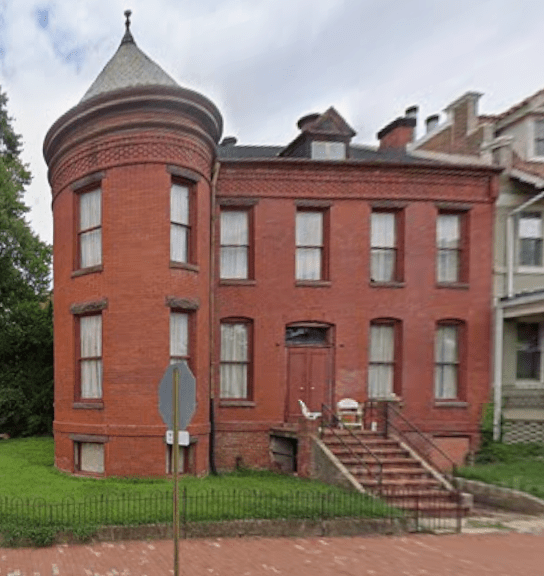
1000 C Street, NE. Photo credit: Google Maps. 2025


The pictured property has been vacant since I moved here in 1998. It has been known as a neighborhood blight at least since Sharon Ambrose was the the Ward 6 council representative.
So far it has been 28 years, and despite the claim that it has been delt with, it is still not resolved. I wouldn’t call that a success.
This system doesn’t work as described. A friend of mine who has dementia got fined for an infraction in her house, which she occupied at the time. We’ve moved her out and paid up, but we can’t get the city to clear the fine, a necessary step so we can repair the house and put it on the market. The system is, in effect, keeping the house vacant.