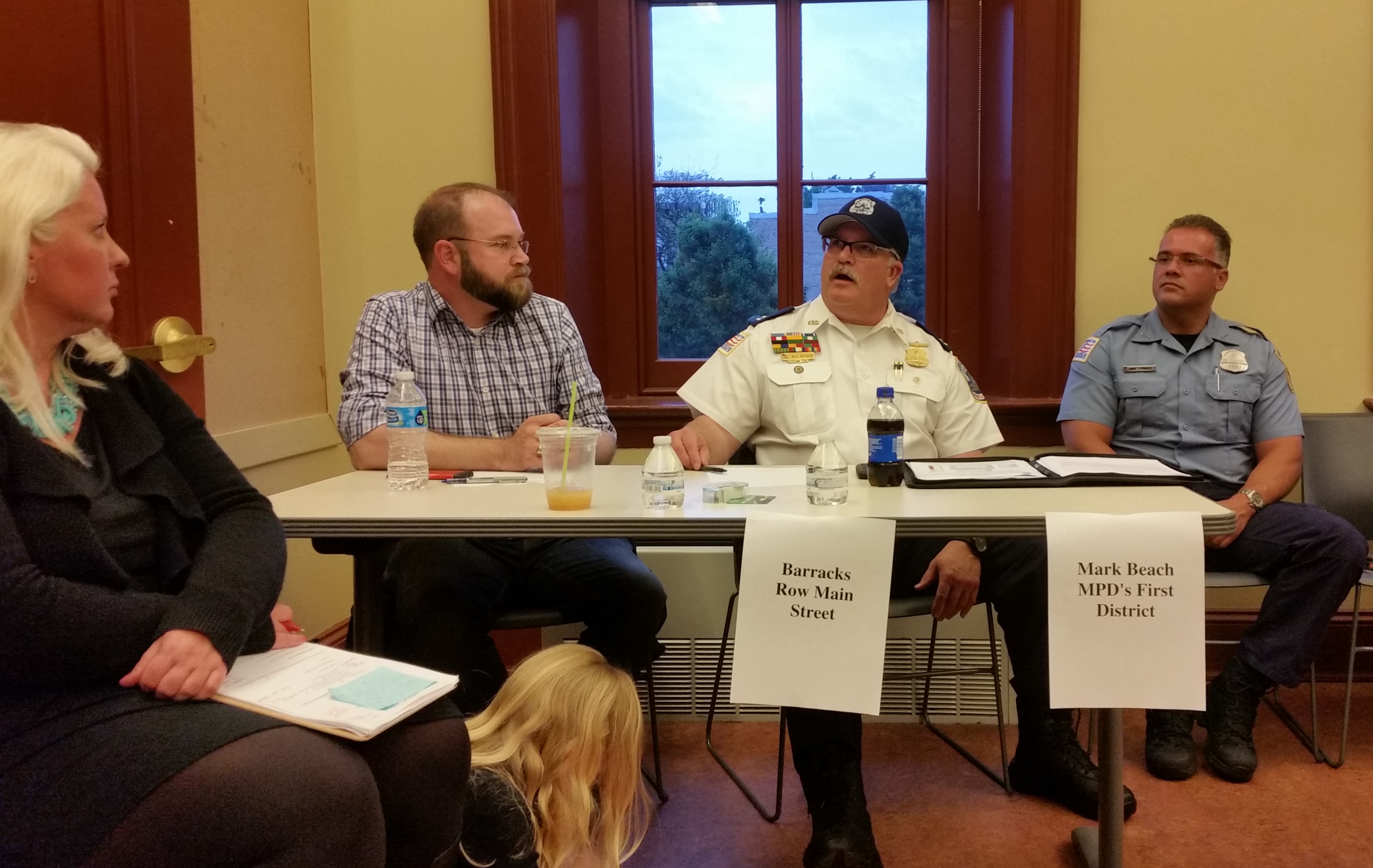
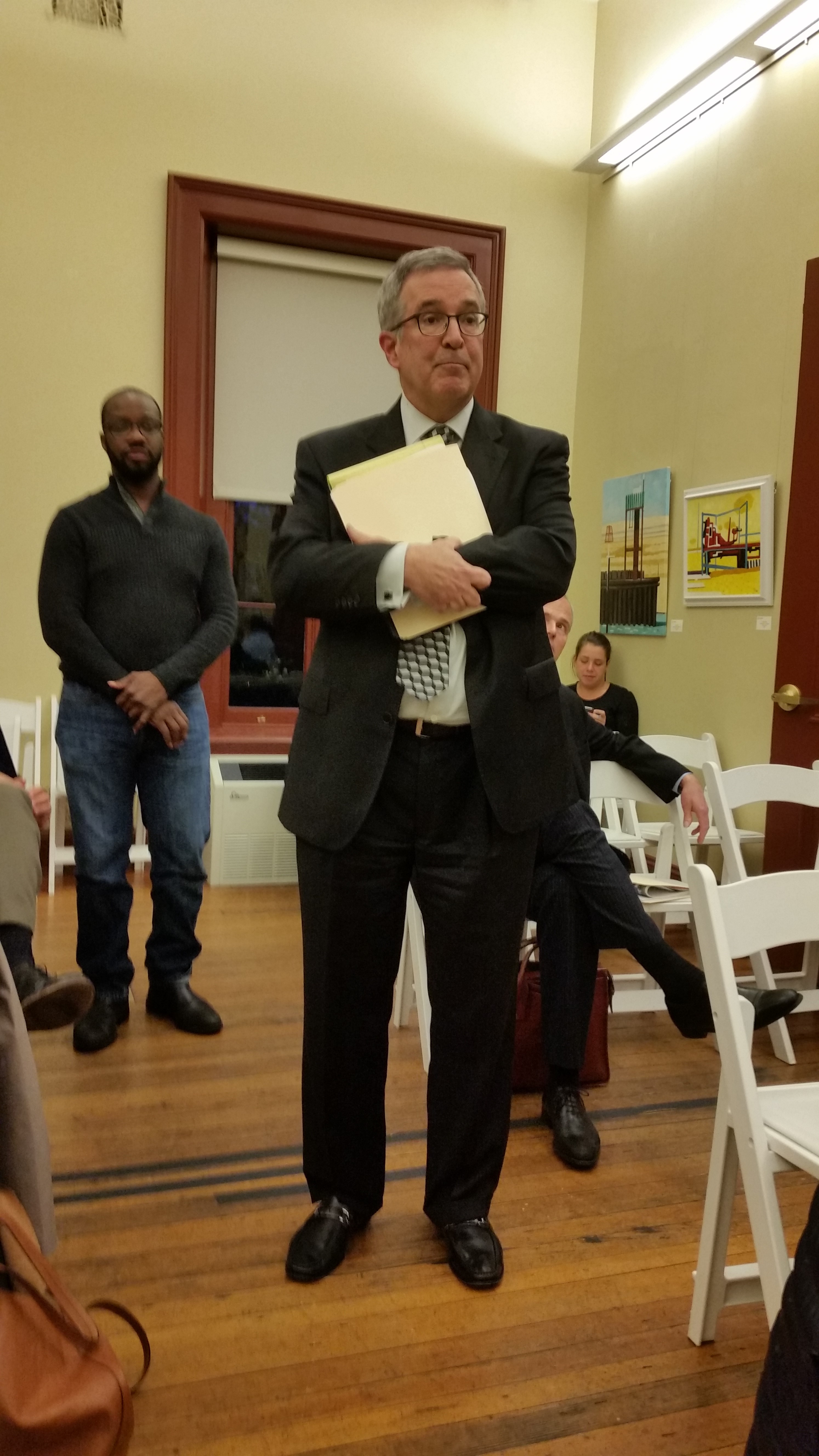
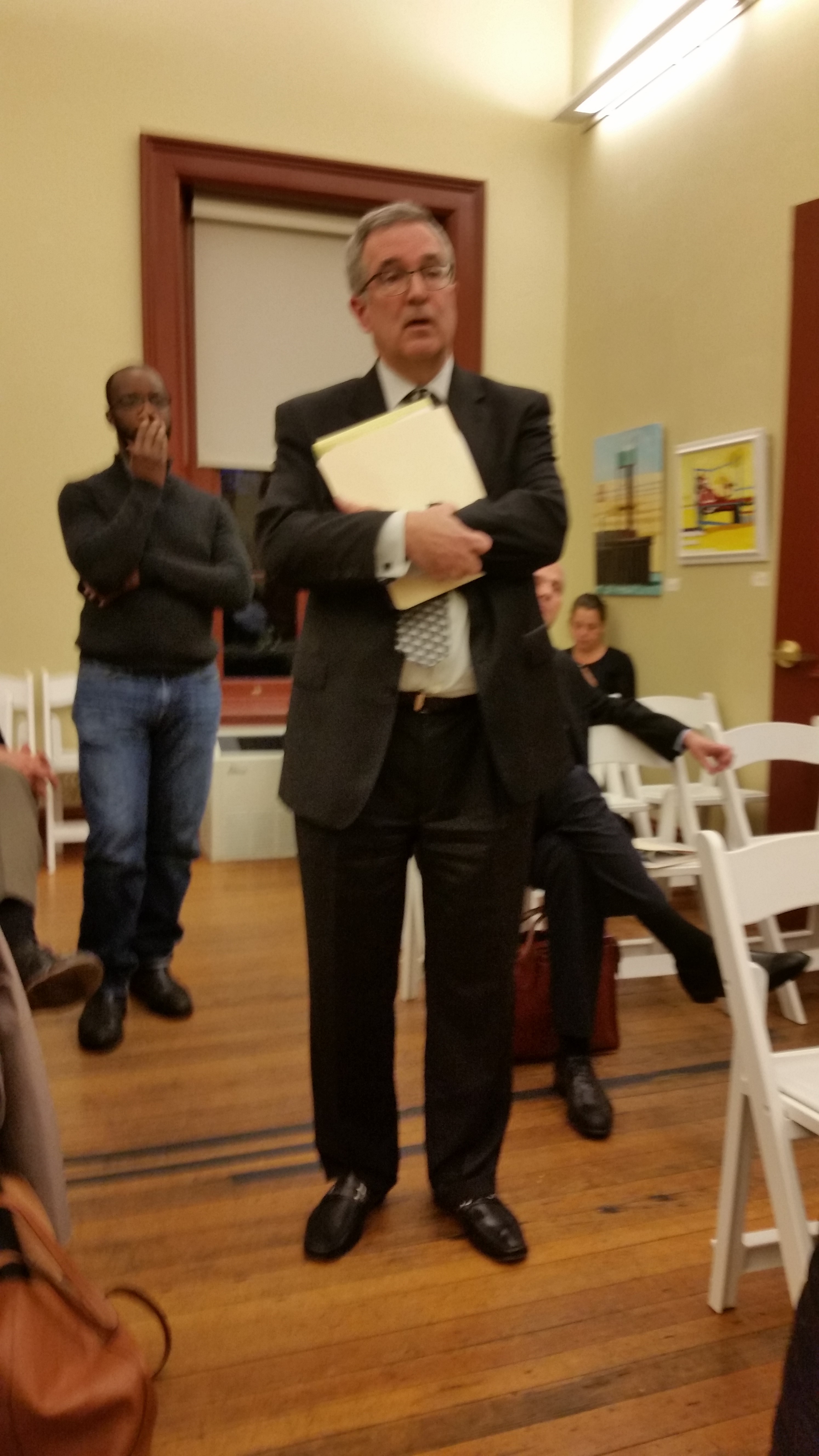
At Monday’s night’s meeting: (L-R) Commissioner Jennifer Samolyk; Martin Smith, BRMS; MPD 1st District Captain Mark Beach and Ulysses Fernandez.
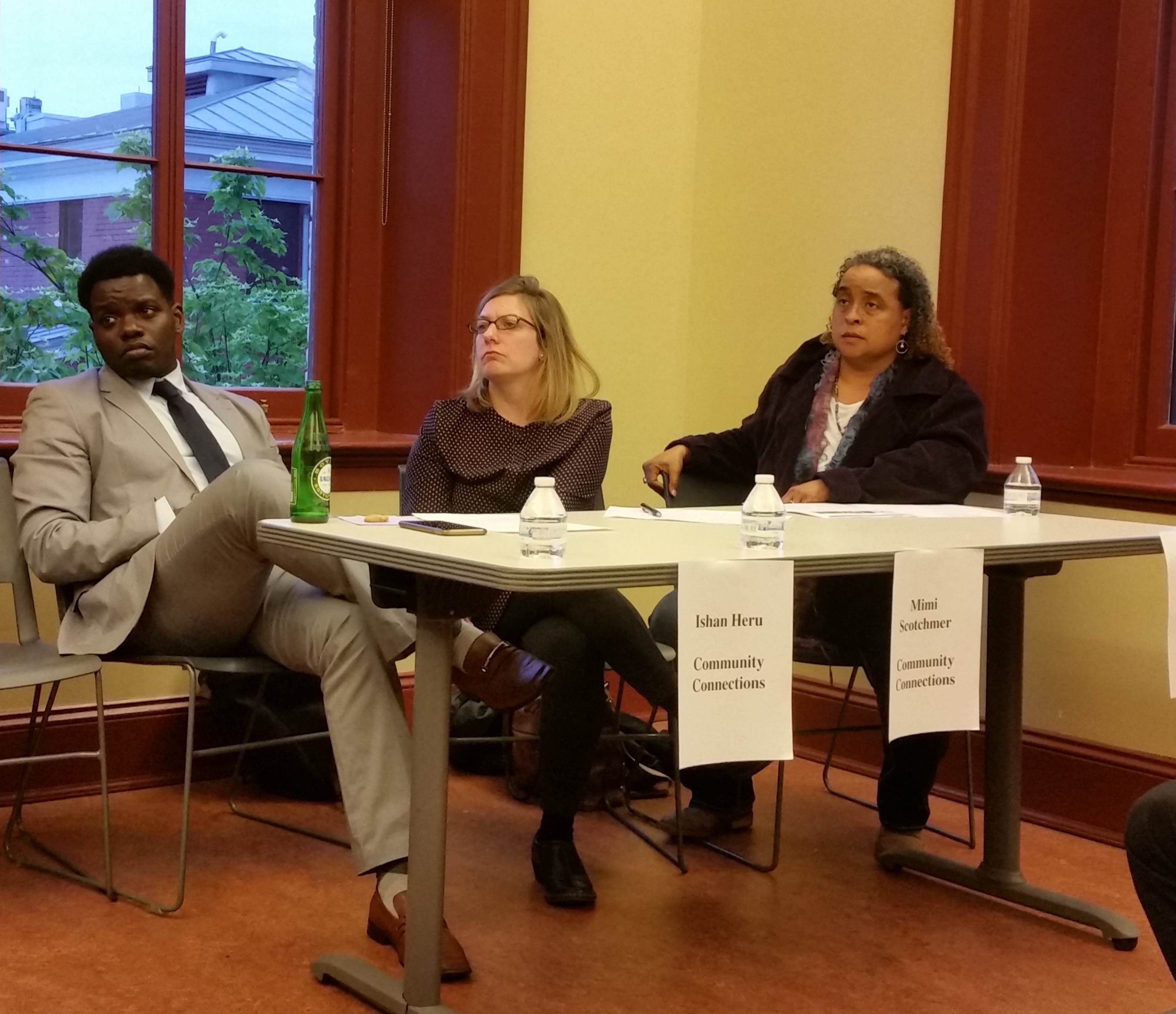
Also at the meeting. (L-R) Ishan Heru and Mimi Scotchmer, Community Connections; Rev. Kelli Jareaux, Safety.net
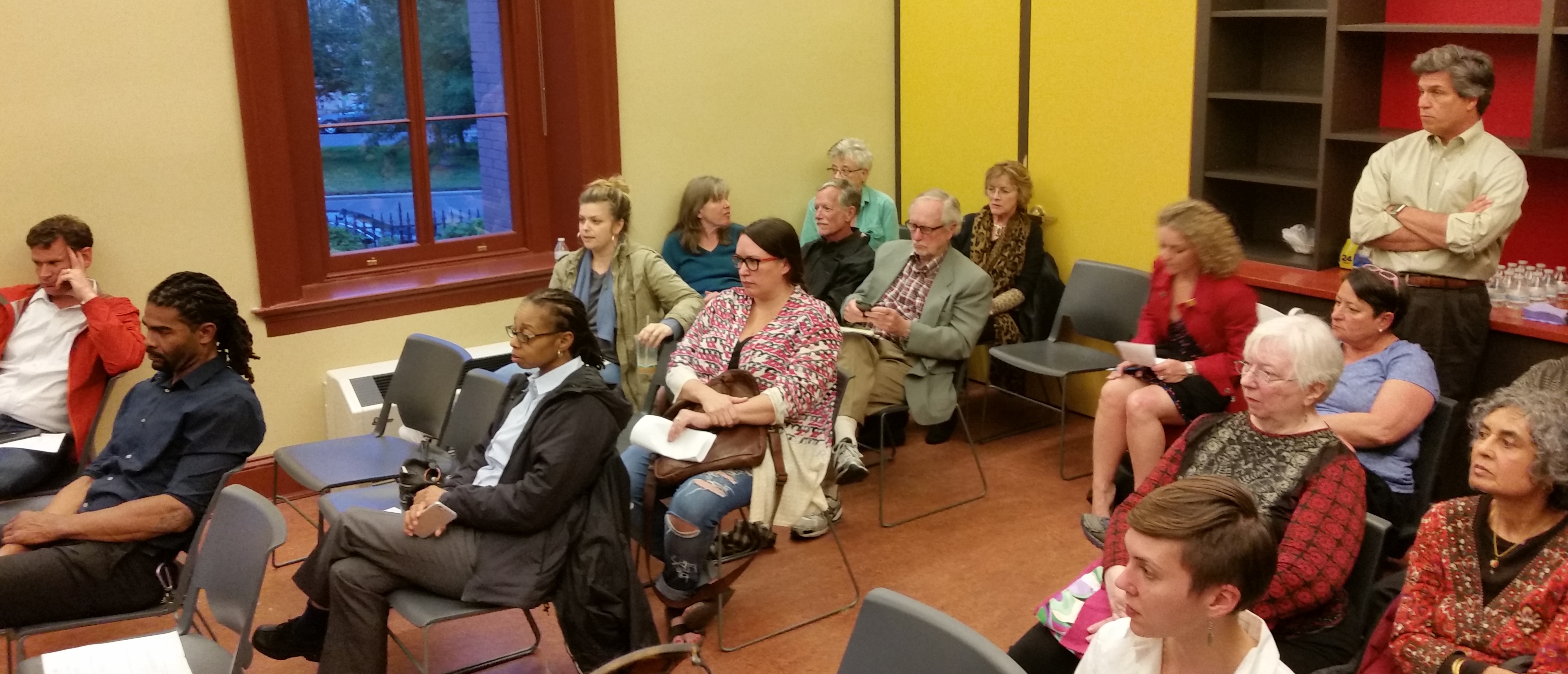
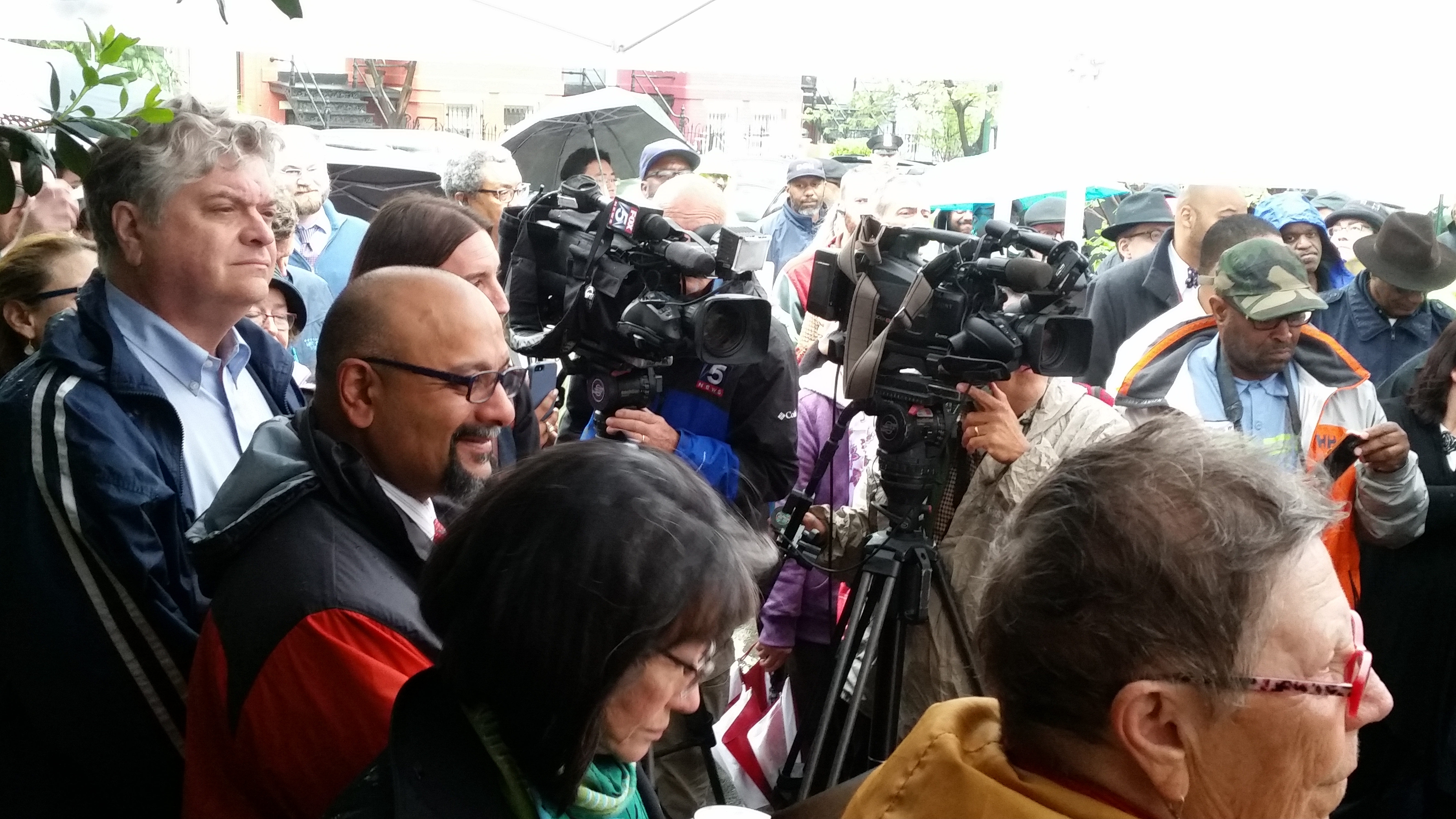
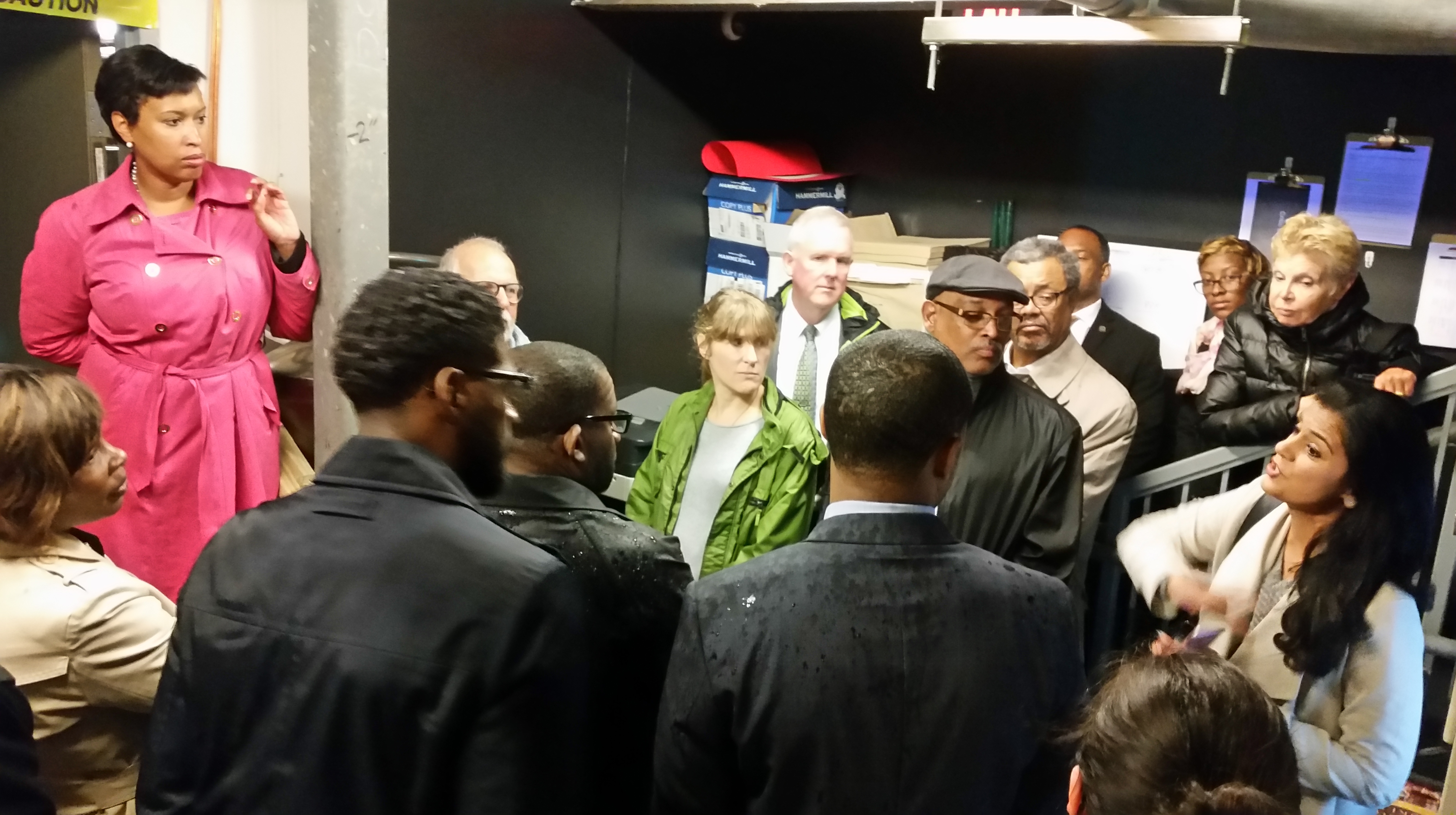
Some members of the audience at Monday’s meeting. Standing at rear is Bobby Coffey, representing Aquila Recovery, a new substance abuse recovery program coming to the office space above the 8th and PA Starbucks. The private pay outpatient clinic treats clients referred by personal physicians.
Addressing the Ongoing “Quality of Life” Issues Around Eastern Market Metro Plaza
by Larry Janezich
ANC 6B’s Outreach and Constituent Services Task force, Co-chaired by Commissioners Diane Hoskins and Jennifer Samolyk, met with residents and community stakeholders on Monday night to address the issues of homelessness, vagrancy, pan handling, and drug abuse near Eastern Market Metro.
The goal of the task force was to provide a forum to discuss quality of life issues and to find ways to address concerns. At the end of the meeting, it seemed clear that the approaches available, i.e., management and displacement, require committed on-going effort which provide limited short-term results, but do little to provide a long-term solution.
There are several reasons why those in need are attracted to the Eastern Market Metro Plaza area: the Metro Plaza transportation hub; available green space; public restrooms in Eastern Market and SE Library (and the library itself); and a well-off community, home to residents who sometimes give money to panhandlers. In addition, there are many faith-based programs on Capitol Hill providing food and clothing to those in need. Two neighborhood churches also provide meals: Church of the Brethren at 337 North Carolina Avenue, SE, and Ebenezer United Methodist Church at 400 D Street.
As has been discussed before, clients of Community Connections, the nonprofit mental health agency located at 8th and Pennsylvania Avenue, are blamed by many residents for some of the neighborhood’s most distressing quality of life issues. On Monday night, Community Connection representatives Mimi Scotchmer and Ishan Heru said that the clinic had increased its security force to three persons, who rotate responsibility for touring the neighborhood hourly to identify clients who remain in the area and to determine how to address additional needs they might have. In addition, the agency attempts to reach out to non-clients whose behavior may be problematic and to bring them into a program.
Although residents often turn to police to solve the quality of life problems, MPD First District’s Captain Mark Beach told attendees that “We can’t arrest our way out of this situation.” Quality of life issues have a low priority from a police force that must address crimes of violence and property first. Often, by the time police can respond to a nuisance crime, the problem is no longer an issue or the complainant is no longer on the scene. Beach said the 25 calls per day the First District gets to deal with unconscious persons drain resources which could be better used elsewhere. In addition, arrests for minor crimes result in only a few hours inconvenience for those arrested.
Barracks Row Main Street (BRMS), represented by Executive Director Martin Smith, is deeply concerned on behalf of Barracks Row businesses. Smith pointed out that persons perceived as problematic are afflicted by a number of overlapping issues: mental illness, homelessness, income instability, and substance abuse.
Judging from Monday night’s meeting, his organization’s approach is to displace the problem, though many of the restaurants on Barracks Row are generous supporters of social service programs to help the city’s poorer residents. BRMS has worked with owners of vacant buildings to board up fronts which are being used as overnight shelters by the homeless. Smith said that landlords are sometimes reluctant to undertake architectural solutions to reduce the use of homeless persons using their business fronts for shelter, fearing pushback from the ANC. He suggested the ANC be more proactive in reaching out to owners in an effort to coordinate solutions.
BRMS is also considering establishing collection boxes for people to make contributions to help the needy instead of giving money to pan handlers. In response to questioning, Smith also said BRMS had looked at hiring private security in the evenings for Barracks Row but so far had not been able to find a way to make it financially feasible.
A group of stakeholders who have a large investment in the community but who were not present at last night’s meeting were the representatives of the corporations who have outlets or franchises near the intersection. Though invited, no one from 7-11, CVS, or Citibank showed up. All three own or lease properties which are problematic, either because of uncaring landlords or indifferent management, or both. Former ANC commissioner Ivan Frishberg expressed his frustration at the 7th and Pennsylvania CVS’s unwillingness to address the problem posed by the group of men who gather daily on D Street behind the CVS and engage in alcohol and substance abuse. Frishberg said, “There was human feces today on D Street by the CVS. CVS refused to clean it up. You guys (MPD and Community Connections) tell me all those things you’re doing. I’m surprised – I just don’t see it.” Captain Beach pledged to do an assessment of the scene to see what MPD could do.
DC has a homeless population of about 12,000. A 1996 analysis of data by the National Survey of Homeless Assistance Providers and Clients showed that over 60% of people who are chronically homelessness have experienced lifetime mental health problems. According to the 2010 Substance Abuse and Mental Health Services Administration report, over 80% have experienced lifetime alcohol and/or drug problems.
The major causes of homelessness in DC appear to be deinstitutionalization of the mentally ill under the Reagan administration, as well as redevelopment and gentrification and the resulting lack of affordable housing.
Commissioners and community problem-solvers at the meeting – as has been the case at others – gave little attention to the issue of drug dealing which takes place around Eastern Market Metro Plaza. The matter remains of deep concern to the community, not only because of its clearly criminal nature, but also because it exacerbates the problems of those with behavioral issues who move in and through the Capitol Hill community. The prevalence of so called “designer drug” designed to stay one step ahead of the law makes enforcement difficult.



 CAPITOL HILL CORNER