The Fact of the Matter Is …

The Fact of the Matter Is …

by Larry Janezich

Telecom Antennas for Hanes Building?

CHRS is reviewing the historical preservation application from a major telecommunications company to install 15 telecommunications antennas and a backup generator on the roof of the Hanes Building at 801 Pennsylvania Avenue.  The request will subsequently go to ANC6b Planning and Zoning Committee.

Eastern Market Metro Info Hub and Landscaping Update

The process for completing the final drawings for the Info Hub project for Eastern Market Metro Plaza has begun.  Additional features for landscaping being discussed include a rain garden watered by runoff from the Info Hub roof, installation of a number of half benches, consolidation of the news vending machines under a shelter, and possibly a new and expanded shelter for personal bikes storage.  Certain areas are being targeted for replanting with appropriate decorative plantings in demarcated beds.  The goal will be to make the Plaza a welcoming gate to the community for those arriving at Eastern Market Metro.

The Info Hub itself might include an ATM machine and interactive electronic information outlets allowing users to ask questions, call police, or hail a cab.

Part of the annual maintenance costs of approximately $15,000 a year may come from the sale of tee shirts and coffee mugs at the Info Hub.

In conjunction with the landscaping DDOT is considering expanding the bike share program with a larger bike rack and possible relocation to the east side of 8th Street.   DDOT is holding a public meeting to solicit input on expansion of the bikeshare program.

Date:  Wednesday, May 25, 6-8pm

441 4th Street, NW, Room 1107

More information is available here:  ddot.dc.gov/capitalbikeshare

Top Chef Tour Coming to Eastern Market

An event designed to promote Eastern Market will feature a competition between contestants from Bravo TV’s Top Chef Tour.  The date has been set for Saturday, May 28, according the the show’s website.  More information can be found at:  http://www.bravotv.com/thetour

1 Comment

Filed under Uncategorized

Councilmember Phil Mendelson Hints Redistricting Will Come at Expense of Ward Six – Penn Quarter Deal Seems Less Likely

Ward Six Democrats Turn Out on Redistriciting Issue

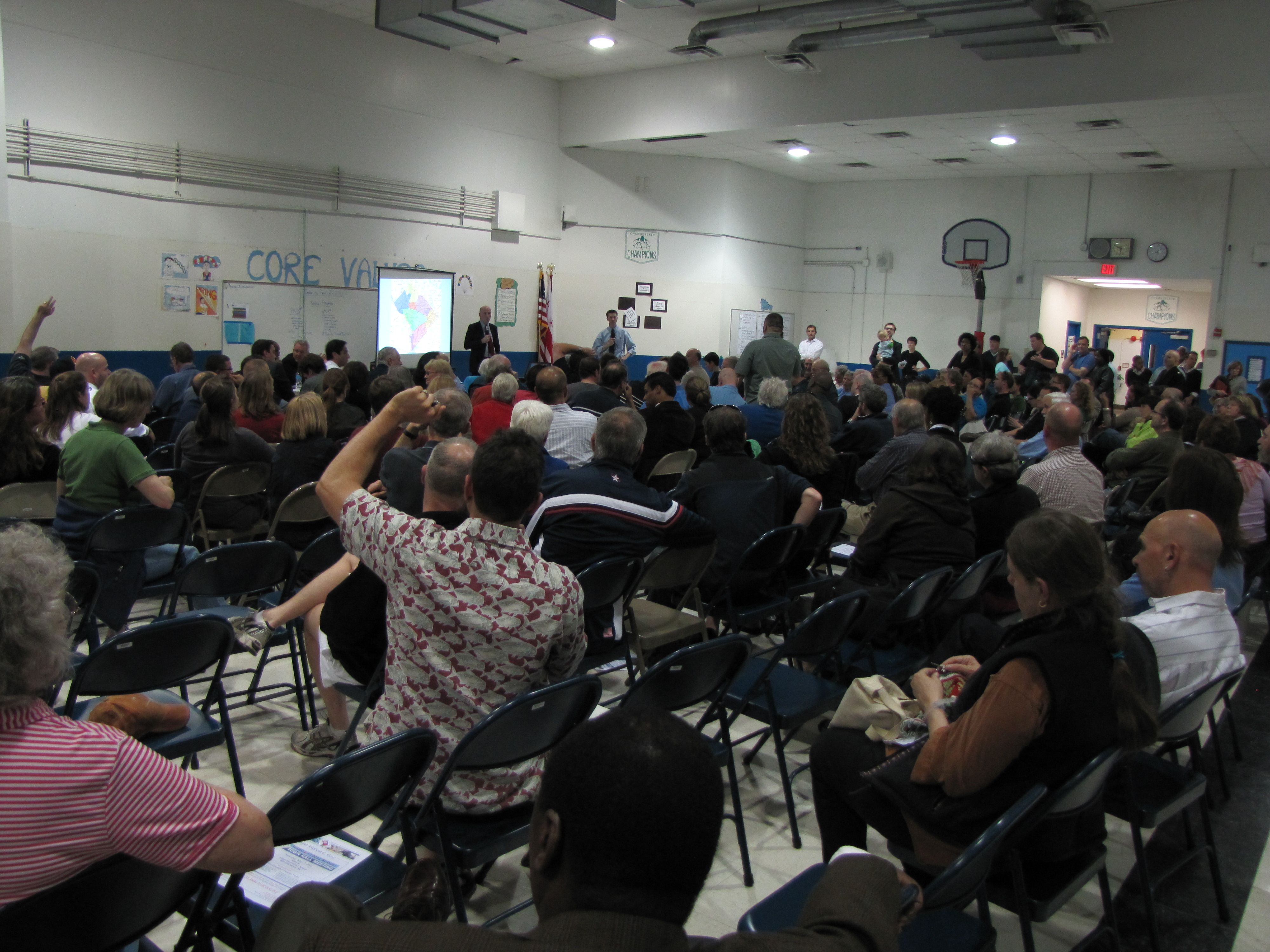
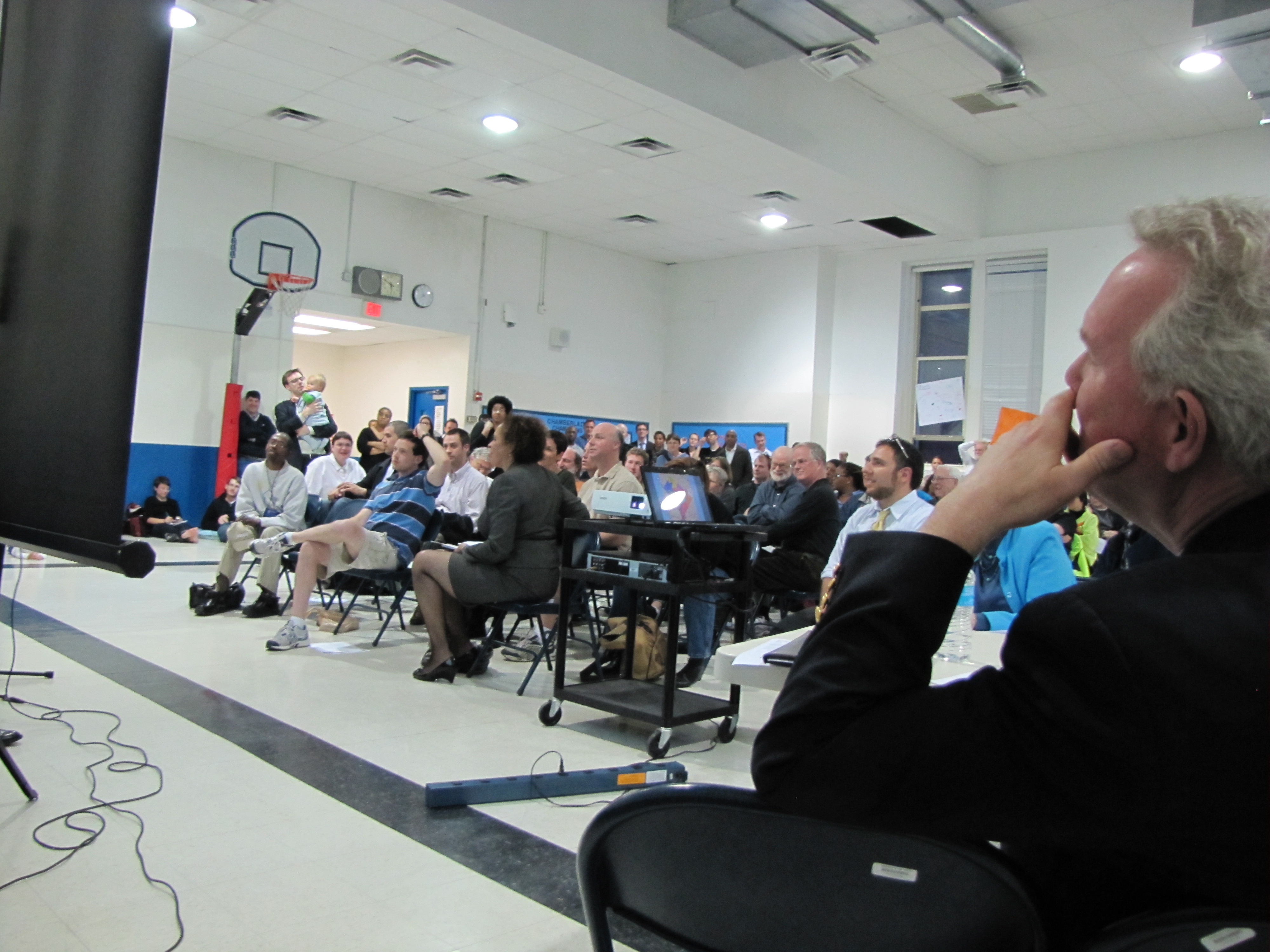
Councilmember Wells at Thursday Night's MeetingCouncilmember Mendelson Takes Questions from Ward Six Democrats

Councilmember Phil Mendelson Hints Redistricting Will Come at Expense of Ward Six

by Larry Janezich

DC Redistricting Committee Member and Councilmember At Large Phil Mendelson told a crowd of over 250 Ward Six Democrats Thursday night that “it’s impossible to do redistricting without making some people unhappy.”  He went on to note that reducing the size of Wards Two and Six would upset the fewest number of people.

He said the Redistricting Committee is faced with either equalizing the ward populations or achieving redistricting with the least amount of disruption.  He said his goal was to “equalize the populations, but that doesn’t mean change will be radical enough to accomplish that.”

Under federal law, wards must be redrawn every ten years.  The goals are that they be compact and contiguous and approximately equal in size within plus or minus 5%

The 2010 Census revealed that Ward 2 has to come down at least 939, Ward Seven has to come up at least 387, and Ward 8 has to come up at least 743.  Technically, Ward Six is within 5% of the average and – all things being equal – would not have to change.  But it has population to spare and is next to wards seven and eight which need population.

The City Council has until July 2011 to produce a new Ward boundary map and has until the end of 2011 to approve new Advisory Neighborhood Commission (ANC) and Single Member District (SMD) boundary maps.

The Redistricting Committee, comprised of Councilmembers Michael Brown, Jack Evans and Phil Mendelson, will propose a new ward map in the next few weeks – maybe by the end of May.  The Committee will hold a hearing on the new map and the Council will vote sometime in June to make any changes to the committee plan, with a final vote in late June or early July.

Thursday night’s meeting at Friendship Public Charter School was hosted by Ward Six Democrats to allow residents to voice their concerns on the redistricting issue.  The meeting’s organizers invited the three members of the Redistricting Committee and Councilmember Tommy Wells.  Only Mendelson and Wells appeared.

Wells told those attending that the guiding principle for redistricting is that “we have to keep contiguous neighborhoods together.”  He told this reporter that “Penn Quarter is on the table,” but he would otherwise “absolutely” vote against any legislation to reduce the size of Ward Six.   Wells would like to broker a deal and give Ward Six’s portion of Penn Quarter to Ward 2, setting up a domino effect that would subsequently increase the size of Wards 5, 7, and 8, leaving all wards with the right numbers.

He told the crowd that “this is not about parking stickers or personalities, but why one ward is working so well.”  He cited Ward Six’s renaissance in schools, its highly effective ANC’s, the amount of development, the families working together, and the ward’s broad diversity. Regarding development, he noted “you can’t have remote ANC’s making decisions affecting” the heart of Ward Six.  “That’s another reason we can’t be Balkanized.”

He told the crowd, “[y]ou have power – beyond phone calls and email.  Make sure – especially the at large members – know how you feel and why.”  The at large councilmembers are Redistricting Committee members Michael Brown and Phil Mendelson and Councilmembers David Catania and Vincent Orange.

Questions from the audience revealed concerns about the impact of redistricting on schools, the historic district, and parking.  Mendelson said that school and historic districts would be unaffected by any changes.  Regarding parking, he said he will propose to the Chair of the Transportation Committee Chair Tommy Wells, that current parking zones be maintained regardless of any ward changes brought about by redistricting.

7 Comments

Filed under Uncategorized

Historic Review Board Gives Partial Approval to Hine Project – Delays Consideration of Height and Massing Issues

Historic Review Board Gives Partial Approval to Hine Project – Delays Consideration of Height and Massing Issues

by Larry Janezich

HPRB met on Thursday to review Stanton Eastbanc’s Hine project and – while approving the basic site plan and the general architectural direction of the project – deferred consideration of the all-important height and massing issues until next month.  Chair Catherine Buell noted these issues are complex and will be addressed building by building.

More than a dozen residents – some representing community groups and some representing themselves – testified against aspects of the Hine project.

The two community organizations which appeared to have the most sway with the Board were ANC6B, represented by ANC Vice Chair Ivan Frishberg, and the Capitol Hill Restoration Society, represented by Shauna Holmes.  Each raised similar objections regarding height and historic compatibility, particularly with the two buildings fronting on Pennsylvania Avenue and D Street.  These objections were in opposition to the staff report of Historic Preservation Office, which looked more kindly on the two buildings.

Frishberg noted that the two buildings should be a distinctive landmark evocative of Capitol Hill and failed to achieve that.  He singled out the 8th andD Street building in particular, saying it does not reflect character of Capitol Hill, is too tall and has an “unrelenting quality.”

Regarding the 7th and Pennsylvania building, Holmes said, “exclamation points are fine – shouting with exclamation points is not.”  She went on to urge reconsideration of the 8th and D building as failing to convey anything other than associations withSouthwest DC.

Holmes also urged HPRB to convene a group meeting of major stakeholders including DDOT, Office of Planning, ANC6B, EMCAC, Market Row,Barracks Row Main Street, andCHRSto provide project input and insure that the proposal is the best that can be done.

Other community organizations testifying included EMMCA, Eyes on Hine, and the 200 block of 8th Street Coalition.  All raised concerns with the project’s height and massing.

Steve Callcott, representing the Historic Preservation Office (HPO), appeared to have become more critical of the project than the HPO staff report published last week indicated.

In his remarks to the Board, he said he was unconvinced that the design of the north residential building was appropriate for the location.  He said he was comfortable with the architectural direction of the 8th Street residential building, suggesting only a variation in the building’s roofline.  However, Callcott went beyond the staff report on the 8th and D Street Building, saying now that it is “very important to address the architectural direction of the building to make sure it was headed in the right direction.”  He noted that HPO had been more optimistic about the building in its report but recognized that there were clearly concerns about the height and architecture.

While recognizing the call of the ANC and CHRS for reduction in height of the 7th Street and Pennsylvania Avenue office building, he said he stood by the HPO assessment that a taller building in this location is compatible with the character of the Historic District.  He said that a softer resolution of the issue of the appearance of the building’s height involving recessing the top floors of the building could be achieved.  Finally, he noted that the architectural direction for the 7th Street office building and the 7th Street residential building have “not been accomplished” and the buildings “have not achieved a sense of place yet,” and would receive further review.  He concluded that he thought the project was largely supportable but the reality is that it still needs a lot of work.

Chair Catherine Buell noted that the majority of comments and concerns raised by community groups and members could be addressed by staff as they work with the architect in light of the views of ANC6b and the CHRS.

Board Member’s reception of the community comments varied.  Board Member Christopher Landis seemed most in agreement with the ANC and CHRSreports encouraging HPO staff to work with architect and with these reports to “move in that direction.”  Chair Catherine Buell said “I’m not a fan of the 8th and D Street building, it is too big, needs to step down, and change design.”  Also, “the building across from the north plaza needs to be rethought as well.” Board Member Pamela Scott seemed to give an uncritical endorsement of the project, saying “the entire design is a very positive addition to Capitol Hill.”

The vote to approve the basic site plan and the architectural direction was 5-0 with Chair Catherine Buell, Maria Casarella, Pamela Scott, Joseph Taylor, and Christopher Landis voting to approve.  Board Member Tersh Boasberg has recused himself from this case.

Members of the community who had testified seemed pleased that their comments appeared to be taken seriously by the Board.  One commenter characterized the feeling as “cautiously optimistic” that the effort would result in positive changes from the community’s point of view.

The concept drawings will undergo revision in the weeks ahead, and these revisions will be considered by the Board in a May meeting to address the project’s height and massing issues.  That will likely be followed by another hearing – probably in June – to review all the changes to date in the project.  Following that meeting, if the Board signs off on the project, the developer can file for Planned Unit Development status and the project will go before the Zoning Commission.  Community members and community organizations will have another opportunity to effect changes on the project and everything will be on the table – not only design elements, but usage issues.  That process is not likely to begin until early next year.

8 Comments

Filed under Uncategorized

ANC6B Joins Others in Criticizing Stanton-Eastbanc Hine Project – Historic Preservation Board Meets on Project Thursday

Community Members At ANC6B Special Call Meeting on Hine

ANC6B Joins Others in Criticizing Stanton-Eastbanc Hine Project – Historic Preservation Board Meets on Project Thursday

by Larry Janezich

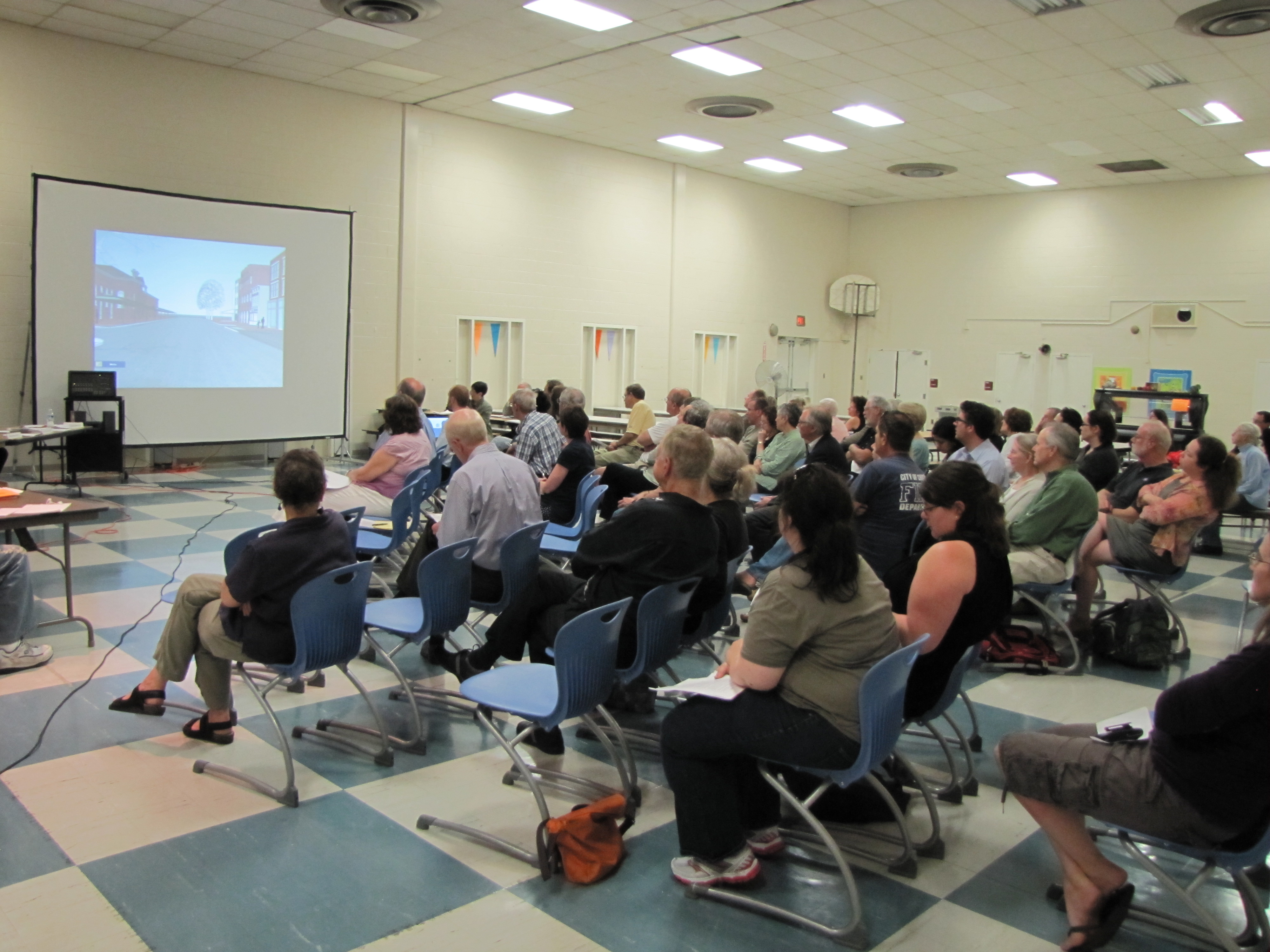
Tuesday night’s ANC6B Special Call meeting on the Hine project started at6:30 p.m.with more than 50 Capitol Hill residents, but there weren’t many of them left four hours later at meeting’s end.

The ANC hammered out a resolution of recommendations on the Hine project which it will present in testimony before the Historic Preservation Review Board which meets today (Thursday) at 2:15 p.m. to review the historical preservation aspects of the project.

The resolution states that the ANC supports the overall density and proportion of the project.  However, the ANC takes issue with specific aspects of each of the four units making up the project:

8th Street Residential Building

The resolution recommends the developer reduce the height of the 8th Street residential building, a goal long sought by the nearby residents.  In addition, the measure emphasizes that the ANC supports reserving the large interior courtyard as public space, and states that if the developer sticks with the current plan of keeping it private, it should shrink in size and be used to reduce the height and mass of the building.

North Residential Building

The resolution expresses the ANC’s vague discomfort with the height, scale, design façade, and streetscape of the North residential building, hinting that things aren’t quire right, but failing to make any recommendation regarding the height of the center portion, that issue being important to nearby neighbors.  The resolution holds open the possibility that this use-driven issue (mandated by 33 affordable housing units in the structure) could be addressed later in the process.

8th and D Residential and 7th and Pennsylvania Office Buildings.

The residential building at 8th and D Streets “does not reflect the character of the neighborhood.”  It’s “too blocky” and “too tall.”  And it needs to be considered in connection with its partner facing Pennsylvania Avenue, the 7th andPennsylvania Avenue office building.

The design of the latter, the resolution states “does not meet the demands of such a promising location.”  The resolution says, “[a]n absolute reduction in height is essential” – and recommends reducing the 106 foot high roofline by ten feet.

Further, it calls for reconsideration of the scale, height, and façade of both the buildings.

7th Street Mixed Use Building.

The resolution states more work is needed – especially in the façade design.

The resolution recommends that the developer 1) reduce the massing and height of the overall development by placing the mechanical rooms underground or inside the building, 2) expand underground retail, and 3) requests the developer to provide a three dimensional site contextual model for the project.

Nearby residents wanted language requiring usage to include services to children and barring retail from the 8th Street residential building.  Both of these proposals were defeated on procedural grounds that this resolution for the HPRB was not the appropriate vehicle for them.

Overall, most efforts to weaken the resolution were unsuccessful.

One effort to weaken it was successful – an amendment by Commissioner Garrison – removed language meant to address the height of the 7th Street façade.  Some commissioners, who supported resolution language addressing the issue, voted for Garrison’s motion to strike the language, apparently in the belief that this would help move the Commission toward unanimous adoption of the measure.  The motion to strike was agreed to, only to have Garrison and his two voting companions oppose the resolution on final passage.  Consequently, the resolution does not address the issue of height on 7th Street which a 2009 ANC6B vote limited to no more than 50 feet.

In the end, the resolution passed on 6-3 vote, with ANC6B Chair Glick, and Commissioners Campbell, Frishberg, Pate, Flahaven, and Critchfield voting for it.  Commissioners Garrison, Oldenburg, and Metzger voted no.

Live coverage of the HPRB hearing may be viewed at the following link:

http://planning.dc.gov/DC/Planning/Historic+Preservation/About+HPO+&+HPRB/Who+We+Are/Historic+Preservation+Review+Board/Video+Broadcast

Comments Off on ANC6B Joins Others in Criticizing Stanton-Eastbanc Hine Project – Historic Preservation Board Meets on Project Thursday

Filed under Uncategorized

Three Member Voting Bloc on ANC 6B Frustrates Unanimity on Hine: ANC 6B Passes Recommendation on Hine to HPRB on 6 – 3 Vote

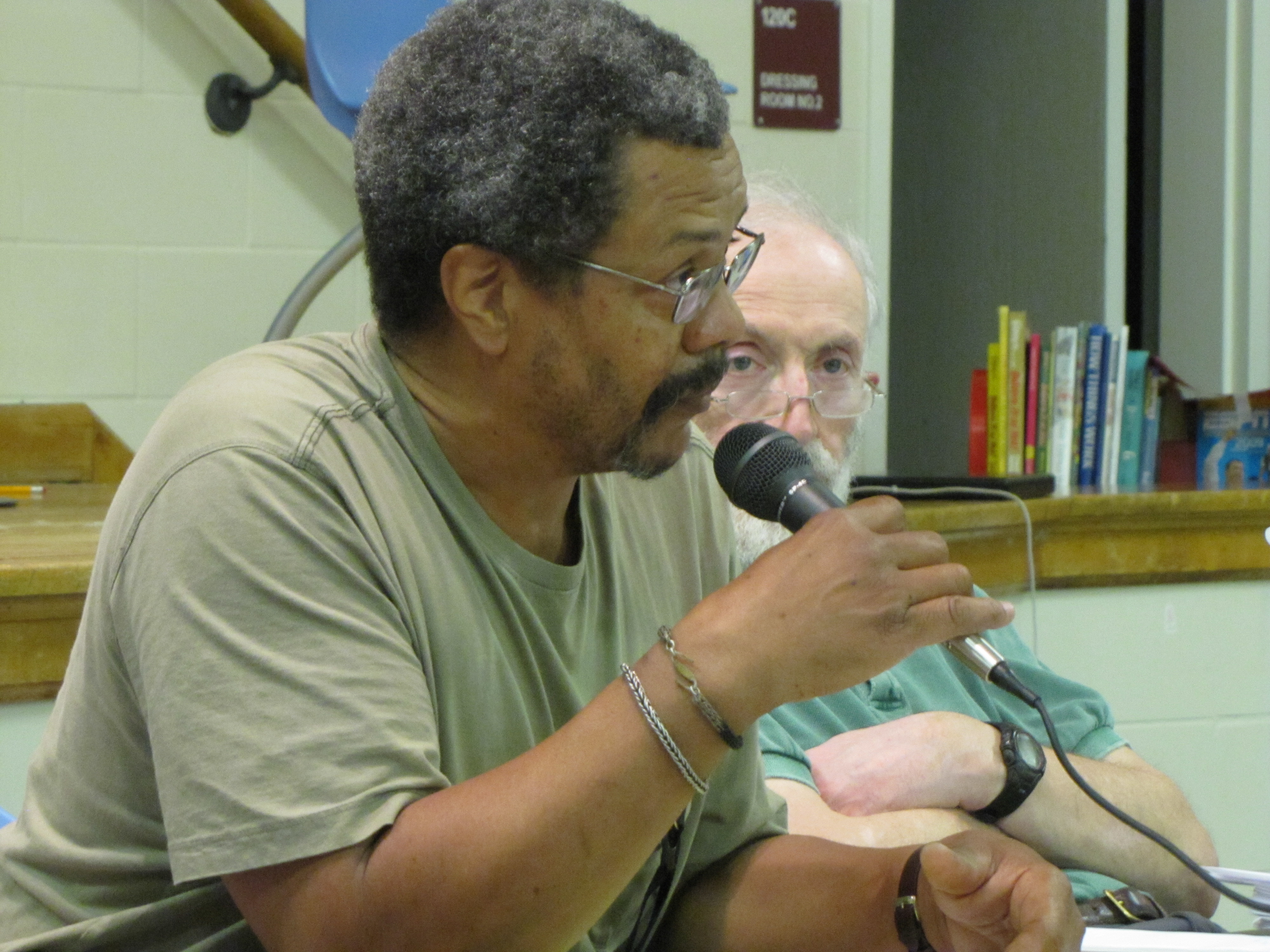
Resolution Supporter Commissioner Francis Campbell, ANC Planning and Zoning Committee Chair

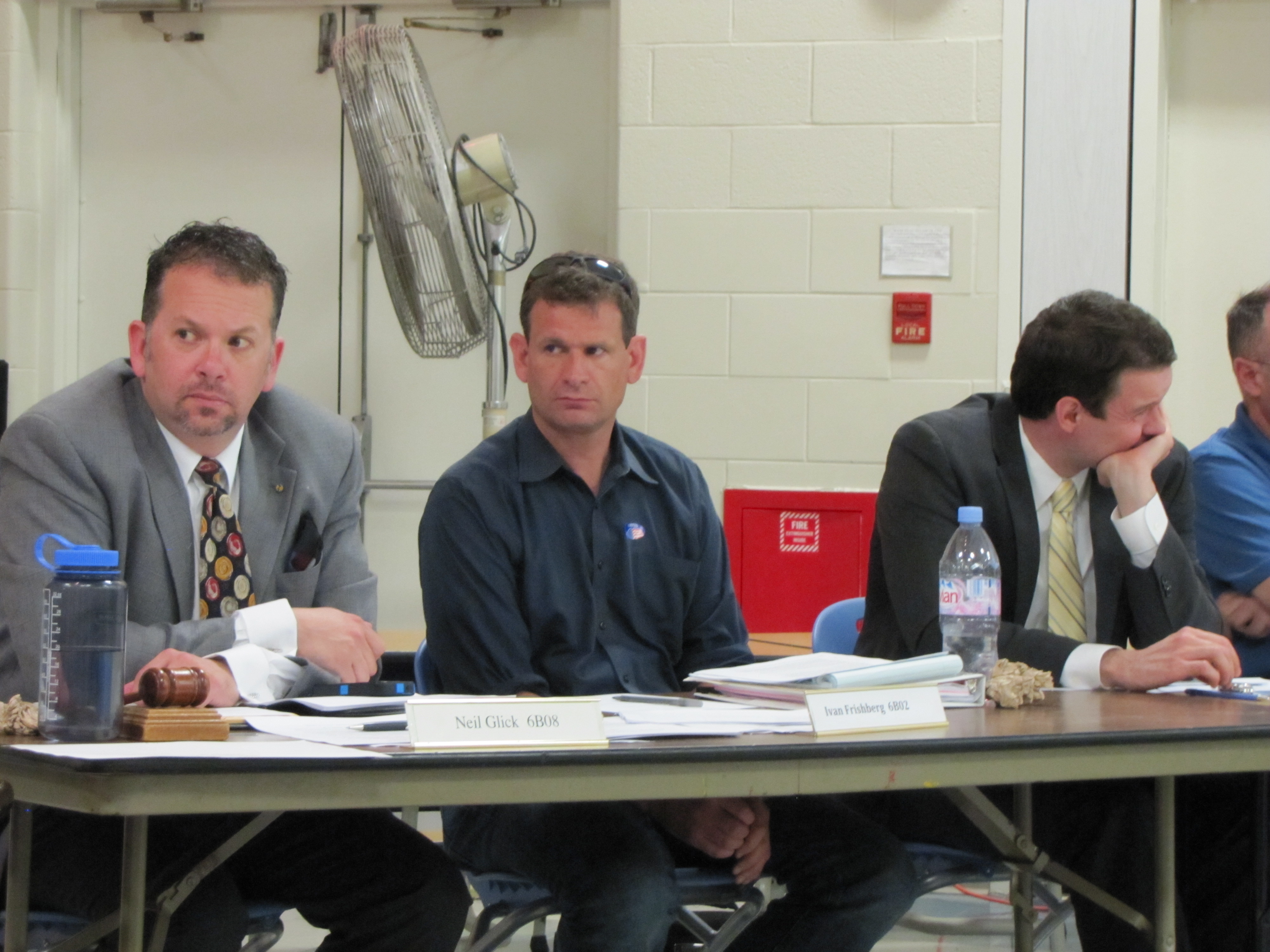
Resolution Supporters Glick, Frishberg and Flahaven Before the Vote

Three Member Voting Bloc on ANC 6B Frustrates Unanimity on Hine:  ANC 6B Passes Recommendation on Hine to HPRB on 6 – 3 Vote

by Larry Janezich

In a long and sometimes contentious meeting last night at Brent Elementary school, ANC 6B voted 6-3 to pass a lengthy document communicating its recommendations on the Hine project to the Historic Preservation Review Board.  The Board will meet to review the project tomorrow (Thursday, April 28).

Voting against the resolution were Commissioners Garrison, Oldenburg, and Metzger.

Voting for the Resolution:  ANC6b Chair Glick, Commissioners Campbell, Frishberg, Pate, Critchfield and Flahaven.

The result and lack of unanimity came as a bitter disappointment to several Commissioners who had worked to forge a document which they hoped would receive the support of the entire commission.

One Commissioner, Ivan Frishberg, expressed his dismay that he had spent three hours with Garrison, Oldenburg, and Metzger on Easter Sunday attempting to assuage their concerns and produce a workable compromise.  A commissioner noted that a draft of the entire resolution had been out there for ten days, and noted that Commissioner Oldenburg had only submitted written comments 12 hours ago.

Commissioner Brian Pate also expressed his disappointment, noting the amount of effort that had gone into attempting to reach a compromise, and the Commission’s success at “staving off inappropriate amendments.”  Other Commissioners proposed amendments that did not pass, like Francis Campbell, but they nevertheless voted for the final product. Campbell said the project was too big and needs to go back to the drawing board for more refinement and he was not happy in any “way, shape, or form” with the project.

The minority voting bloc engineered many changes to the document and met with success on more than half of the amendments they offered, but nevertheless they decided vote against it in the end.

Commissioner Brian Flahaven said the resolution was “not my ideal,” but that he would support it in the spirit of compromise, given the time, the number of communications, and the energy that had gone into the effort.  He said that he would “focus on the things that he liked in the resolution, instead of the things he didn’t like.”

Garrison, in contrast, said though the resolution had been improved, “in the end, there are still aspects in the resolution I do not agree with.”  Metzger said the resolution had not been changed to the point where he could support it.  Oldenburg, who had offered the greatest number of successful amendments said, “the resolution doesn’t represent what my constituents tell me,” and declared her opposition to it.  Many of her amendments seemed to be favorable to the developer, or – as she admitted – were “cribbed from the Restoration Society recommendation.”  It was not otherwise clear which constituents she was referring to.

As a result, last night’s lengthy meeting thus resulted in what was in many ways a watered down document which still will not be presented to the city with the authority of a unanimous ANC vote.

A final copy of the Resolution can be viewed here:  http://www.anc6b.org/library.html

1 Comment

Filed under Uncategorized

HPO Staff Issues Report Favorable to Hine Developer – Statement Places HPO at Odds with Community Sentiment

HPO Staff Issues Report Favorable to Hine Developer – Statement Places HPO at Odds with Community Sentiment

by Larry Janezich

Friday afternoon, the staff of the Historical Preservation Office (HPO) posted its report and recommendation to the Historic Preservation Review Board (HPRB) on the Hine Project.  The report amounted to a tepid endorsement of the project.  As such it is at odds or with the four community organizations most involved and affected by the development:  EMMCA, Eyes on Hine (EOH), CHRSand a group of 8th Street residents.

The developer, Stanton-Eastbanc, is represented by architect Amy Weinstein and seeks conceptual design approval by the HPRB for the Hine Project.  Weinstein is a former member of the HPRB (a board of that is informed by, but not beholden to, the HPO staff).

The HPO report provided details which have not been obvious to community members trying to analyze the drawings provided by the developer.  For example, the report lists the maximum heights of the buildings as follows:  North Residential Building, 48 feet; 8th Street Residential Building, 35 to 48 feet; 8th and D Corner Building, 63 feet; Pennsylvania Avenue Office Building, 88 feet; and the Plaza Residential Building, 58 feet.

Another detail not heretofore appreciated is that the loading dock accessed from 7th Street will apparently be visible from the street: “the conceptual direction is … to recess the loading dock considerably back from the building face to minimize its visibility.”

The report evaluates the project regarding three critical elements:  the site plan, the general architectural direction, and the overall height and massing.

The report finds the conceptual site plan is consistent with established patterns in the Capitol Hill Historic District.  This finding is at odds with the public statements of the aforementioned community groups as well as the DRAFT ANC6b statement on Hine.

The report finds the overall architectural direction of the project consistent with the Board’s design principles for new construction.  While avoiding superlatives, the staff takes the criticism of community groups head on, saying “the project reinterprets the character of the historic district in creative and often whimsical ways.”

It does recommend the architectural direction of the North residential Building be reconsidered, questioning the whether the central core of the building is an appropriate design model.  As for other components to the project, the report states only that “implying depth and providing shadow to the skin of the 8th and D Corner Building will be particularly important for this design,” and notes that the 7th Street elevation remains too preliminary to comment on.

The report finds that the overall height and massing of the 8th Street residential building is compatible with the surrounding residential blocks.  Although thePennsylvaniaAvenueOfficeBuilding will be the tallest building on the Avenue, that “doesn’t necessarily mean that it will be incompatible with the Historic District …additional height in this location is not inappropriate” provided certain refinements be adopted.  Among these, the report recommends setting the top floor back from the façade plane, eliminating the vertical masonry projection on Pennsylvania Avenue, and scaling down the height of the ground level storefronts.

The report was most critical of the penthouses, urging minimizing of the penthouse levels by moving the amenity spaces inside the building,

Overall, the staff report recommends approval of the general site plan, approval of the general architectural direction, each with further study in the areas noted above.

The report recommends the approval of the height and massing for the various buildings, with further study of the Pennsylvania Avenue Office Building and the penthouses.

It is unclear what weight the HPRB will give to the HPO staff report, and whether and to what extent the views of the various community groups will be considered by the Board when it meets next Thursday.

The webpage with the documents for the April hearing is here: http://planning.dc.gov/DC/Planning/Historic+Preservation/Plans+and+Reports/Project+Reports+and+Actions/HPRB+Reports/HPRB+Meeting+and+Hearings,+April+28,+2011

3 Comments

Filed under Uncategorized

Neighbors Detail Objections to Hine Project in Letter to HPRB

April 19, 2011

Ms. Catherine Buell, Chairperson

Historic Preservation Review Board

Office of Planning,District of Columbia

1100 4th Street, SW, Suite E650

Washington,DC20024

Dear Ms. Buell:

We write on behalf of a coalition of over a dozen households on the 300 block of8th Street, S.E., across the street from the proposed Hine School Development Project. Although we support mixed-use development for theHineSchoolsite, we believe that the current Stanton-Eastbanc design exceeds reasonable limits for the height, massing, and proportion for new construction within a historic neighborhood and that such radical disharmony threatens to undermine the surrounding neighborhood’s cultural and historical integrity. We are united in calling for a project more compatible with the neighborhood’s established character and residential nature.

This letter focuses specifically on the concept design for the proposed residential building bounded by the 700 block ofD Street, 300 block of 8th Street, and the 700 block of the reopenedC Street, S.E.(hereafter called “8thStreetResidentialBuilding”). We raise three concerns about that structure: (a) its elevation and massing; (b) its disharmony with the scale and style of the historic neighborhood, including setbacks, rooflines, and facades; and (c) the proposed commercial use at theD Streetend of the building, a factor influencing its design.  

Because comprehending the massing and scale of the entire Hine School development relative to surrounding structures will be essential to informed community input about this important project, we also urge HPRB to support our request (made repeatedly to the developers over the last two months) for a site context model. 

Elevation and Massing

To paraphrase Frank Lloyd Wright, Capitol Hill was “born rather than built.” The amalgam of architectural styles and historical eras, from the farmhouses of the early 1800s to the bungalows and Wardmans of the twentieth century, gives Capitol Hill its charm, its romance. The modest proportions and human scale of the older buildings and diversity of visual experience, like the diversity of our neighborhood, draw new residents and thousands of tourists every year. As the DC Comprehensive Plan states, “The community’s attractive housing stock, living history, low scale, and proximity to the U.S. Capitol make ‘the Hill’ one of the District’s most celebrated and attractive communities.”

The houses on the block across from the proposed 8th Street Residential  Building range along the spectrum of typical Hill designs, reflecting the area’s architectural evolution. Two pre-Civil War frame farmhouses, three Victorian townhouses, three houses built together in 1899 and retaining their original facades, front stairs, and fences, Barrett Linde townhouses constructed after World War II, and in the alley at back, surviving frame carriage houses, all present in a microcosm the eclectic variety that gives Capitol Hill its charm and attractiveness. None of the houses exceeds three stories; most of them present modest, unpretentious faces to the street. 

The developer’s current design calls for a structure far out of proportion to its surroundings. The 8thStreetResidentialBuildingwould present a massive, continuous, unbroken facade, looming dozens of feet and several stories over the facing structures in the 300 and 200 blocks. The current design soars almost six stories alongD Street, and up five stories in an “apartment building entrance” mid-block, further mocking the more modestly scaled houses on the east side. Such an inappropriate design would degrade the nature and feel of a street that currently serves as a pleasant “gateway” to residential neighborhoods to the north, its canopy of trees and colorful gardens offering an inviting alternative to the bustling retail and restaurant activity to the south.

To justify the proposed height and massing of the 8thStreetResidentialBuilding, the architect has shown photographs of multi-family buildings elsewhere on Capitol Hill, yet each example featured a five- or six-story building surrounded by two-story and three-story rowhouses. No example filled an entire block; instead, the adjacent lower rowhouses stretched for the majority of those blocks, preserving a modest scale more characteristic of the Hill. 

To follow the design principles articulated for DC “New Construction in Historic Districts,” the Stanton-Eastbanc building’s scale should respect “the prevailing scale of its neighbors,” “existing building heights,” “the massing of neighboring historic buildings,” “the rhythm of its neighbors as well as that of the street,” and “the existing proportions of neighboring buildings.”

Four stories (or the 40-foot height limit comporting to current R-4 residential zoning along8th Street) should be the maximum height for the entire8th Street ResidentialBuilding, including the southeast (D Street) and northeast (C Street) sides and the proposed apartment entrance mid-block.

Setbacks, Rooflines, and Harmony

DC “New Construction in Historic Districts” design principles also state that “the roof shape of a new building should respect those of its neighbors.” Roof shapes along the 200 and 300 blocks of8th Street(as well as surrounding residential blocks) vary considerably. Corner towers and articulated parapets alternate with flat roofs. The dominant anchor buildings surrounding the proposed development include the gabled and turreted Grace Church condominiums, gabled Southeast Public Library, gabled Eastern Market building, and pleasant corner roofline of the Haines department store building.

As currently designed, the8th StreetResidential Building frontage would stretch unbroken fromD Streetto the restoredC Street, with flat rooflines and flat frontages. Far from offering variation to this monolithic stretch along8th Street, the exaggerated and raised mid-block apartment entrance suggests a design out of harmony with theneighborhood and merely serves to exaggerate the development’s massiveness.

Variation in height and roofline are essential elements of Capitol Hill’s residential character. If the 8thStreetResidentialBuildingis to respect that character, then its rooflines and setbacks should be more varied. Rather than pushing up an additional story, for example, the mid-block apartment entrance might be lowered and pushed back into the property, with a suitable streetside garden, thereby creating an inviting open, green space and echoing the current school entrance.

 At present, there is varying and wide setback of city-owned land on the east side of 8th Street, and the current public land on the west (school) side stretches even further.

These varied setbacks of the currentHineSchool, combined with the playground and unpaved areas, have provided open spaces in the neighborhood for almost half a century, making the street a spacious, reassuring entryway to Eastern Market and the residences to the north. The massive size and scale of the entire Hine Development demands deeper, more varied setbacks in order to avoid a starkly institutional visual impression out of harmony with its residential setting.

 The current Hine Development Project concept appears to exhibit a flagrant disregard for elements explicitly encouraged in the DC Comprehensive Plan, such as establishing gradual transitions between large-scale development and nearby lower, smaller buildings like single family or row houses [Policy UD-2.2.4], avoiding monolithic or box-like building forms or long blank walls which detract from the human quality of the street [Policy UD-2.2.5], complementing the established rhythm of existing and adjacent facades [Policy UD-2.2.6], avoiding overpowering contrasts of scale, height and density [Policy UD-2.2.7], and breaking large structures into smaller, more varied forms to “reduce harsh contrasts and improve compatibility” with adjacent structures and neighborhoods [Policy UD-2.2.8]. Policy UD-2.2.9 encourages protection of neighborhood open space. In the case of the current design, the only open space remaining would be a gated courtyard and garden reserved for Stanton-Eastbanc tenants.

Residential Use

To retain the residential integrity of the neighborhood, we oppose any commercial or retail operations in the portion of the8th StreetResidential Building fronting along D Street. Insinuation of retail, office, or restaurant uses into a neighborhood that has historically been residential would threaten not merely the character of the 300 block of 8th Street but of other surrounding residential blocks.

 The developer has used a proposed commercial use to justify inappropriate “storefront-style” window openings (or features that could be adapted to be storefront windows) in the tall, modernist building facade along the 700 block ofD Street. Such design seems in jarring disharmony with the surrounding neighborhood and a serious threat to maintaining residential uses along 8th Street.

History of the Neighborhood

Section 101.2 of the DC Historic Protection Act notes the expressed purpose, among other goals, of safeguarding “the city’s historic, aesthetic and cultural heritage.” Policy HP-1.1.2 explicitly calls on decisionmakers to adopt an “encompassing approach to historic significance,” recognizing social as well as architectural history, neighborhoods as well as individual buildings, the representative structures as well as the “exceptional.”

The developers of the Hine project are fond of referring to three- and four-story Victorian-era houses built to signal an owner’s prominence and wealth, but Capitol Hill history also rests on the middle class, on the skilled tradesmen who worked at the Navy Yard, on the journalists, grocers, and schoolteachers who grew up in more modest two-story dwellings built in the late 1900s, and the federal workers who purchased the post-World War II townhouses. A “multitude of citizens both famous and ordinary” have made Capitol Hill their home and, per HP-1.1.3, “historic preservation should bear witness to the contributions of all these people,” and to their homes and neighborhoods.

The plot of public land on which the Hine School Development would be built has historically been either Native American campground, farmland, residences, or schools. Previous public buildings on theblock–WallachSchool, Victorian-era Hine School, and the current Hine School–all occupied less than half the block at the time, leaving open space for surrounding residents. After construction of the current school, open spaces designated for sports activities like tennis and basketball (areas now converted to parking and flea market) occupied the other half of the block. The existing Hine buildings provide pedestrians with views of Eastern Market. For the first time in history, if the Stanton-Eastbanc design is approved, no open space on theHineSchool block will be accessible to the entire neighborhood. Instead of a public playground or park, Stanton-Eastbanc’s gated inner courtyard and mid-block “garden” would be for private use by its tenants.

Additional Concerns

Although certain additional concerns are traditionally part of the PUD or zoning review, we believe that they are intimately related to the impact created by a development of the proposed size and scale in this residential neighborhood.

a. The Negative Impact of Increasing Density in an Already Dense Neighborhood.

The “feel” of our historic neighborhood is established in part by its two- and threestory rowhouses, and in part by how the neighborhood is used.Lotsize, height, and other building restrictions have preserved the pleasant human scale of tree-lined Capitol Hill streets. A monolithic development will add an influx of people and traffic comparable to that of busy downtown blocks. Increased density is an historic preservation issue. Encouraging and enabling vastly increased private passenger, truck, and trash vehicle traffic will dramatically exacerbate the current density and, in the added burden of vibration and pollution, threaten the integrity of surrounding historic structures.

District of Columbiaplanners acknowledge the neighborhood unity of Capitol Hill, calling it a “city within the city,” with urban streetscapes of a scale that continually evokes a sense of its varied history, with successive blocks of well maintained yards and structures, and pleasant variation and occasional whimsical architectural features. In various public meetings, the Hine Project developers have justified their proposed height and massing as necessary to achieve “smart growth,” but that, in fact, is a phrase better applied to stopping suburban sprawl. It is a justification inappropriately applied to a neighborhood which is already a model of density and smart urban living, with the three R’s (residences, retail, restaurants) within walking distance of public transportation options (Metro, buses, Circulator, bicycles, taxis, and pedicabs). Neighborhood residents already leave their cars at home. Moreover, recent studies now show that simply increasing urban density for the sake of densification does not necessarily produce the promised environmental reward. Individuals in the new Hine Development apartments may leave their cars in the garage but the increased concentration of vehicular traffic, congestion, vibration, and pollution created by an inappropriately dense complex—imposed upon an already dense neighborhood—will have a serious detrimental impact on the health of residents and pedestrians and on the integrity of adjacent historic structures.

b. The Need for More Comprehensive Traffic Analysis at the Design Phase. Swift passage of emergency vehicles along8th Streetis essential to the public health and safety of residents to the north of the proposed development. At our first meeting with developers and their traffic consultant in February, residents noticed that the traffic studies had not accounted for the greatly increased congestion, exacerbated by closure of streets surrounding the Capitol, already occurring on Saturday mornings and Sunday afternoons, or during major sports events at Nationals and RFK stadiums or events on the Mall.

 Although we understand the impulse to reopenC Streetas part of an overall restoration of the L’Enfant plan, two aspects of its reopening will have a potentially adverse effect on the surrounding neighborhood: the proposal that the block be open to vehicular traffic and the selection ofC Street(rather than either7th Streetor Pennsylvania Avenue) as the parking garage entrance/exit for passenger vehicles.

Increased vehicular congestion at the intersection of C and 8th Streets will pose a potentially serious threat to pedestrians, to normal traffic flow along8th Street, and to efficient and rapid transit of emergency vehicles. Because the selection of garage entrances/exits are an essential aspect of the overall concept, we have called for more detailed “24/7” traffic studies and projections during the design phase.

c. Environmentally Responsible Development. We believe the Hine Development project should embody the ideals of environmental sustainability, aiming at the highest standards of “green” demolition, construction, design, and use, without destroying or degrading the surrounding neighborhood. Environmental quality, however, also encompasses such seemingly subtle assaults on the public health as noise. Eighth Street serves as a major route for emergency vehicles, with sirens screaming during rush hours or other times of increased congestion such as Saturday mornings. We are especially concerned that an unbroken facade on the 8th Street Residential Building would raise noise levels, both normal and peak, to unacceptable and unhealthy levels at street level, for residents and pedestrians alike. Attention during the design phase to the unintended consequences of the development’s streetscape and facade may help to avoid future public health problems.

Historic Preservation and Accommodating to Change

The concerns we raise are not new to historic preservation and urban planning discussions. During 2005 and 2006 DC Comprehensive Plan workshops, Capitol Hill residents explicitly mentioned the potentially negative effects of unrestrained growth “on quality of life and community character,” the encroachment of non-residential uses into rowhouse neighborhoods, development that threatened the architectural integrity of Eastern Market, and infill development incompatible with the prevailing density and architectural fabric of the surrounding community [Section 1507.2]. And they urged “that any future development on surplus public property should conform to the prevailing density and architectural fabric of the surrounding community,” and expressed “particular interest in retaining row houses and building new row houses to keep the Hill an attractive place for families.” In a February 12, 2008 resolution, ANC6B stated that the “Hine site is a key location at the heart of the Capitol Hill neighborhood” and therefore “any future use of the site [should] match the scale and character of the surrounding neighborhood,” and on June 30, 2009, ANC6B reaffirmed that the development project should “blend in with the surrounding historic district” and “avoid design approaches that may dominate or overwhelm the surrounding blocks.”

At the time of the 2005/2006 community meetings, Capitol Hill was already in the “vice grip” of development occurring in NoMA and the Near Southeast Waterfront and Stadium areas. Today, that construction has generated the predicted economic success but it has also increased traffic and demand for community services. Although the Hill has evolved and endured over two centuries, our neighborhood, as noted in the Comprehensive Plan, “remains fragile and vulnerable to change.”

In closing, we believe that the current concept design for the Hine ProjectDevelopment is not compatible with, does not harmonize with, and potentially threatens the historic character of the neighborhood surrounding Eastern Market and the Capitol Hill Historic District. The massive, block-sized building plan evokes corporate standardization, anonymity and conformity, rather than the historical traditionalism that characterizes this neighborhood now. We also support the concerns raised by neighborsin the 200 block of 8th Street and by the Eastern Market Metro Community Association.

Throughout discussions with the developers, our criticisms have often been met with a claim that economic growth and a desire for density around public transportation hubs should trump any concern for maintaining the character of a historic district, a dichotomy that we believe is spurious because the residential neighborhood surrounding

Eastern Market is already a model of reasonable urban density, a walkable, pedestrian friendly place where nearby residents leave their cars at home. We support the DC government’s effort to spur economic development and to bring jobs and affordable housing to District residents, but at one recent meeting, a neighbor asked, “At what point does unconsidered ‘growth’ extinguish a neighborhood’s historic character and subvert the goals of the historic preservation movement? Where do you draw the line?” We believe that the Hine Project developers can create an alternative design concept far more responsive to and compatible with the neighborhood in which it will sit for the next 99 years. We hope that the Historic Preservation Review Board will agree.

Sincerely yours,

Marcel Chotkowski LaFollette, Ph.D.

President, 300 Block Coalition

 Robert Bresnahan

Vice-President, 300 Block Coalition

Jonathan Page

Vice-President, 300 Block Coalition
Comments Off on Neighbors Detail Objections to Hine Project in Letter to HPRB

Filed under Uncategorized

CHRS Criticizes Stanton-Eastbanc’s Hine Proposal – Urges Reconsideration of Major Features

CHRS Criticizes Stanton-Eastbanc’s Hine Proposal – Urges Reconsideration of Major Features

by Larry Janezich

The Capitol Hill Restoration Society issued a report to the city’s Historic Preservation Office (HPO) today that was strongly critical of the latest design proposal for the Hine Project.

Regarding the project’s Pennsylvania Avenue streetscape, the report states,   “[a]t this point, we do not think the proposed Pennsylvania Avenue streetscape is successful.  The buildings are not compatible additions to the Historic District, and the side-by-side massing of the two very large structures only emphasizes the problem.  We would welcome a ‘signature building’ but neither of these meet that criteria.”

The report goes on to say that the proposal submitted in 2009 which won the nod from the city, as well as a version put forward by Stanton-Eastbanc in February 2011, provided plans with more appropriate massing and or width.  “We are not sure why that concept was not pursued;”CHRS notes, adding, “[w]e recommend that the massing of both of these proposed buildings be re-studied.”

With respect to the office building at Seventh and Pennsylvania Avenues, the report states that the “building volume is simply too tall and large to blend gracefully with its Capitol Hill neighbors.  A significant reduction in height is necessary to achieve compatibility.”

The Board was also critical of the large amount of glass and the rotated corbelled columns on the office building:  “it is very difficult to assess and understand how this complex design would relate to the historic district …. It is a building and design that is better suited for new offices in a historic warehouse or industrial area where the scale would be in keeping with nearby buildings.”

As for the residential building at Eighth which faces Pennsylvania Avenue/D Street, the CHRS said it, too, “fails to be convincing as a Capitol Hill Building.”

It wasn’t all bad news for Stanton-Eastbanc.  The CHRS did like the restoration of the 700 block of C Streetto the L’Enfant grid, the triangle shaped plaza next to the 7th and C Streets intersection, the C Street entrances to the new North residential building, and the four story height of the Eighth Street residential building.

But they went on to criticize the redundant presence of the existing alley parallel to the newly to-be-reopened C Street, hinting, perhaps, that the north/south alley behind the restaurants and retail opposite Eastern Market should connect with the reopened C Street.

This notion received support from comments filed separately with HPO by CHRS Board member Monte Edwards, who said, “The plan should also include removal of the east-west alley (that largely duplicates the function of the reopened C Street) and restoration of the original alley connecting Independence and the restored C  Street.”

Other changes called for in the report included the following:

Eighth Street residential building:  Vary the roof line and style references (more balconies, articulated cornices and trim)

C Street facades:  Design architecture for theC Street facades with a “stronger identification with its location” in relation to Eastern Market and the adjacent commercial corridor.

North residential building:  (“building seems uncomfortably large for the location”), reconfigure the use of space (closing the alley would allow lowering the height – ed.), break up the façade on C street and consider store front bays for first floor retail there and on 7th Street, vary the roofline.

South Side of C residential building:  (“Severe, sharply angled, could be overpowering”), reduction in height of one story, other comments on architectural expression deferred until next review.

Seventh Street Office Buildings:  Reduce height to 58 feet – the height of the existing Hine School, other comments on architectural expression deferred until next review

Finally, the CHRS report urged developers to incorporate street trees and garden spaces so that this feature of Capitol Hill is maintained on all of the site’s streets.

It was unclear what process CHRS followed to generate these recommendations, since most of that process took place in private conversations or correspondence among the Historic Preservation Committee members or CHRS Board members.  It did seem, however, that the views of the Historic Preservation Committee held sway without much revision or comment.

ANC6b meets next Tuesday night to finalize its recommendations to the Historic Preservation Review Board.  A preliminary draft of their resolution appears in an earlier post to this blog.  The Special Call Meeting will start at 6:30 p.m. at Brent School.  The agenda includes an update from Stanton-Eastbanc, questions/comments from Commissioners, questions/comments from community, and commission deliberation on recommendations to the HPRB.

HPRB is scheduled to meet on Stanton-Eastbanc’s Historic Preservation application on Thursday, April 28.  #1 Judiciary Square, 441 Fourth Street, NW, Room 220 South.  It is the first of what is likely to be several reviews.  EMMCA will be among those groups to present recommendations to the HPRB.   The Hine project will be the last case of the day, scheduled for the afternoon.  Live or delayed video coverage of the meeting will be available at the following link:  (http://planning.dc.gov/DC/Planning/Historic+Preservation)

5 Comments

Filed under Uncategorized

CHRS Board Approves Recommendations on Hine Project – But Holds Cards Close to Its Vest

CHRS Board Approves Recommendations on Hine Project – But Holds Cards Close to Its Vest

by Larry Janezich

On Tuesday night, the Capitol Hill Restoration Society met and unanimously approved its recommendations for the Hine project regarding height, massing, and compatibility with the Capitol Hill Historic District.

Nancy Metzger, CHRS Historic Preservation Committee Chair, reported to the Board that earlier that day she had emailed to the Board, a cover letter to accompany the comments which will be sent to the Historic Preservation Office by Thursday.  She described the contents of the cover letter, which she said:  1) concerned the April 5 membership meeting on Hine which CHRS had sponsored, 2) what the city hopes to accomplish with the Hine project, and 3) as drawing attention to comments on the project which have been developed by the CHRS.

The recommendations had evidently been circulated among Board members by email prior to the meeting.  Metzger said that “comments had been received on the draft” recommendations, but “no major changes” had been made.  She offered no description or characterization of what the recommendations or comments were.  Board member Monte Edwards made a motion to adopt the comments and the motion was seconded by President Elizabeth Purcell.  The vote proceeded without debate or discussion and the motion was carried unanimously.

The vote on the comments with “no major changes” means that the Board effectively endorsed the recommendation of the Historic Preservation Committee without modification.

Metzger alluded to three other letters, which, along with the cover letter, will be included in the package sent to the Historic Preservation Office.  She said that the cover letter and the CHRS comments would go up on the CHRS website on Friday.

Those Board members in attendance and voting for the motion are as follows:

President Elizabeth Purcell, Paul Cromwell, Catherine Davis, Monte Edwards, Shauna Holmes, Nancy Metzger, Elizabeth Nelson, Gary Petersen, Janet Quigley, Sharon Weiss, and Lisa Wilson.

1 Comment

Filed under Uncategorized

ANC6B Releases DRAFT Resolution on Hine Development

DRAFT  DRAFT  DRAFT  DRAFT  DRAFT  DRAFT  DRAFT  DRAFT

(The draft below is a discussion draft that has not been endorsed by either the whole ANC6b or any individual commissioner.  Further modification may take place before the formal resolution is considered at the April 26th Special Call Meeting.  The intention of this draft is to stimulate feedback and allow the community to focus comments at that meeting on the recommendations of the ANC.

It is EMMCA’s hope and understanding that commissioners will receive comments throught email as well as by reading and participating in the comments section of this blog.  ANC commissioners may be reached through emal addresses listed at: http.//www.anc6b.org/ )

Advisory Neighborhood Commission 6B Resolution on Proposed Conceptual Design for Hine School site redevelopment

 Tuesday, April 26, 2011

WHEREAS the city has decided to demolish the existing Hine Jr. High School building and to redevelop the entire block bordered by 7th, Pennsylvania Avenue, D Street, 8th Street, and both sides of a to-be-reopened block of C Street; and,

WHEREAS as noted in an The Commission resolution dated June 30, 2009, “the development of this key location, sitting as it does in the heart of Capitol Hill, adjacent to major activity centers such as the Eastern Market, the Eastern Market Metro Plaza, and 8th Street Barracks Row, is of the highest importance to the future success of the community”; and,

WHEREAS the city conducted a competition to choose a development group to take on 21 this project and selected the Stanton-East Banc team; and,

WHEREAS The Commission held three Special Call meetings (February 2, March 15, and April 26) to consider the Stanton-East Banc team’s conceptual design, and also considered the proposal at a March 1 Planning and Zoning Committee meeting and took community comments at a March 8 Commission meeting; and,

WHEREAS The Commission has received numerous communications from community members expressing views on the proposed design, and individual Commissioners have participated in various discussions of the project with many Capitol Hill residents; and,

WHEREAS ANC6B understands that the initial conceptual review by the HPRB on April 28, 2011 will be followed by subsequent reviews by the Board, possibly one or more times before the PUD process begins and then after a PUD is approved and the project returns to the Board for further review. ANC 6B expects to participate in all substantive reviews of the project by the Board and requests that the Board insure that ANC 6B has an opportunity to participate at each review stage; and,

WHEREAS ANC6B understands that some issues noted in this resolution will be taken up during the zoning (Planned Unit Development) review of the project about to begin.

NOW THEREFORE BE IT RESOLVED that Advisory Neighborhood Commission 6B (ANC 6B) commends the Stanton-East Banc proposal for its:

1. Overall density;

2. Inclusion of mixed uses (residential, office, retail, parking);

3.  Commitment to use materials that respect the 1 materials used on nearby properties;

4. Division of the project among several distinct structures;

 5. Emphasis on supporting new and existing local retail;

6. Provision of affordable housing units, empty nester units and units that are of an appropriate size for families with small children;,

 7. Reopening of the 700 block of C Street;

8. Size and location of the public piazza at the 7 th and C Street corner;

9. Proposed accommodations for the use of the piazza and C Street on weekends  for the flea market;

10. Use of green building techniques;

11. Commitment to have this critical development provide additional revenue to the city; and,

 BE IT FURTHER RESOLVED that ANC 6B supports the setback, orientation and proportion of the proposed design as defined in the DC Historic Preservation Guidelines for New Construction in Historic Districts; and

BE IT FURTHER RESOLVED that ANC 6B recommends that the Historic Preservation Review Board approve the proposed conceptual design once the following concerns and recommendations are addressed:

Eighth Street Apartment/Condo Building

Height

The heights of the building at the corner of 8th and D St SE (greater than 60 feet from 29 curb to ceiling) and at the 8 th St entrance (greater than 40 feet from curb to parapet) are in 30 excess of the historically appropriate height for this area, and, in the context of this 31 residential block, violate the Board’s Guidelines for New Construction in an Historic District. The Commission recommends reducing the height at the corner of 8th and D St. SE and at the 8th St entrance.

Rhythm and Setback

Option A: Recent changes in the plans respond to Commission and community  comments about the uniformity of the property line and have significantly improved this building. Its design, massing, and siting are fundamentally sound. We urge continued efforts to “soften” the façade, expressed through the design of lintels, cornices and the like.

Option B: While recent changes in the plans respond to concerns about the uniformity of the property line, the uniformity of the 8th st façade, specifically the homogeneity of the roof line, continues to concern the Commission. ANC 6B believes this building would benefit greatly from additional diversity in the height and style of the roofline.

Interior Courtyard

The Commission strongly supports retention of the interior courtyard as a public space.  Current plans present the courtyard as a gated, private area. Should this approach be maintained, we recommend that the developers either reduce the size of the interior open space or elevate the courtyard (in a manner similar to Jenkins Row) to accommodate greater amenities that may relieve height and massing concerns elsewhere in the project.

North Residential Building

Height, Scale and Design

This building, in particular its western portion, should serve as a complement to the Eastern Market – in scale, height (especially the middle portion) and design. The Commission recognizes that this building presents some design challenges in its narrowness and in the requirements set by the terms of the DC Government for provision of 33 affordable housing units in this building. Loosening these terms to allow for more flexibility in the plans for this building should be discussed during the upcoming PUD process.

Rhythm and Façade Design

Variation in the monotone glass façade of the C St side of the building would create a more dynamic rhythm to the building and would reduce its institutional tone.

Pedestrian level streetscape

As designed, this building fails to connect to the historic character of the neighborhood.  C Street will be a new block with no facing historic structure. What is needed is a building design that reflects the character of the neighborhood. The current design does not meet this need.

D Street Building

Design, scale, ornamentation and height

This building does not reflect the character of the neighborhood. It is uniform in almost every aspect and has a “blocky” look that is not part of historic Capitol Hill. Nor does it present a design appropriate to a large and open setting in a historic neighborhood. In concert with the height of the building immediately to its west, as well as its own flat qualities, the building presents itself as too tall and featureless to be an asset to this historic square. The attenuated windows and brick panels make it seem taller than it is. It has an unrelenting quality that relies more on pattern making than architecture. This building seems more akin to buildings in Southwest DC (which may be entirely appropriate in that setting)and is not in harmony with other buildings 1 on historic Capitol Hill.

This building and the one immediately to the West will, by their location and size, be an ensemble landmark, announcing to visitors that this is Capitol Hill. That means the building needs to be distinctive, evocative of the history of the Hill, and welcoming. The two buildings, taken as a unit, do not meet those criteria. The scale, height and façade of these buildings require reconsideration.

Office building at 7th and PA Ave

Design and Scale

The rotated colonnades of the building add playfulness to what otherwise appears as a predominantly traditional office building. Further, the inclusion of brick and high Victorian windows is consistent with architectural features found in the historic district.  The overall design, however, does not fully meet the demands of such a prominent location that sits in the sight lines of Eastern Market, the U.S. Capitol, the Jefferson building of the Library of Congress, and the original and historic Carnegie construction of the SE Library. This building should be a landmark announcing Capitol Hill. The Commission believes that the current design does not meet this objective.

Height

At 85 feet using the standard measures (distance from the curb to ceiling of highest floor) , this is by far the highest point of the development with the penthouses level reaching a height of 106 feet. While recognizing that this building will face a large open area (Pennsylvania Avenue and Metro Plaza), this height is still too great for the area, A lower building overall than the proposed design is needed, one that reduces its feel of massiveness.

7th Street

Design and pedestrian engagement

Design of this building poses both an opportunity and a challenge. The opportunity is to join a street of lively, varied, and attractive commerce on its west side. The challenge is to create a design that does that. While the design under review approaches that goal, more work is needed to meet it, especially in its façade design. The Commission is mindful that the parking access for commercial traffic poses challenges and that it is difficult to design retail fronts absent retailers. With further design work, the Commission believes that this building can be quite successful, and partner with the west side of the street in offering a vibrant and attractive experience for residents, visitors, and retailers.

 Height

The design on the East side should complement the building heights on the West side of this block of 7th Street. In its 2009 resolution, the Commission recommended a height of no more than 50 feet (curb to ceiling of top story) for this component of the development.  The Commission recommends that the height of the new 7th Street building as it approaches the Pennsylvania Avenue building be stepped down to more closely approximate the height of the West side of 7th Street.

General Recommendations:

1. The Commission recommends that the developers investigate options for reducing the massing and height of the overall development by reducing the footprint of mechanical rooms, where possible placing them underground or in the interior of the building.

2. The Commission recommends the expansion of subterranean retail such as grocery stores or theatre. This will allow greater flexibility in the developers approach to the above grade massing, design and scale of the building, while maintaining the overall density of the project.

3. In order to better inform the public, the Commission requests that the developers prepare and display in the North Hall of Eastern Market a three dimensional concept model of the development

BE IT FURTHER RESOLVED that the Commission, by a vote of X to Y, approved this resolution at a Special Call meeting, duly noticed, on Tuesday, April 26, 2011 and instructs the Commission Chairperson to transmit this resolution to the Historic Preservation Review Board prior to the April 28, 2011 HPRB meeting on this project; and

BE IT FURTHER RESOLVED that the Commission authorizes the Commission Chairperson to designate one or several Commissioners to testify at the HPRB hearing on behalf of the Commission.

Attest:

Secretary

Date

6 Comments

Filed under Uncategorized