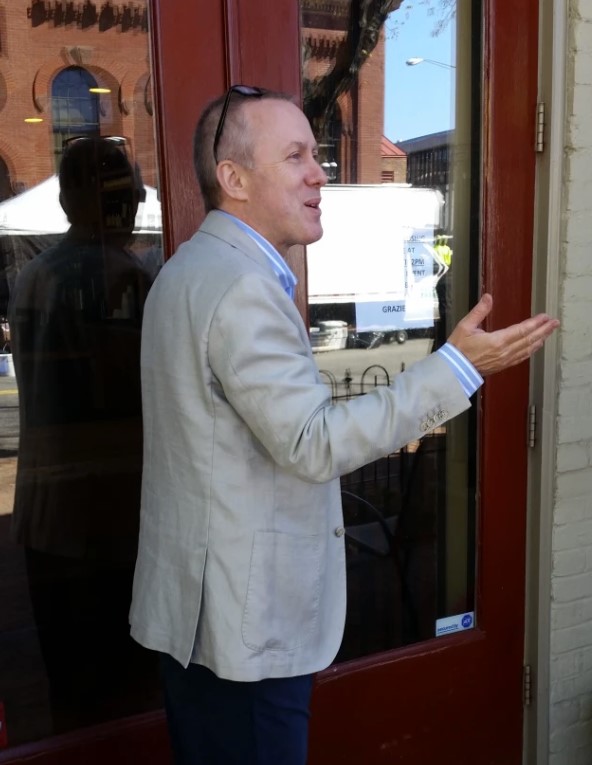
On Saturday, East City Books celebrated its 8th birthday. Owner Laurie Gillman, pictured above, defied the conventional wisdom about the demise of the brick and morar bookstore and opened its doors for the first time on Independent Bookstore Day in 2016. Here’s a link to their website: https://www.eastcitybookshop.com/
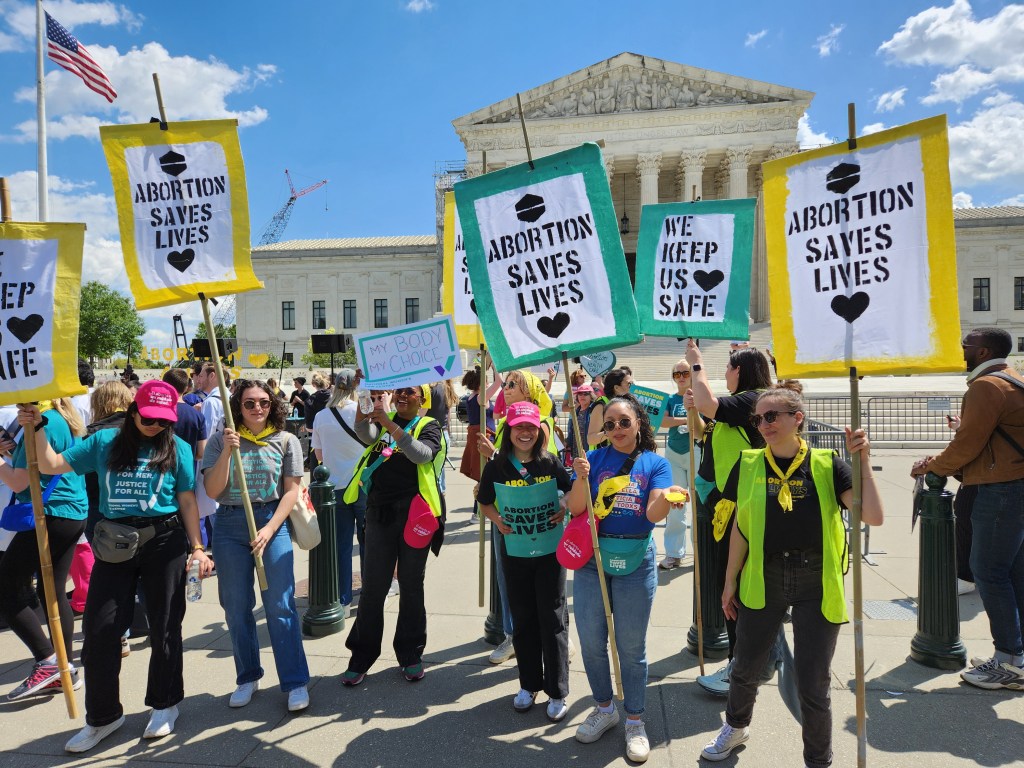
Wednesday, demonstrators gathered in front of the Supreme Court which was hearing arguments on whether a federal law aimed at protecting access to emergency medical care superseded Idaho’s near-total abortion ban. One observer was overheard, “There’s energy everywhere.”
On Thursday, another group of protestors demonstrated while the Court heard arguments regarding whether former President Trump has immunity from criminal prosecution. This would seem to be a slam dunk, and it’s scary that it’s not.
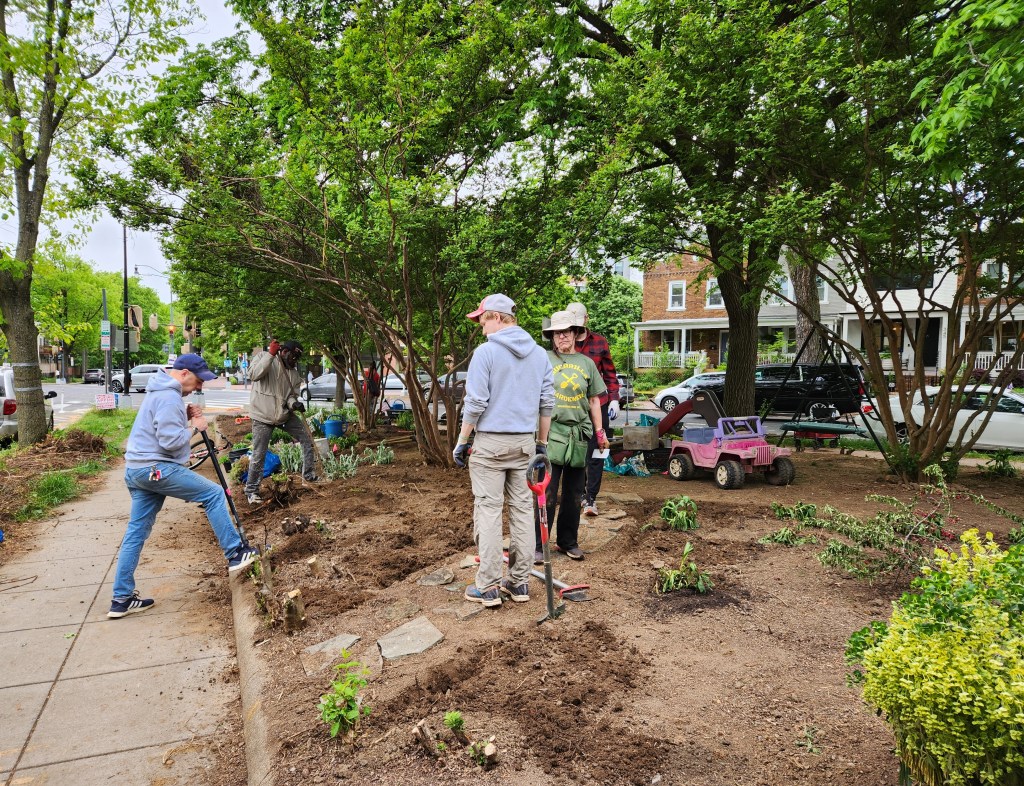
Guerrilla Gardners were out in force Saturday morning in the Potomac Avenue Triangle Park at 13th and Potomac Avenue SE. Pictured from left is Jim Guckert, GG founder and Executive Director, and two of the volunteers from Naval Lodge No. 4 at 330 Pennsylvania Avenue, SE. For more on how to donate or volunteer, go here: https://guerrillagardenersdc.org/
More Guerrilla Gardener volunteered were digging and planting in the Triangle Park at 14th and Kentucky Avenue, SE. Pictured from left is ANC6B Commissioner Vince Marino, Bryan Bundens, and Diane Kroupa.
Here’s another view of the Triangle Park, catty corner from the Southeast Safeway.
The Week Ahead…
Tuesday, April 30
ANC 6B Executive Committee will hold a virtual meeting to set the agenda for the May meeting of the full ANC. 8:15pm – 9:45pm.
Capitol Hill Corner would also like you to know about:
Thursday, May 2, 7:00pm. FREE.
East City Bookshop welcomes Nicole Chung to discuss her memoir, A Living Remedy. Joining her in conversation is Lupita Aquino. This hybrid event will have both an in-person component with limited seating as well as a virtual broadcast via Zoom Webinar. Both in-person and virtual attendees will be able to pose questions to the authors during audience Q&A. https://bit.ly/49QMQMM
Mapping Segregation in Washington, DC – Walking Tour Featuring Historian Sarah Jane Shoenfeld. 2:00 pm – 5:00 pm $15. https://bit.ly/4dsdO0i
Wednesday, May 03 – Sunday, May 05, 5:00 PM
The Force is strong on 8th St Barracks Row – May 3rd to 5th Barracks Row Main Street’s Unofficial Star Wars Weekend. For more, go here: https://www.barracksrow.org/
Comments Off on The Week Ahead…& Some Photos from the Past Week
The Conservative Partnership Institute’s (CPI) Headquarters in the 300 block of Pennsylvania Avenue, SE.
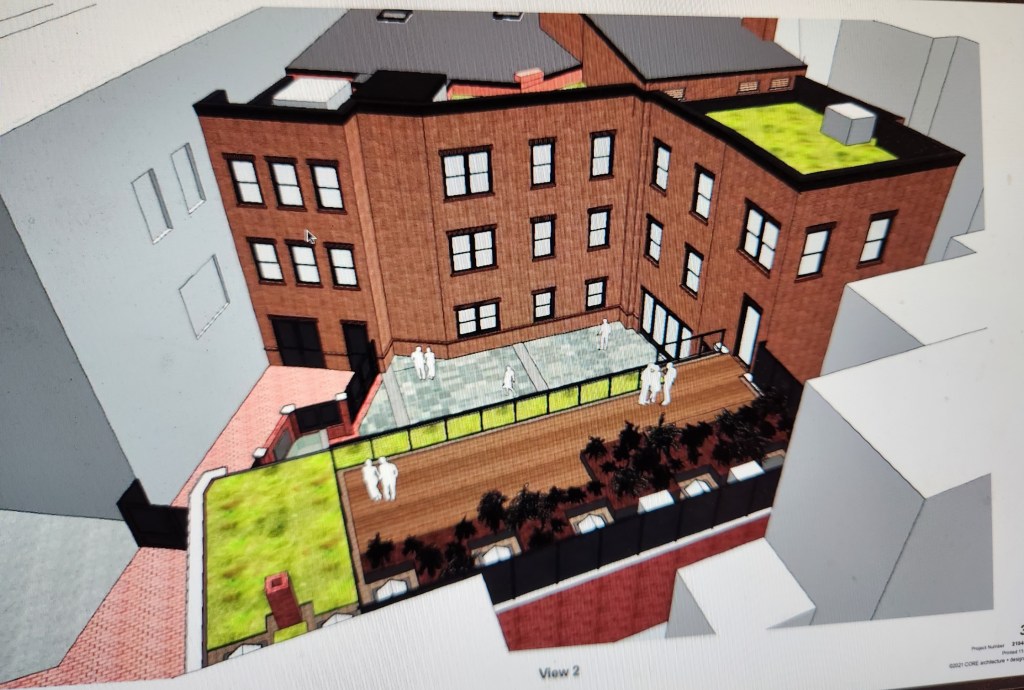
After closing the alley, CPI’s plan is to use the space for a courtyard behind the former Capitol Lounge.
Community Benefits Proposed in Conservative Group’s Bid to Close Alley
by Larry Janezich
Posted April 27, 2024
Details of the deal ANC6B’s Planning and Zoning Subcommittee reached with the Conservative Partnership Institute (CPI) regarding the latter’s application to close the dead-end alley behind the former Capitol Lounge have been posted on the ANC’s website. (Technically, the agreement is with Clear Plains, LLC, a legal entity controlled by CPI.)
The CPI has assembled a bloc of properties on the 300 block of Pennsylvania Avenue and around the corner on the 200 block of Third Street, SE, for use as the new CPI Headquarters. They say they plan to open a restaurant in the former Capitol Lounge and suggest that use of a courtyard in what is now a deadend alley behind the property may be used for outdoor seating by the restaurant.
Since the application would require the city to surrender the right-of-way it currently holds for public use of the alley, and as is the case in other private development of city controlled property, community benefits are often sought as compensation for loss of public space.
Negotiations between the Subcommittee – chaired by ANC6B Commissioner Frank Frank D’Andrea – and representatives of CPI have been ongoing for several months. The Subcommittee has scheduled a virtual meeting at 7:00pm on Wednesday, May 1, to vote on forwarding the proposed agreement to the ANC6B Planning and Zoning Committee. That committee would then meet to vote on the Subcommittee’s recommendation. A vote in favor there would send the agreement to the full ANC6B for approval. The City Council will have the final word in the form of passing legislation approving the alley closing.
(Ed. Note. An earlier version of this post mis-identified the Chair of the Subcommittee which is chaired – as noted above – by Commissioner Frank D’Andrea, who also chairs the ANC6B Planning and Zoning Committee.)
Under city regulations, city agencies are required to give “great weight” to ANC opinions on zoning and public space issues including alley closings.
Here are the main community benefits which have tentatively been agreed upon by the Subcommittee and representatives of CPI:
In part exchange for ANC support of the alley closure, CPI will make a total contribution in the amount of $100,000 to the Capitol Hill Community Foundation. CPI will condition its contribution upon the Capitol Hill Community Foundation’s promise to use it to benefit organizations based in ANC 6B. The agreement provides for $25,000 up front and $75,000 after Alley Closing Legislation becomes DC Law.
Current Zoning or Land Use Designations on the Comprehensive Plan Future Land Use Map of abutting properties will remain in place and no attempt will be made to change them. This preserves the current residential use of properties on Third Street.
CPI and any lessee will only use the outdoor areas of the Courtyard under their control from 7:00 a.m.–12:00 a.m. (midnight) Sundays through Thursdays, and 7:00 a.m.–1:00 a.m. Fridays and Saturdays; provided, that, if a ground-floor lessee obtains a valid license to serve alcohol in the Courtyard, the hours of that license will control the lessee’s hours of operation in the Courtyard.
ANC 6B’s Use of Courtyard. If and after the Alley Closing Legislation becomes effective and within three months after substantial completion of Courtyard renovation, the Courtyard will be available for use by the ANC, its committees, subcommittees, and task forces and by mutually agreed upon ANC6B community groups which the ANC designates from time to time, up to a total of six times per year provided this does not interfere with regular operations of the tenant.
Use of Interior Building Space for Community Meetings. Starting six months after the ANC votes to endorse this Agreement, CPI will make interior Building space, of at least a capacity of 20 people, available for use as a community meeting space by the ANC Bodies; provided that under certain circumstances CPI may substitute equivalent indoor space elsewhere in ANC6B.
Use of Interior Building Space for meetings by ANC6B community groups. Starting one month after the Alley Closing Legislation becomes DC law and the Alley Closing Plat is recorded, CPI will make interior Building space, of at least a capacity of 20 people, for use as a community meeting space by ANC 6B community groups that the ANC designates and that CPI approves for such use.
Use of Interior Building Space would be no more than twelve times a year for ANC bodies and ANC community groups combined, provided that CPI at its discretion may permit additional use.
The Conservative Partnership Institute is chaired by former Senator Jim Demint who founded the organization after he was bumped from the leadership role at the Heritage Foundation. Former WH Chief of Staff Mark Meadows is listed as the organization’s Senior Partner – ahead of President and CEO Ed Corrigan and COO Wesley Denton.
Here’s a link to info on how to join the Subcommittee’s virtual meeting at 7:00pm on May 1, including info on how to join virtual meeting: https://bit.ly/4bdZGFX The agenda includes a link to the full text of the proposed agreement.
US Attorney for DC Graves Takes Flak at ANC Public Safety Committee Meeting
by Larry Janezich
Posted April 27, 2023
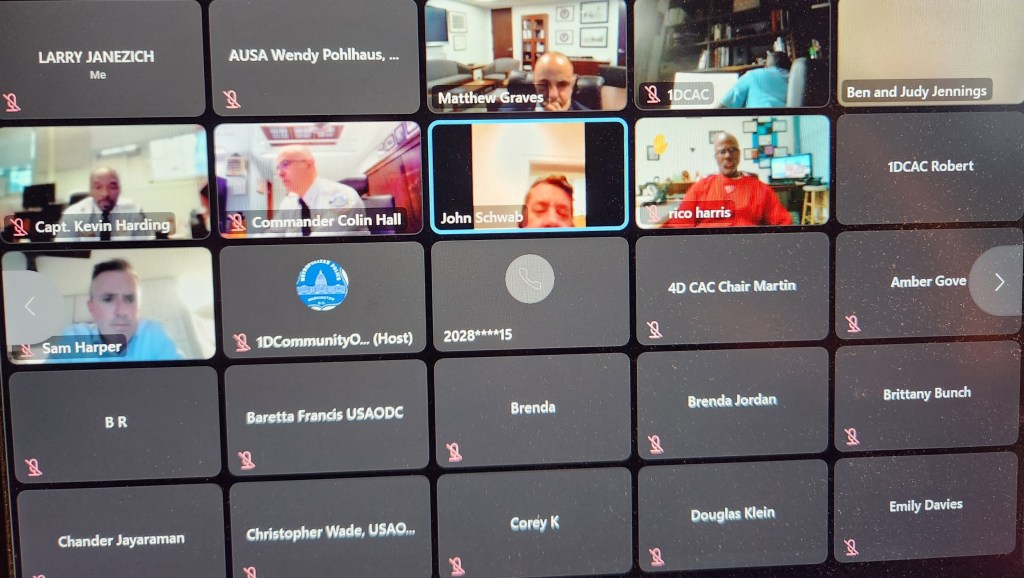
US Attorney for DC Matthew Graves visited ANC6B’s Public Safety Committee (PSC) Wednesday night. The meeting, chaired by Resident Member Lisa Matsumoto, was hybrid – both in person and viewable online. Graves was invited to give a presentation on the role his office plays in prosecuting crime in the District.
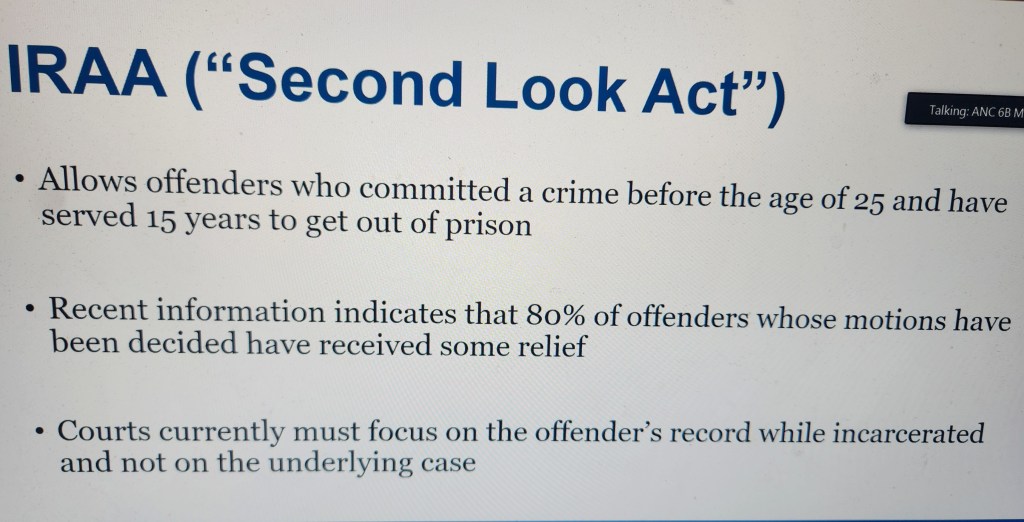
Graves appeared earlier this month at the MPD 1st District Community Advisory Council for a similar presentation. An attendee at that meeting had asked him if he would bring his suggestions for tweaking current legislation to the Wednesday night PSC meeting. As a result, Graves appeared before the ANC with the latest crime data and a list of recommendations for amendments to the Youth Rehabilitation Act and the Second Look Act.
Graves presented an avalanche of recent data on crime trends:
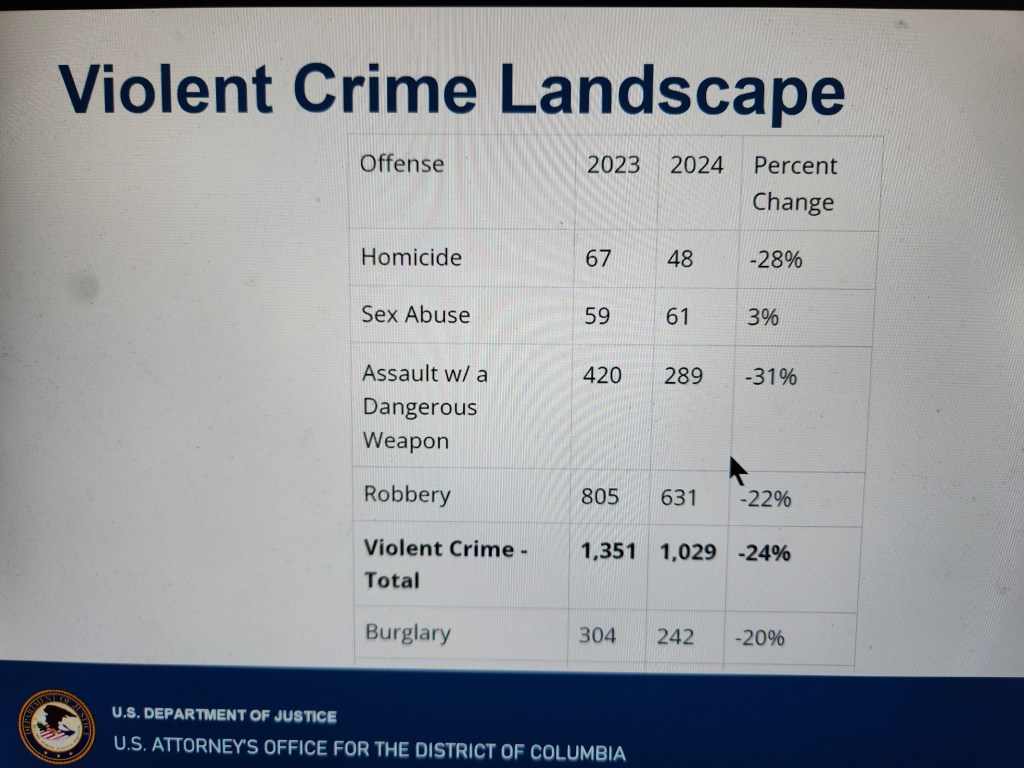
A city-wide 24% decline in the number of violent crimes this year to date compared to last year to date. (chart below)
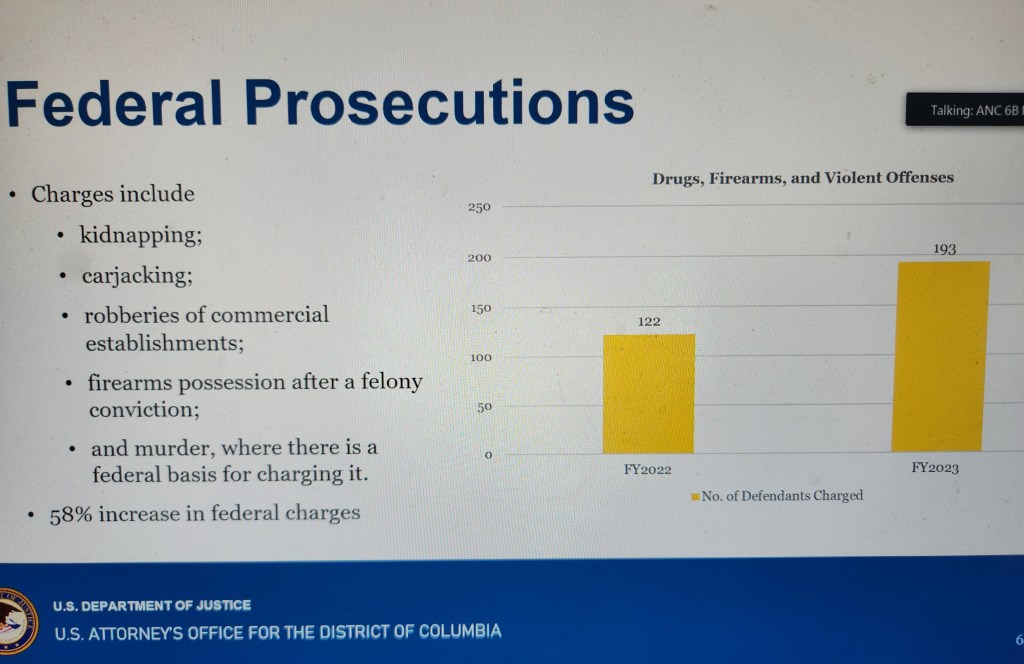
A 58% increase in federal prosecution of federal crimes in FY 2022 and FY 2003. (chart below)
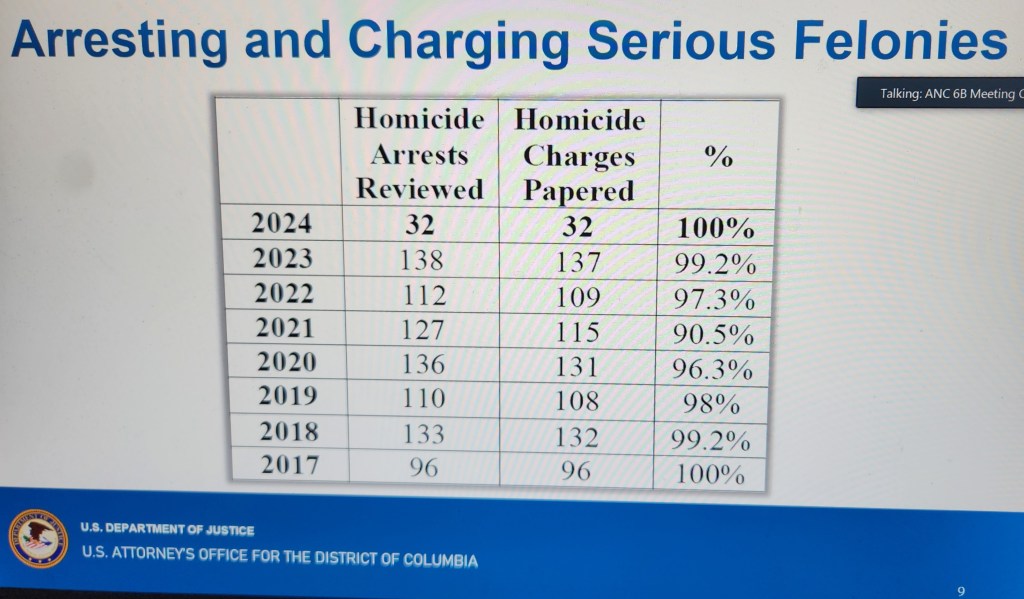
A steady increase in the number of arrests and charging of serious felonies over the past three years. (chart below)
He explained why there is a disparity between the number of arrests and the number of prosecutions, adding that almost all violent crimes are prosecuted. Among the reasons prosecutors decline to pursue a conviction:
DC is an outlier in jurisdictions which require arrests in cases of all domestic violence, few of which are prosecuted.
Many arrests for misdemeanors are not prosecuted because it’s not warranted.
Constitutionality issues. (Probably this means that incriminating evidence would not be allowed in trial because it was not obtained properly.)
Much of the discussion involved the proliferation of guns and the increase in numbers of gun-related offenses. Graves said that prior to 2022, the high point in MPD recovery of illegal guns was 2,300 in a year. In 2022 and 2023, MPD recovered about 3100 guns each year. Roughly 450 to 500 of these (20%) were untraceable ghost guns assembled from kits at home. (In 2018, only 25 ghost guns were recovered.) He said manufactured guns come from legal purchases in VA and MD and along the I-95 corridor all the way to Georgia where purchase of guns is easy.
Following the lengthy presentation, the discussion turned to changes in current legislation the Office of the US Attorney General for DC would like to see. Graves said that his office supports both the Youth Rehabilitation Act and the Second Look Act, but each contained language with consequences his office thinks the Council did not intend. He listed the following recommendations:
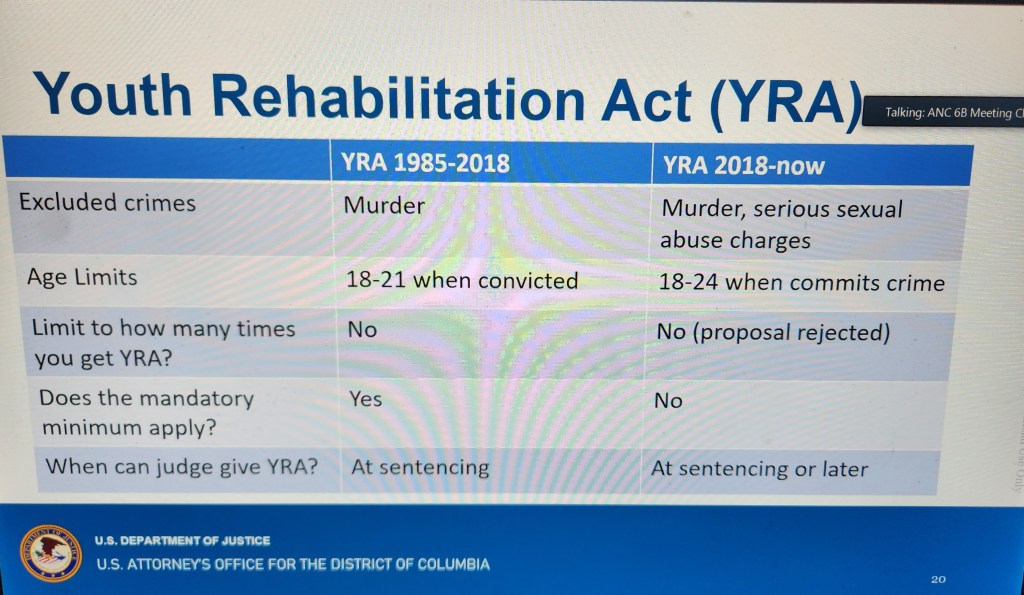
The Youth Rehabilitation Act (YRA): (see illustration below)
Limit YRA provision expunging the record for those under 25 to one occasion per offender rather than multiple instances of granting relief under YRA.
Make a mandatory minimum applicable in carjacking cases – most of which are committed by juveniles – rather than the no mandatory minimum for juveniles under current law.
The Second Look Act: (see illustration below)
Allow the courts to fully consider the nature of offense when applying relief in sentencing under the Second Look Act.
Require the court to assess rehabilitation and whether remorse has been demonstrated.
Require the court to consider a community impact statement if provided.
Make sure released inmates are supervised in the community rather than granted relief from parole under the Second Look Act.
In the Q&A period following his presentation, Graves ran into tough and critical questioning on how these proposed amendments would work to reduce crime in the community and whether resources would be better devoted to determining the source of firearms and stopping the flow of guns. The criticisms were raised by Public Safety Committee alternate resident member Jody Kent Lavy. Lavy is a senior fellow at the Campaign for the Fair Sentencing of Youth and has deep roots in criminal justice system including work for the ACLU.
Much of the nearly hour-long Q&A was concerned with the proposed amendments, with participation of members of the audience affiliated with community organizations involved with addressing criminal justice such as Credible Messengers and Violence Interrupters. After the meeting, one commissioner expressed surprise at the presence in the PSC audience of this community criminal justice contingent.
Graves concluded by reminding the audience that he had been asked to make recommendations regarding what could be done legislatively to amend portions of the Secure DC Act to further the public safety goals of his office. He said that his suggestions were meant to address the “unintended consequences of reform,” and that it was not the “end-all be-all” but “it is the right thing to do.” Graves added that “part of the equation is busting the myth which has grown in recent years that there are no consequencs for anything, particularly if you’re a juvenile.” He called the proposals “modest measures” and added, “We’re doing all these other things as well” – referring to his office’s “robust community relations division. “
The meeting – which ran well over its scheduled time limit, ended somewhat abruptly with a thank you to Graves. The video feed ended before a formal motion to adjourn was made.
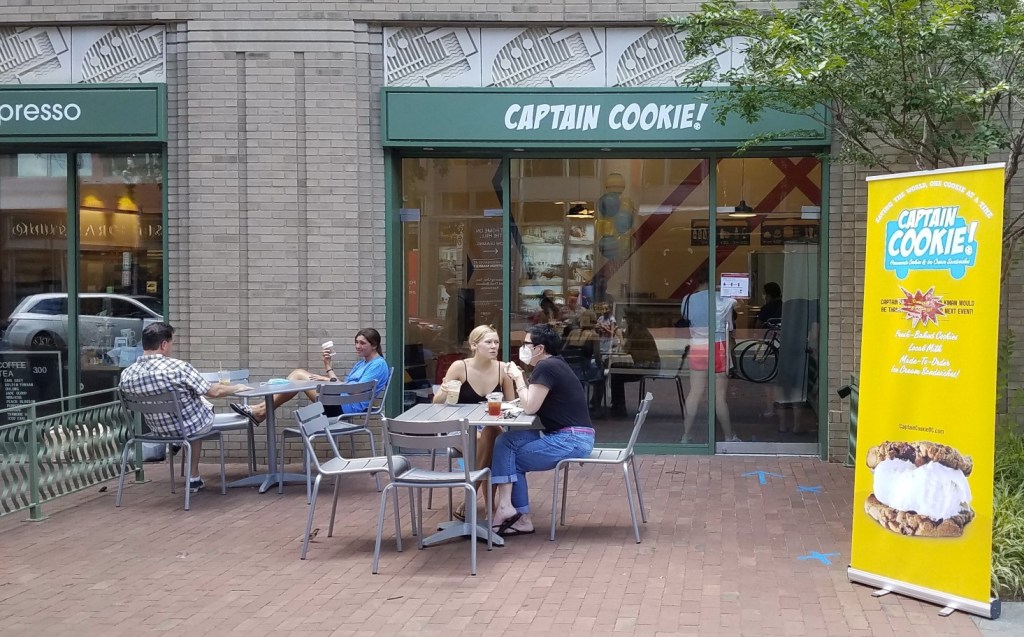
Friday evening, shortly after Radici announced it will close on Sunday, April 28, Captain Cookie at 660 7th Street, SE, announced it will close the same day. Both retail outlets share the same landlord, Stanton Development. A source familier with the situation says there will be an announcment very soon about a new tenant replacing Captain Cookie who will take over their lease.
Radici’s announcement cited “difficulties with the extension of our lease and condition of the building proved impossible to overcome” as the primary reason for their closure. Captain Cookie did not offer an explanation for closing.
In their announcement, Captain Cookie said, “To our beloved Eastern Market neighbors: we are sad to say we will permanently close the doors of our 660 Pennsylvania Ave SE location after this Sunday, 4/28. It’s our privilege to be able to continue to delight you with the best cookies and local ice cream in DC from our cookie truck or any of our other DMV locations either in person or with delivery.
We deeply appreciate all the support from our Eastern Market customers these past four years and look forward to the opportunity to serve you again soon!”
Captain Cookie opened at the 7th Street location in February, 2020, in the space formerly occupied by Pitango Gelato. Pitango continues to operate at other locations in DC, MD, and VA.
Captain Cookie started as a food truck merchant before opening the two brick and mortar bakeries which also market their menu of a dozen different cookies, ice cream, and local milk. The Captain Cookie trucks still service the city and are popular hires for special events. According to their website, each truck is a mobile bakery with running water, dipping freezer and bakery oven.
Their website stresses the company’s commitment to social issues, stating that they have committed a large portion of their profits to support efforts to end hunger including the DC Central Kitchen, Capital Area Food Bank and No Kid Hungry.
Comments Off on Closing – Captain Cookie at Eastern Market
Above: The Radici Team. Owners Bridget Thibodeau Sasso – center – in a recent photo and Enrico Sasso.
Eastern Market’s Radici Closes on Sunday, April 28
by Larry Janezich
Posted April 24, 2024
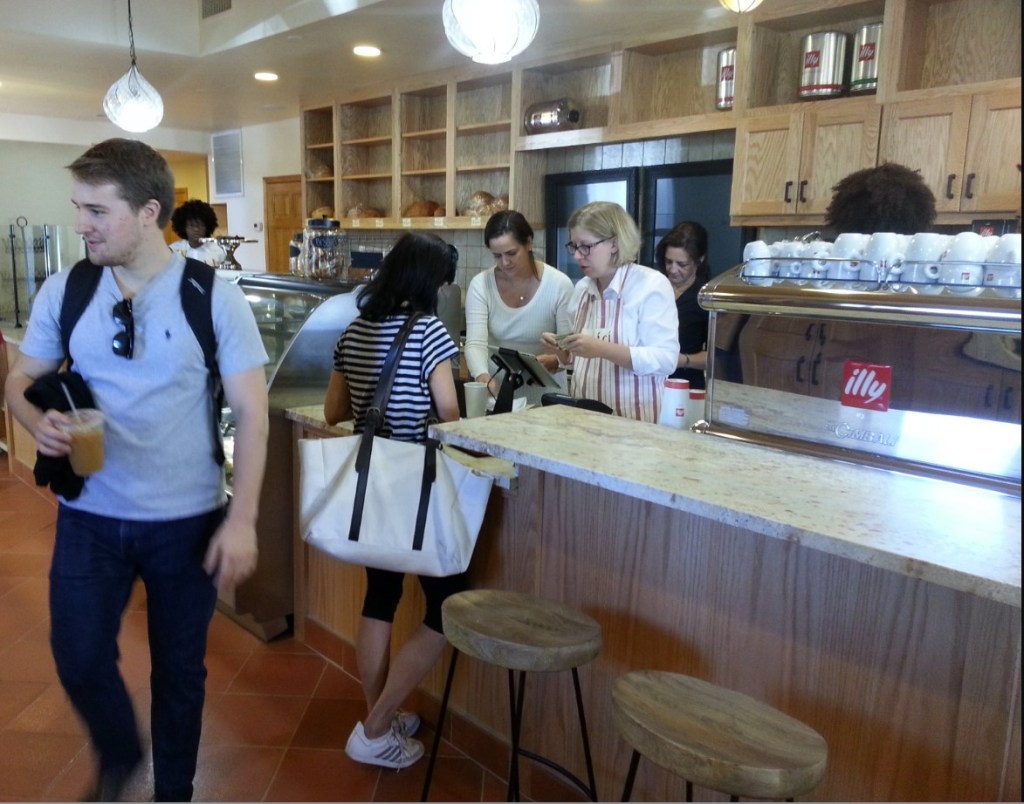
Wednesday afternoon, Radici, the popular Italian deli/café across from Eastern Market, announced that it will close its doors on Sunday, April 28. Radici posted the announcement Wednesday afternoon and distributed it on Instagram. (See link below.)
The announcement stated, in part, “Over the past six months we have tirelessly explored every avenue to ensure continuation of Radici at our current location. We considered various options to sustain our operations and engaged in lengthy negotiations with our landlords, but despite our best efforts, difficulties with the extension of our lease and condition of the building proved impossible to overcome.”
Radici’s landlord is Stanton Development whose offices occupy the second story of Radici. A previous verstion of this story reported that a source told CHC that the current lease for the first floor and the basement was $20,000 a month. Another source familer with the negotiations said that number was inaccurate and overstated. The second source also said that Radici had an option to extend its lease for an additional five years that it did not attempt to exercise or negotiate. That would appear to indicate Radici felt it could not continue to operate under that lease – otherwise they would have.
Radici’s announcement cites numerous challenges Radici has faced: three years of disruptive construction across the street, a global pandemic, endless maintenance issues and increasing crime – and notes, “Reflecting on our unwavering dedication and resilience in the face of these challenges … the decision… was not made lightly.”
Radici opened at at 303 7th Street in October of 2014, in the space formerly occupied by The Silver Spork.
One of Radici’s finer moments came in April of 2016 when First Lady Michelle Obama was one of a group of women who attended a birthday luncheon for an unnamed friend, an event which drew a large crowd as word spread.
The communique ended on a hopeful note: “We bid you arrivederci for now thile we find a new home for Radici and look forward to the day when we can welcome you back to our table….”
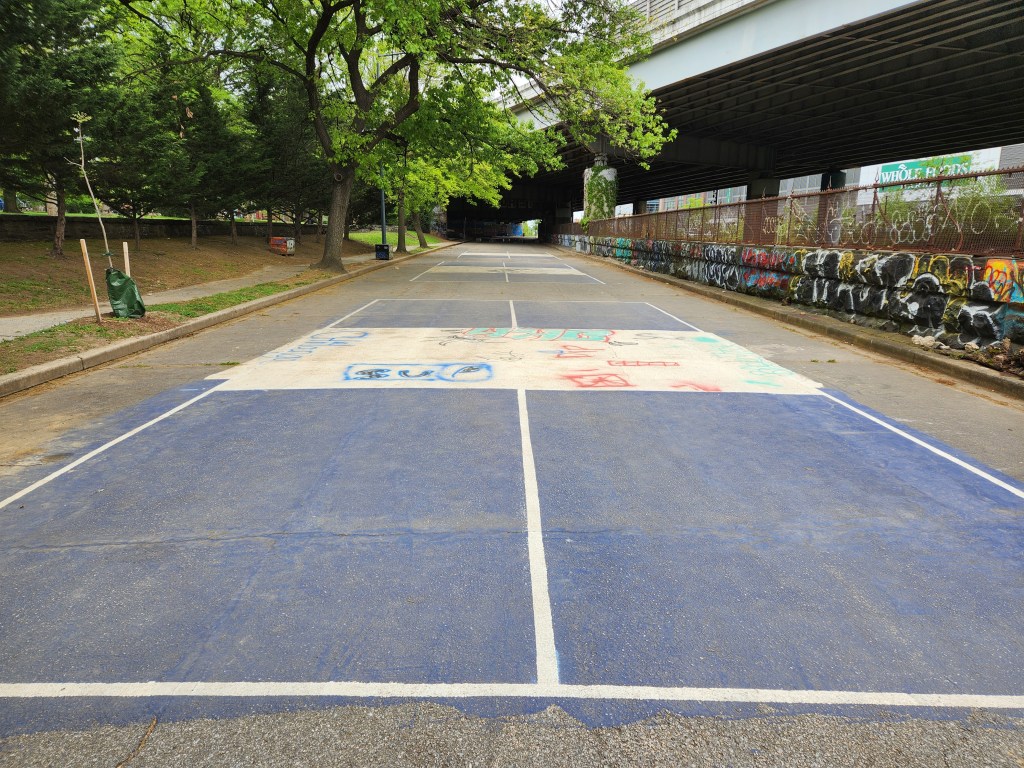
Pickleball court proposal for Virginia Avenue/Garfield Park Connector Project moves forward. After four years of advocacy by Washington DC Pickleball (WDCP) involving CM Charles Allen, ANC6B, ANC8F, the Capitol Riverfront BID, the Garfield Players Group, Capitol Hill Village, Friends of Garfield Park, the Brent Elementary Players Gourp, Capitol Hill Day School, DDOT, DPR, and the Office of Public Space Permitting, the milling and repaving of the dead-end part of Virginia Avenue under the freeway beteeen Garfield Park and Canal Park appears to be on track to become a reality. At last Monday night’s meeting of ANC6B’s Parks and Public Space Taskforce, Chair Jerry Sroufe shared a report from WDCP Adcocacy Director Eileen Dougherty outlining the history of the effort and the current state of affairs. The latest is that ANC6B Commissioner Frank Avery will submit an application this month on behalf of ANC6B for the necessary public space permit. Approval of the application is a three month process. WDCP has established a committee to raise private funds to support the effort. The image above is the current state of the Virginia Avenue pickleball – lines were first laid down in 2017 by guerrilla pickleballers.
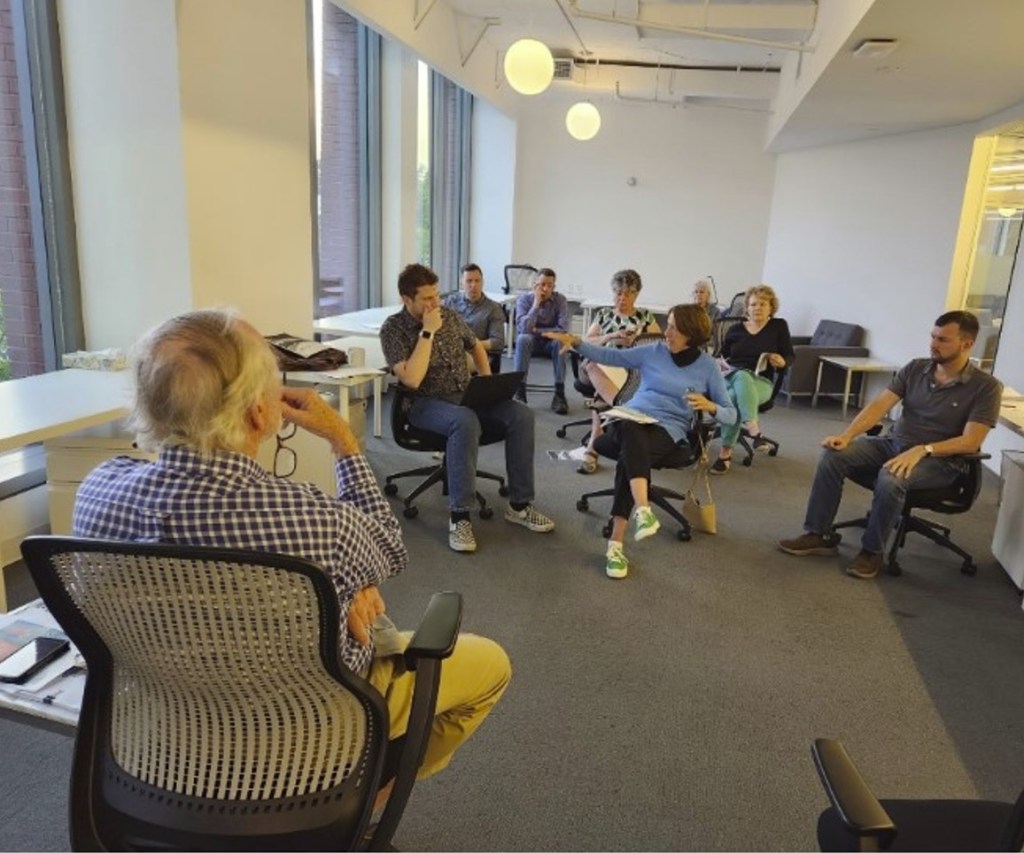
ANC6B Parks and Public Space Taskforce: Here’s a stock photo of a meeting of the ANC6B Parks and Public Spaces Taskforce chaired by Sroufe. Eileen Dougherty is front row center.
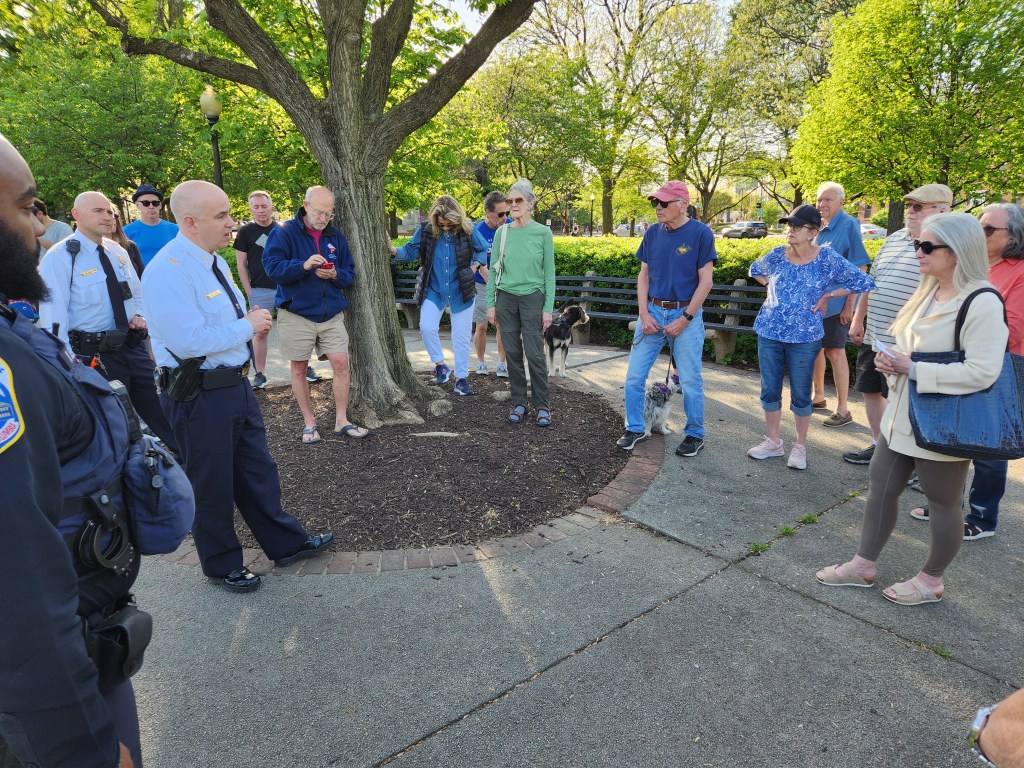
Stanton Park Safety Walk: Tuesday night, CM Charles Allen, along with MPD 1D Commander Colin Hall and 1D Captain David Augustine led a Public Safety Walk on the north side of Stanton Park. (The park is named after Lincoln’s Secretary of War. Shortly after Stanton’s death in 1869, Congress authorized a statue of Revolutionary War general Nathanael Greene, which was erected in the park in 1878.) The walk was organized by ANC6C02 Commissioner Leslie Merkle. Allen told the 20 + residents assembled in the park that there had been a positive trend in crime stats in the past 3 to 6 months. Hall said that violent crime is down 20% year to date, robberies are down 30%, and homicides down 70%. He added that stolen autos are down 30% and stolen autos are often used in robberies and homicides; the stats are “trending in the right direction, heading into summer.” ANC6C03 Commissioner Jay Adelstein, who said he was one month into grand jury duty, added that he was “shocked” to learn as the result of his service how many resources – teams of detectives – MPD has deployed on Capitol Hill and are involved in cases being brought before the grand jury. Above, L-R, MPD Officers Miller, Levin, Rose, CM Allen, Commander Hall and Captain Augustine.
Commander Hall updates attendees on crime stats: L-R, Hall and Augustine (behind), Adelstein (against tree), long-time former ANC6C Chair Karen Wirt (center in green top), and Commissioner Leslie Merkle (at far right). Hall recommended residents sign up for AlertDC to receive public safety text messages to stay informed about what’s happening in their neighborhood or around the District. Here’s where you sign up: https://hsema.dc.gov/page/alertdc
The Capitol Hill Restoration Society 2024 Mothers Day House & Garden Tour – the 67th annual – will be held Saturday, May 11 (4-7 pm) & Sunday, May 12 (1-5pm). This two-day event features nine beautiful homes and gardens, and three interesting semi-public buildings, all within the Capitol Hill Historic District.
Tickets ($40 in advance; $50 weekend of) and additional information are available here: https://bit.ly/3WbKnJw
Tickets sold out last year. Consider becoming a member – to get early opportunities to buy tickets (and receive a discount) for this year. Go here: https://chrs.org/
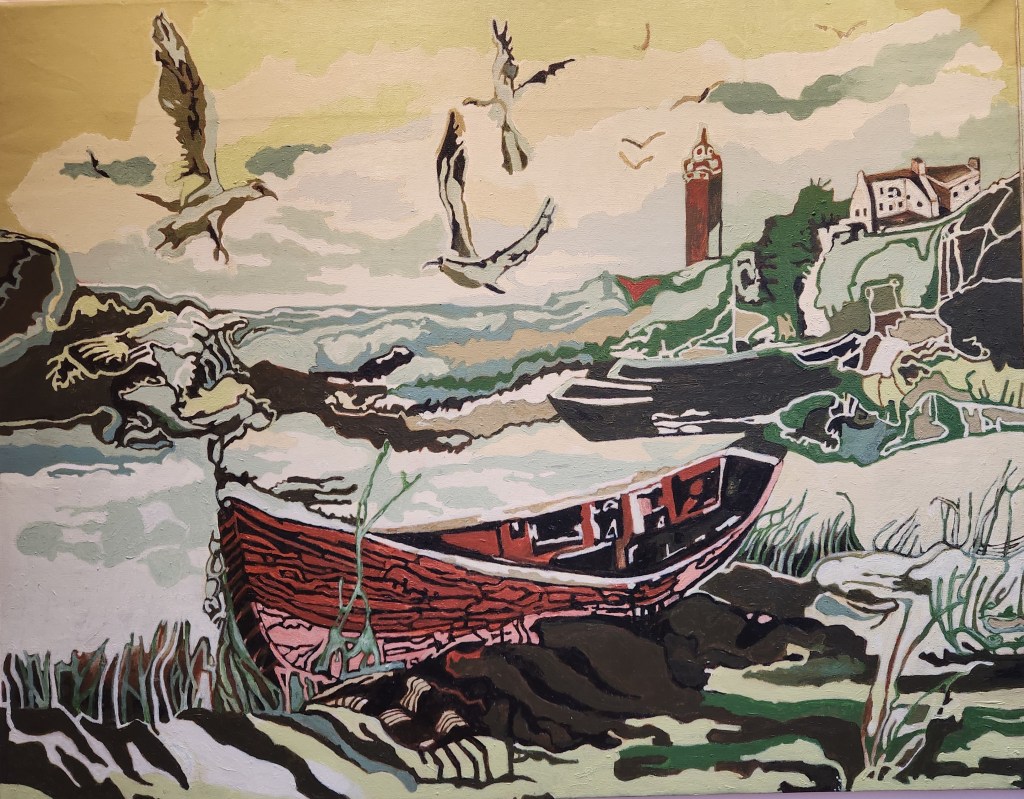
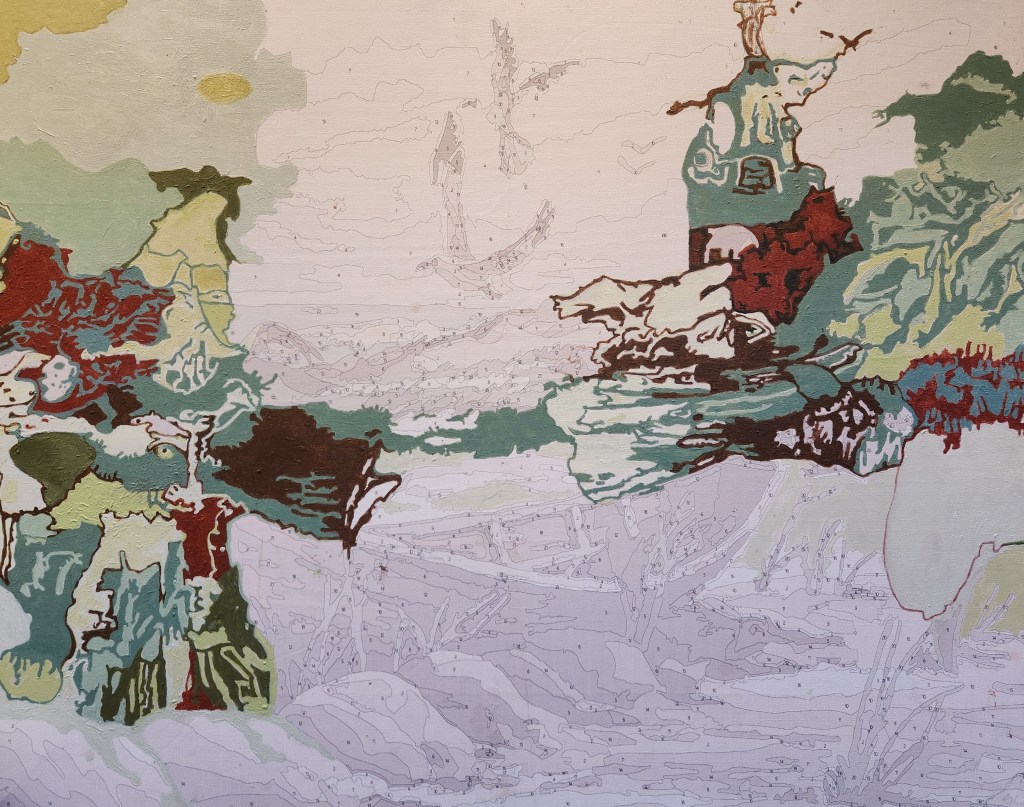
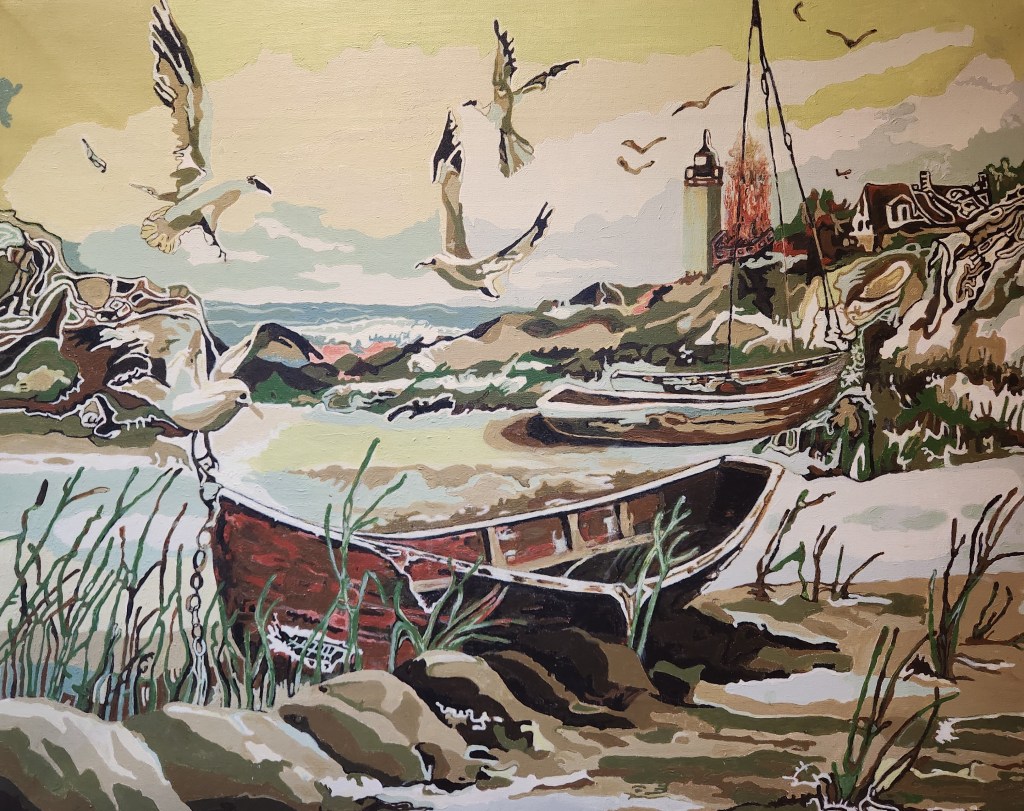
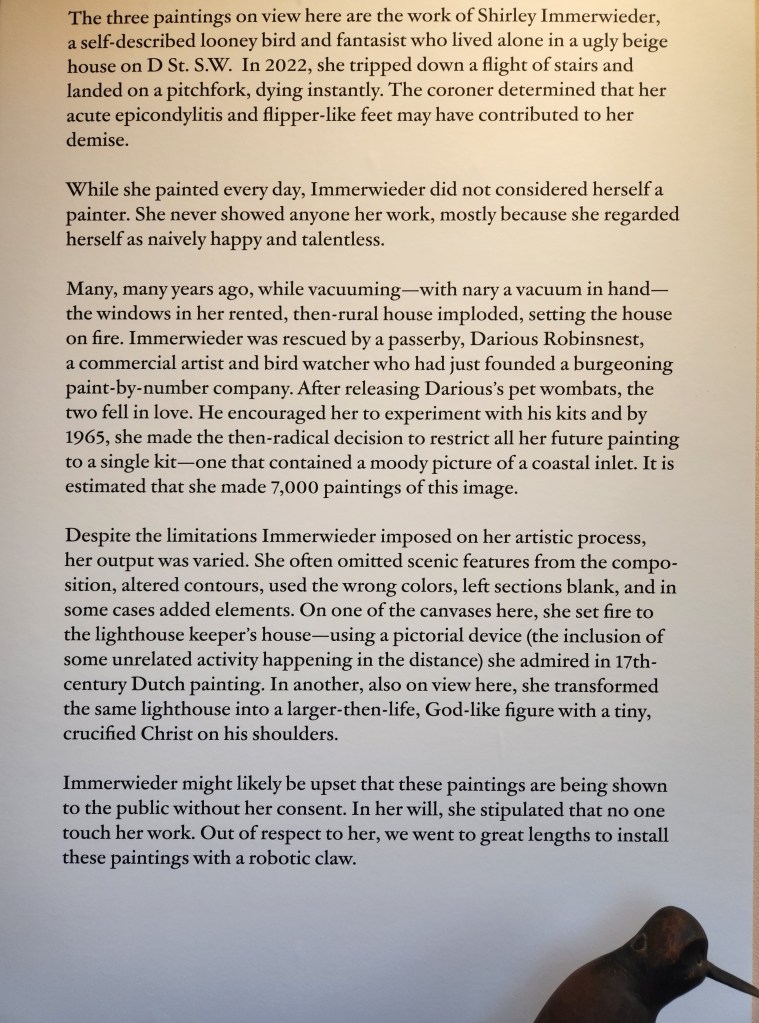
Here’s Triple Candies’ April installation in the space in front of the former Li’l Pub at 655 Pennsylvania Avenue, SE.
The installation is hard to describe: an accompanying origin fantasy describes three fantastical paintings and perhaps continues the devolution of art started by Thomas Wolfe in The Painted Word.
Triple Candie is a research-oriented curatorial agency run by art historian co-founders Shelly Bancroft and Peter Nesbett. Their purpose – according to their website – is to create alternative exhibition methods making that the object of critical focus rather than what is displayed (which for the most part does not include original artworks). For more, see here: http://www.triplecandie.org/
The Week Ahead…
Highlight: U.S. Attorney for the District of Columbia, Matthew Graves is before ANC6B Public Safety Committee on Wednesday night (see below).
Monday, April 22
ANC6A Community Outreach Committee will hold a virtual meeting at 7:00pm.
Discussion of renewal of a Class A retail liquor store license with a tasting endorsement at New H Wine & Spirits at 914 H Street, NE.
Discussion of renewal of a Class A retail liquor store license with a tasting endorsement at Montana Liquors at 710 H Street, NE.
Discussion of renewal of a Class A retail liquor store license with a tastingendorsement at H Street Spirits at 1368 H Street, NE.
Discussion of renewal of a Class A retail liquor store license with a tasting endorsement at H Street Beverage Warehouse at 1431 H Street. NE.
Discussion of renewal of a Class A retail liquor store license at Noble Liquor and Tobacco at 1305 H Street, NE.
Discussion of renewal of a Class A retail liquor store license at Jumbo Liquors at 1122
H Street, NE.
Discussion of application for a Class C tavern license at Smokin’ Pig with Carry-out and Delivery, Live Entertainment and Cover Charge, and Game of Skill Endorsements at 1208 H Street, NE.
Wednesday, April 24
ANC6B Public Safety Committee virtual meeting at 6:30pm.
Presentation by U.S. Attorney for the District of Columbia, Matthew Graves.
In person Community Meeting at Mott’s Market – 233 12th Street, SE – 7:00pm.
Agenda:
DDOT Notice of Intent to expand sidewalks and install permanent infrastructure to replace the flexiposts and temporary traffic calming measures that are currently in place at the intersection of Independence Avenue / Kentucky Ave / 13th Street SE.
Eastern Market Community Advisory Committee hybrid meeting at 7:00pm, North Hall, Eastern Market.
Agenda:
Chair Report
Death of Tom Kuchenbert
Committee positions: Treasurer, Operations Committee, At Large Member seat vacancy
Communications Committee
Rumsey Center
AD HOC Public Safety Committee Recommendations to Committee
Tenants Council Report
Operations Budget Committee Report
Capital Improvements Report
Market Manager Report
New EMCAC Business
Community questions, suggestions & Comments
Closed session
Thursday April 25
ANC6B Southeast Library Taskforce will hold a hybrid meeting at 6:30pm. Meeting location will be 700 Pennsylvania Ave SE; Second Floor (entry adjacent to Trader Joe’s).
Capitol Hill Corner would also like you to know about:
Wednesday, April 24
Hill Center: Ben’s Chili Bowl Co-Founder & DC Matriarch Virginia Ali in Conversation with Chef Jerome Grant and Ben’s Official Historian Bernard Demczuk. 7:00 pm – 9:00 pm – $10
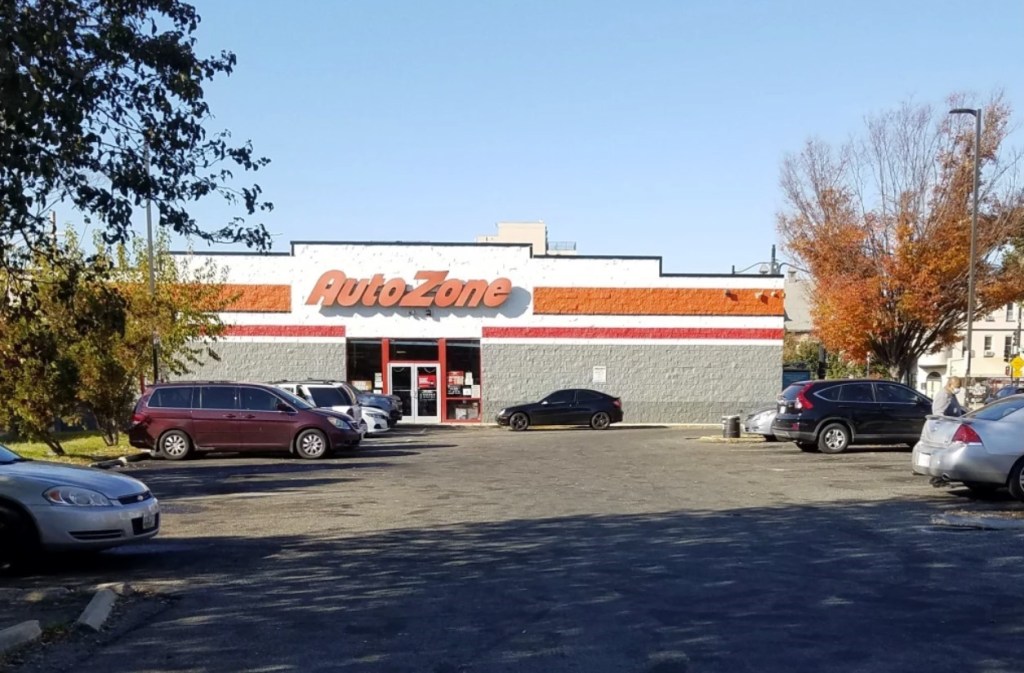
Auto Zone on H Street NE is closed and up for lease. WestMill Capital, the H Street development firm had plans to develop the site as multifamily units. Co-owner Ben Miller said the firm was considering a number of options, including the potential use of the city’s Inclusionary Zoning Plus program which provides for no-hassle rezoning of a development site if the developer commits to making 20% of the units affordable at 60% AMI. Miller didn’t sound 100% committed to this option – WestMill would be the first to use the program. Miller said in 2021 that he was also pursuing selling the property outright, as well as extending Auto Zone’s lease. Washington Business Journal first reported the up-for-lease story. In a follow-up piece, ConnectCRE suggested that “The current leasing opportunity indicates a potential delay or change in the redevelopment plans.” https://bit.ly/3Ui364Y
CM Charles Allen visited ANCB’s hybrid meeting last Monday night to talk about the budget. He called it one of the most challenging he had seen. The good news is that all of the Ward 6 school, library, rec center, pool, and park modernizations are included and preserved. Among his priorities are restoring funding for the equity fund for day care workers, maintaining the SW – L’Enfant Plaza – Eastern Market Circulator Route which the Mayor wants to phase out in six months, increase funding for the Emergency Rental Assistance Program, restore funding to avoid laying off 200 school employees, and to preserve funding for Vision Zero, school safety, as well as recreation and senior centers. Allen will hold a hybrid Ward 6 Budget Town Hall on Monday, April 29, at Northeast Branch Library from 6:00 to 7:30pm. From L-R, ANC6B Commissioner David Sobelsohn, Allen, ANC6B Chair Edward Ryder.
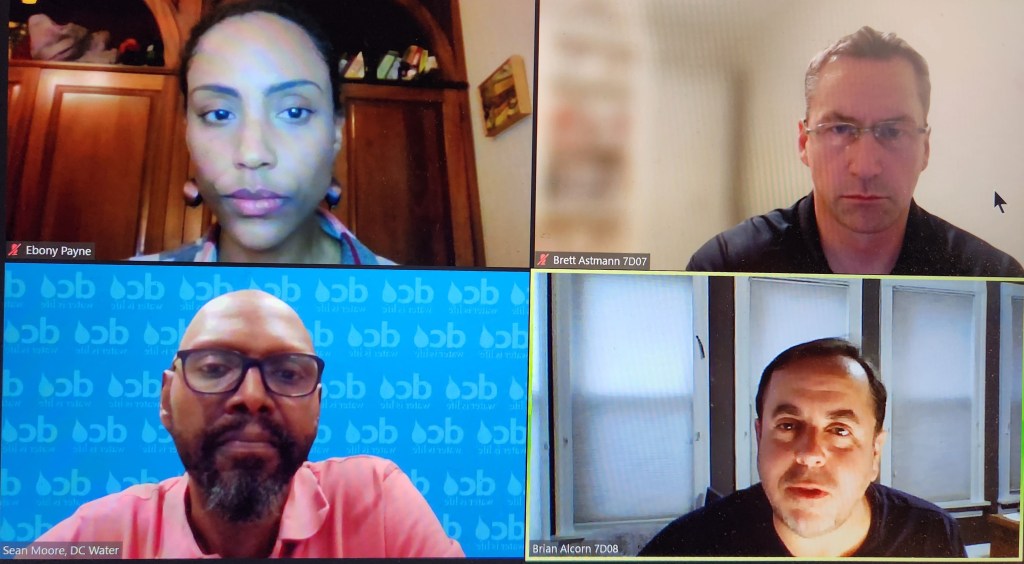
Lead Pipe Replacement in ANC7D. ANC7D met Tuesday night and heard from DC Water’s Communication Manager Sean Moore about DC Water’s free lead pipe replacements starting this year in ANC 7D. The agency is focusing on replacing lead in vulnerable and historically underserved communities. The replacement is free with restoration in kind for any disruptions to property. The city is responsible for maintaining the portion of service in public space – to the property line. In some cases, funding is available to replace lead on private property with the consent of the owner. Replacement for 1158 premises on 74 Blocks in ANC7D will begin this year. For more, go here: https://bit.ly/3PXY8YA and to see if your pipes are lead, check the interactive map here: https://geo.dcwater.com/Lead/ Clockwise above, 7D Commissioners Ebony Payne and Brett Astmann, ANC7D Vice Chair Brian Alcorn, and Sean Moore, DC Water.
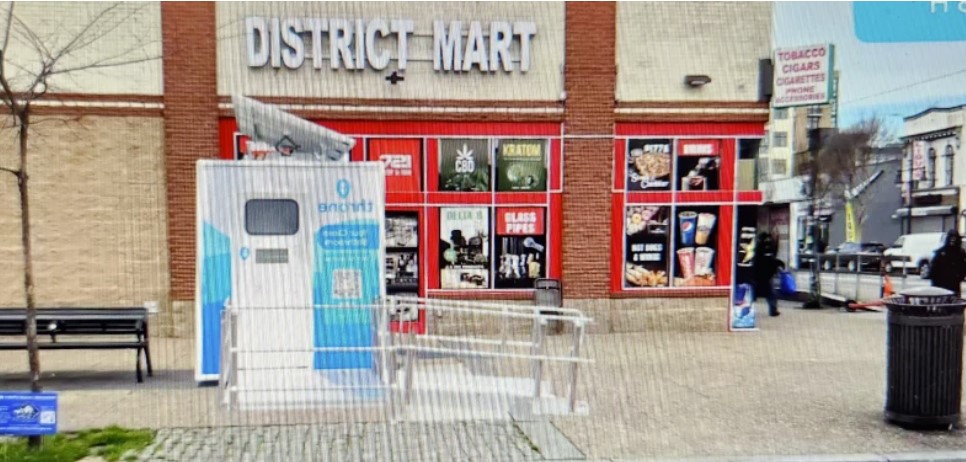
H and 8th Street Corner NE De-Throned. Thursday night, ANC6A01 Commissioner Keya Chatterjee announced at the ANC6A April meeting that Throne Labs has withdrawn a request to place one of its public bathrooms at the corner of 8th and H Streets, NE, as part of a city-sponsored pilot program. Community concerns regarding the placement of the “Throne” at the troubled corner apparently raised company concerns that there would not be unanimous agreement on the ANC about the placement and decided to pursue location of the bathroom elsewhere on in the Capitol Hill community. One location being considered is Eastern Market Metro Plaza where the public restrooms in SE Library are not and will not be available during a two year library renovation project. Above is a rendering of what the Throne at H and 8th Streets, NE would have looked like.
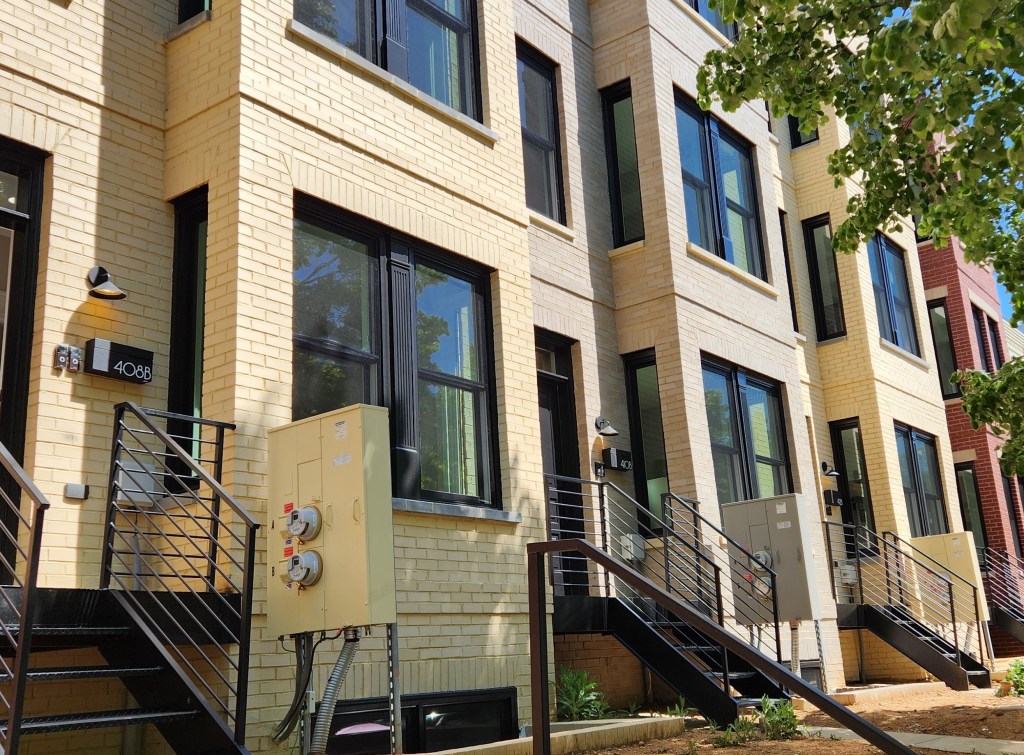
Ebenezer Row Condo Update. Construction on condo project is nearing completion – a significant improvement on the 400 block of D Street, SE. Still, it seems more thought might have been given to placement of the electric meter panels on some of the units.
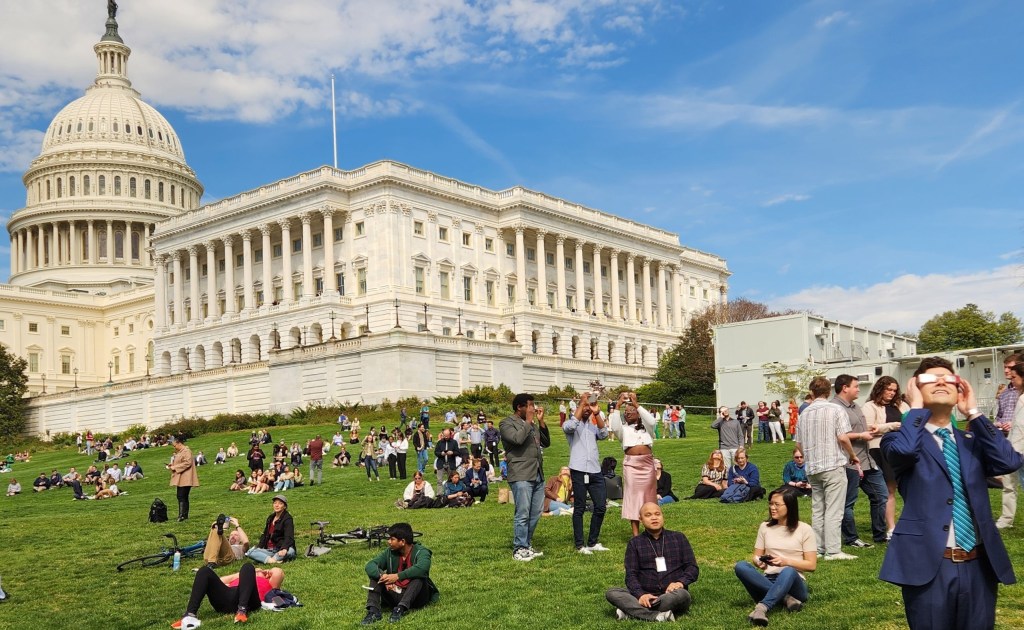
Viewing the Eclipse from the West Front of the US Capitol. Here’s an image of eclipse watchers gathered on the House side of the West Front of the U.S. Capitol during the eclipse.
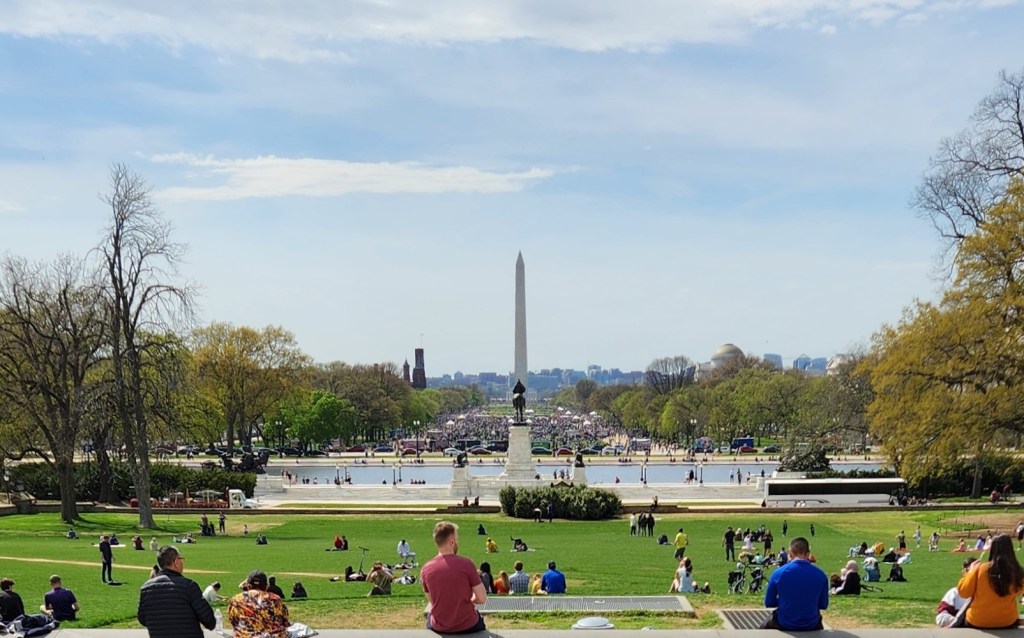
And here’s a shot from the center of the lower terrace of the West Front showing the crowd of eclipse watchers gathered on the National Mall.
The Week Ahead…
Monday, April 15
ANC6A Transportation & Public Space Committee will hold a virtual meeting at 7:00pm
Florida Ave NE Streetscape Project Update. The Florida Ave NE Streetscape Project outreach team will provide project updates and address community safety concerns with related contractor work.
Vision Zero Hardening at the intersection of 13th Street NE/Constitution Ave NE/Tennessee Ave NE.
Lane Re-configuration of westbound C Street, NE between 17th Street NE and 16th Street NE.
ANC6B Parks and Public Spaces Taskforce will hold an in-person meeting at 7:00pm in Conference Room 201, 700 Pennsylvania Avenue, SE (entrance next to Trader Joe’s)
Among items on the draft agenda:
Among items on the draft agenda:
Status of Eastern Market Metro Plaza
VA Avenue Review and Update
New Director of DC Parks and Recreation/Park Manager
808 I Street, NE: Zoning Adjustment Application to construct a third story and rear addition to an existing, attached, two-story with cellar, principal dwelling unit in the RF-1 zone.
257 Warren Street, NE: Zoning Adjustment Application to construct two new, attached, three-story with basements, principal dwelling units in the RF-1 zone.
1432 F Street, NE: Zoning Adjustment Application to construct a two-story rear addition to an existing, attached, two-story with cellar, principal dwelling unit in the RF-1 zone.
430 10th Street, NE: Zoning Adjustment Application to construct a rear addition to an existing, attached, two-story with basement, principal dwelling unit in the RF-1 zone.
Thursday, April 18
ANC6D Alcohol Beverage Control Committee will hold a virtual meeting at 7:00pm.
Capitol Hill Corner would also like you to know about:
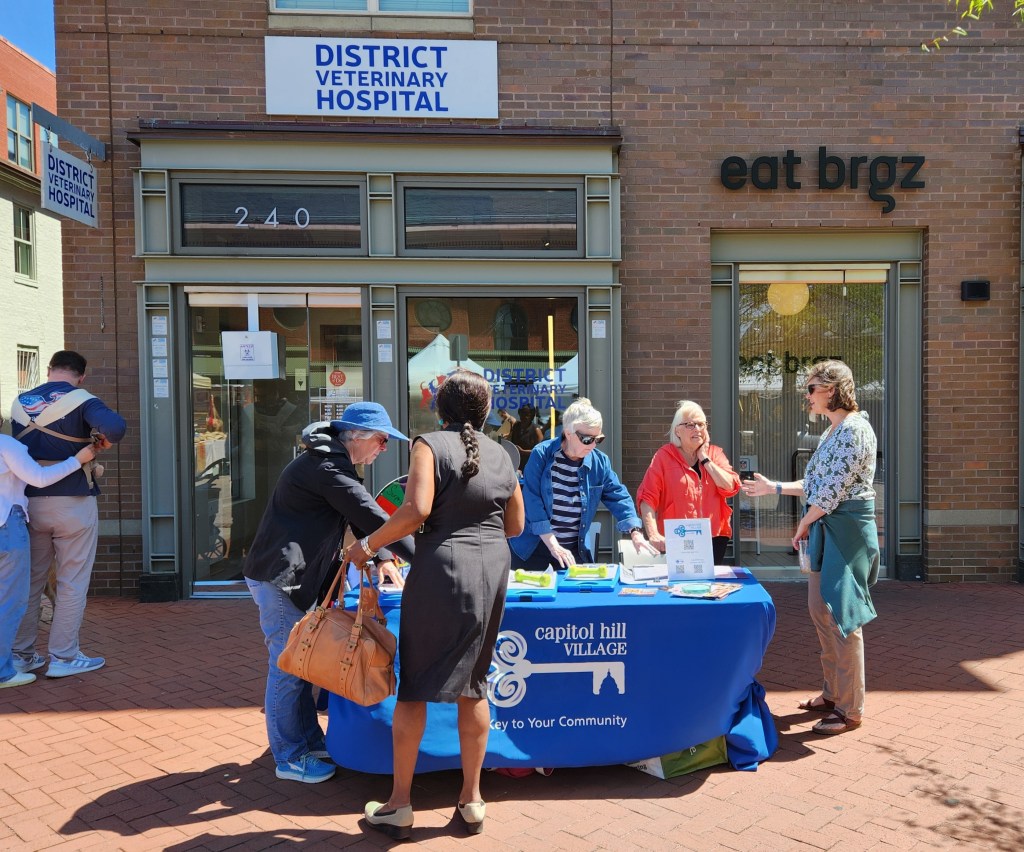
Capitol Hill Village (CHV) is running a Membership Drive throughout the month of April, with a table at Eastern Market on Saturdays and Sundays. CHV engages residents, especially adults 55 and older, to build a stronger community. Village members, volunteers of any age, staff, and experts host programs, activities, and events, and provide short-term case management for those in need.
CHV members design and host over two dozen “Affinity Groups,” monthly or more frequent get-togethers to enjoy outings, activities, and discussions on books, opera, theater, museum visits and the cinema; to play mahjong, practice improvisation, or write a memoir; and to walk, kayak, bike and dance together. CHV offers education, resources, and referrals through our dedicated staff and volunteers.
CameraConnect DC, the Metropolitan Police Department’s new community camera sharing program, gives residents, business owners, institutions, and others an additional way to help police solve crime in their neighborhood. By registering your camera system – such as a doorbell camera or private CCTV system – and giving officers advance knowledge of available sources of evidence should a crime occur near your location. Registration is free. Residents would have to agree to a request to share video with MPD on a case by case basis. For more, go here: https://mpdc.dc.gov/cameraconnectdc
Comments Off on The Week Ahead…& Some Photos from the Past Week
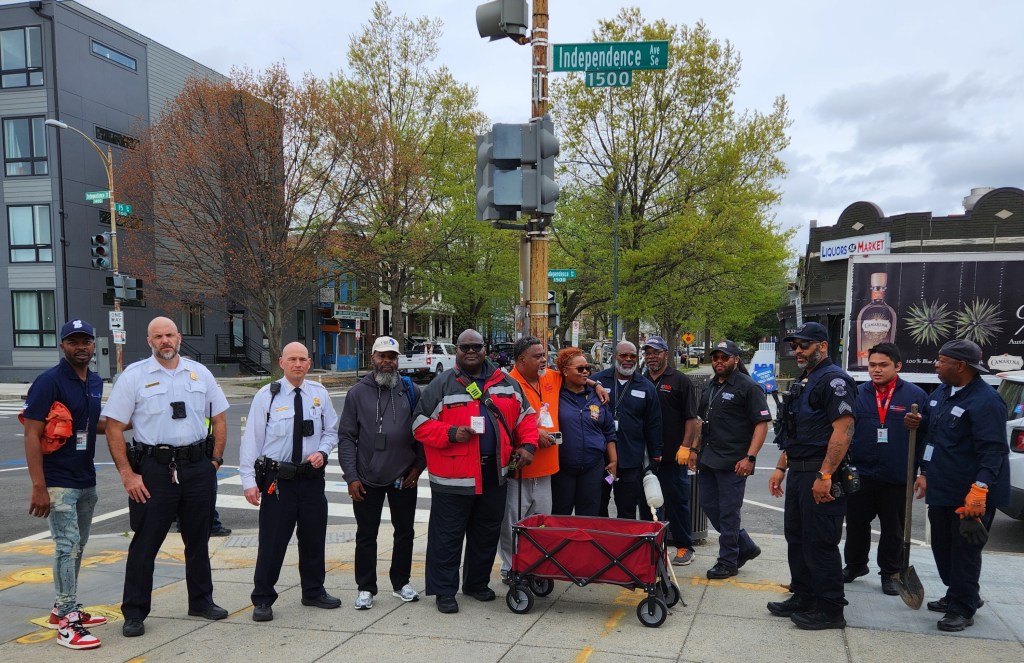
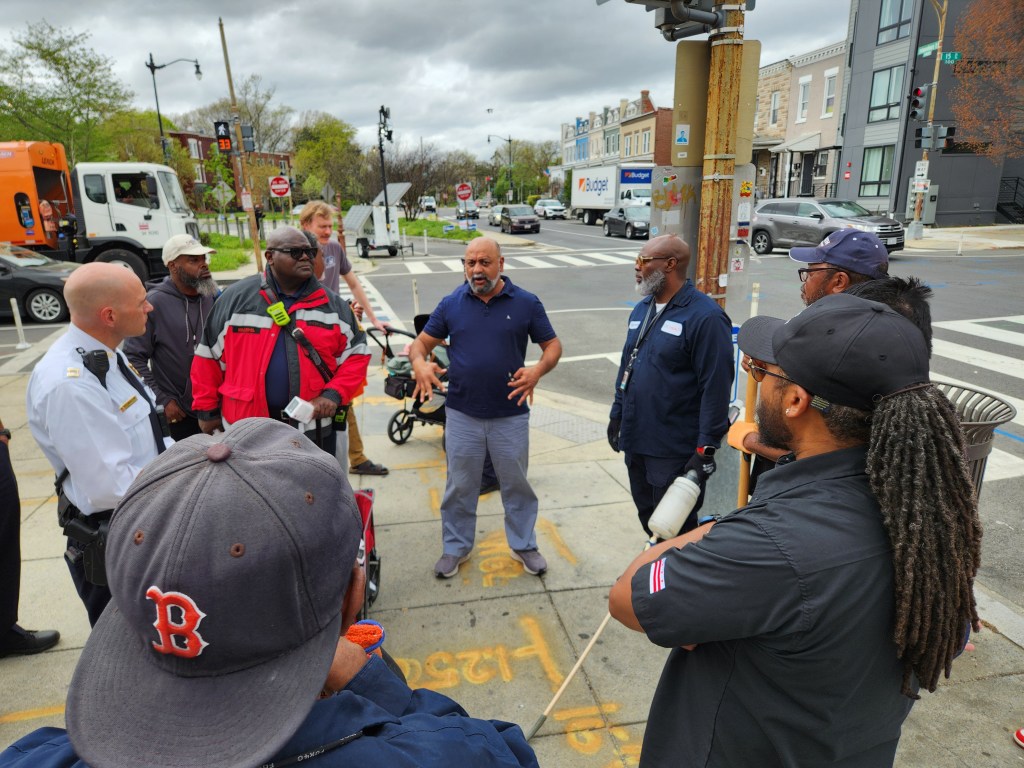
City agency reps assembled to address envioronment and quality of life issues around 15th and Independence on Thursday afternoon included L-R Byron Johnson, Office of the Deputy Mayor for Public Safety and Justice; MPD 1D Lt. Seth Anderson, MPD 1D Captain David Augustine, and representatives of DPW, DOB, FEMS, DOH, Parking Enforcement, DOT, and the Department of Hired Vehicles.
ANC6B Commissioner Chander Jayaraman, who lives on the Ward 6 side of 15th Street, lent his voice to the effort, pointing out some of the issues in the surrounding streets and alleys.
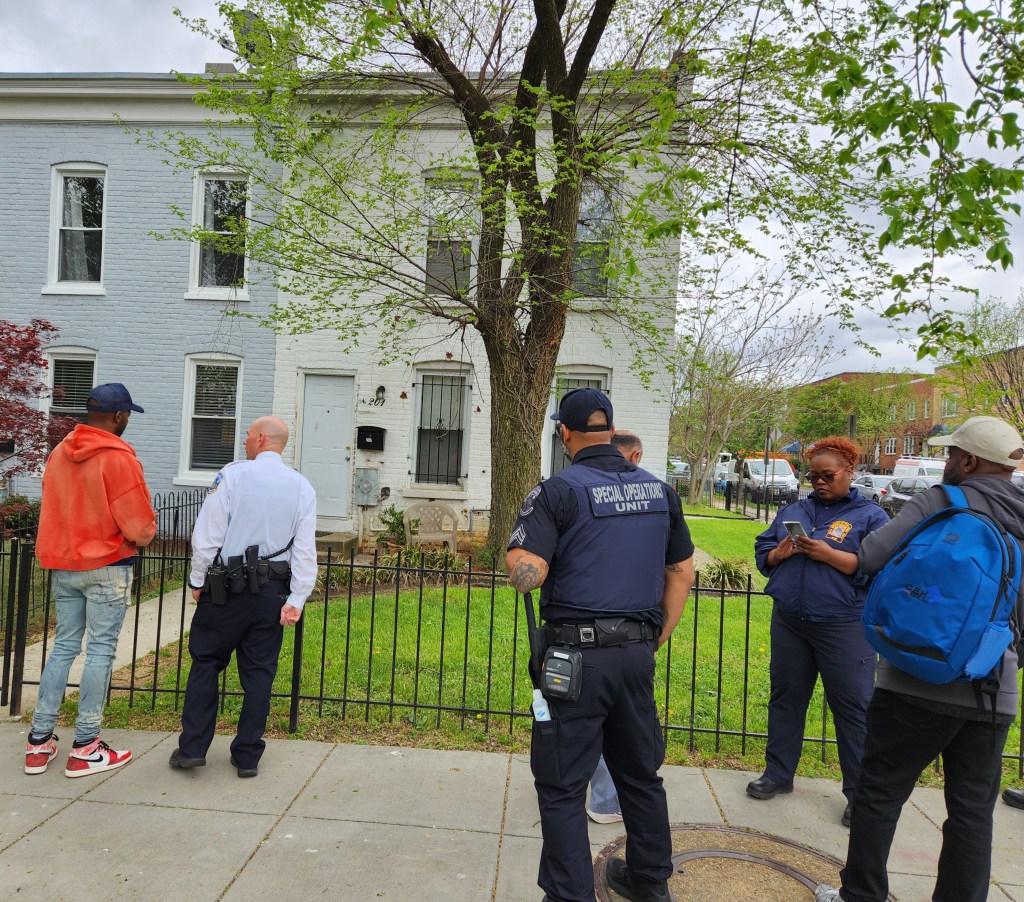
The house at 201 17th Street, SE, which neighbors say is the frequent target of gunfire.
Hill East “Nuisance House” Attracts Gunfire – City Agencies Join Response to Hill East Shootings
by Larry Janezich
Posted April 12, 2023
As was announced on Wednesday night, representatives of numerous agencies convened at 15th and Independence, SE on Thursday afternoon for a walking tour of the alleys and streets near Independence Avenue between 15th Street and 17th Street, SE. The mission was to address in real time environmental and quality of life issues as well as to look specifically at what neighbors say is an illegally occupied house on 17th Street which is a target for drive by shootings
The walk was led by MPD 1D Captain David Augustine and the house in question at 201 17th Street was the final stop. Neighbors say the house is occupied illegally – perhaps by a relative of the deceased owner. The occupant, they say, changed the locks and the legitimate owner was not able to gain access. The house shows evidence of having been struck by rounds fired from passing vehicles. MPD says that the gunfire involves a small munber of individuals and is apparently the result of a dispute with residents of another neighborhood.
City officials say that the address of the corner house has been referred to the Office of the DC Attorney General (OAG) for possible declaration as a nuisance house. OAG can sometimes file legal actions against property owners in cases involving drugs firearms or firearms related nuisances. These actions are aimed at forcing owners of properties where criminal activity occurs to make changes that improve safety and security.
There are specific criteria which must be met for the property to be declared a nuisance – illegal activity is one. The Public Advocate Division of the OAG deals with vacant and nuisance properties. Here’s a link to the list of Divisions of the Office of the DC Attorney General – and emails of the key personal of the Public Advocate’s Office to whom questions regarding vacant or nuisance properties and evictions can be directed. https://oag.dc.gov/about-oag/our-structure-and-divisions
City officials have also initiated a request for a building inspection by the Department of Buildings to determine if the property is habitable. The building would seemingly have to be condemned in order to take action against an occupant and condemnation would require the building to be found to be a public health hazard.
Eviction of an occupant – even a squatter – can be a lengthy legal process and requires initiation by the property owner. Any eviction must be pursuant to a court order, and must be scheduled and supervised by the US Marshals Service.
MPD is currently maintaining a heightened presence near the house to deter additional shootings.
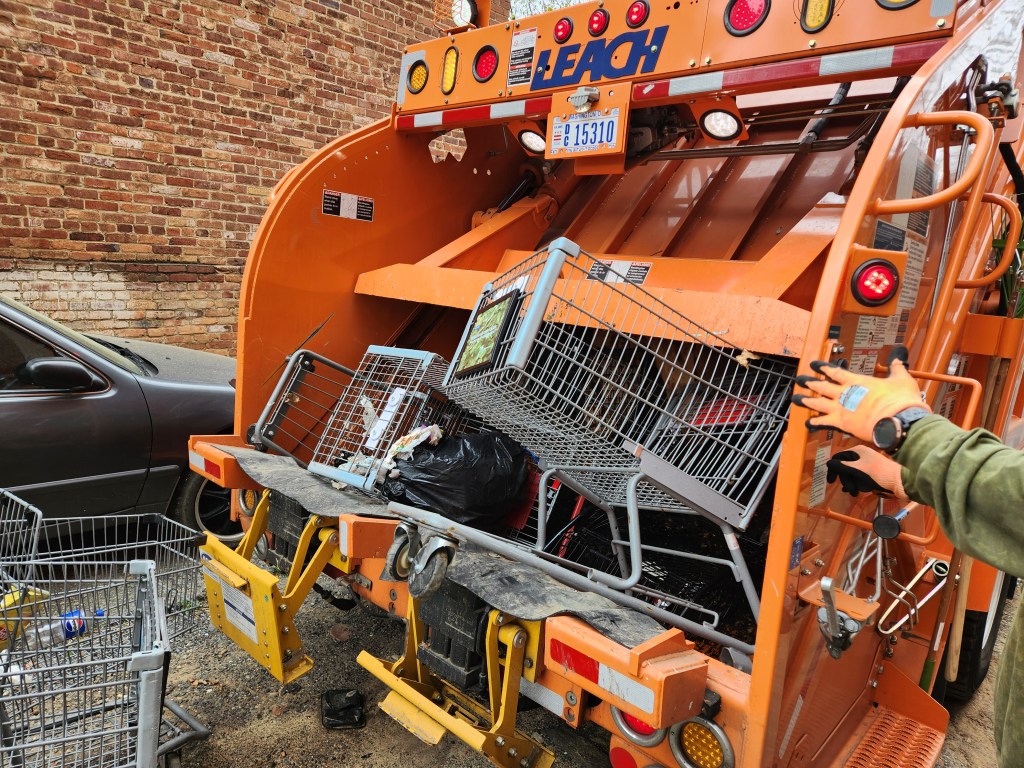
The rest of the walk to correct envioronmental and quality of live problems in real time involved a tour of nearby alleys where city officials found ten abandoned cars, accumulated alley trash, and lighting issues. Though tow trucks were on hand, officials determined that abandoned vehicles on private property had to be inspected and ticketed before they could be removed and requests were submitted to DOT. But DPW had no reluctance in trashing and crushing 8 abandoned Safeway shopping carts which had found their way to an alley off Independence and abandoned on public space.
Regarding the attention law officials are giving to community outreach, it’s noteworthy that US Attorney for DC Matthew Graves will give a presentation to ANC6B’s Public Safety Committee at a hybrid meeting on April 24 at 6:30pm. ANC7D’s Public Safety Committee will schedule a virtual meeting later in the month – TBA – to hear from criminal justice and public safety individuals. And the MPD D1 Commuity Advisory Council will hold a virtual meeting at 6:00pm on the first Tuesday of the month, May 7. https://anc6b.org/ and https://1dcac.com/
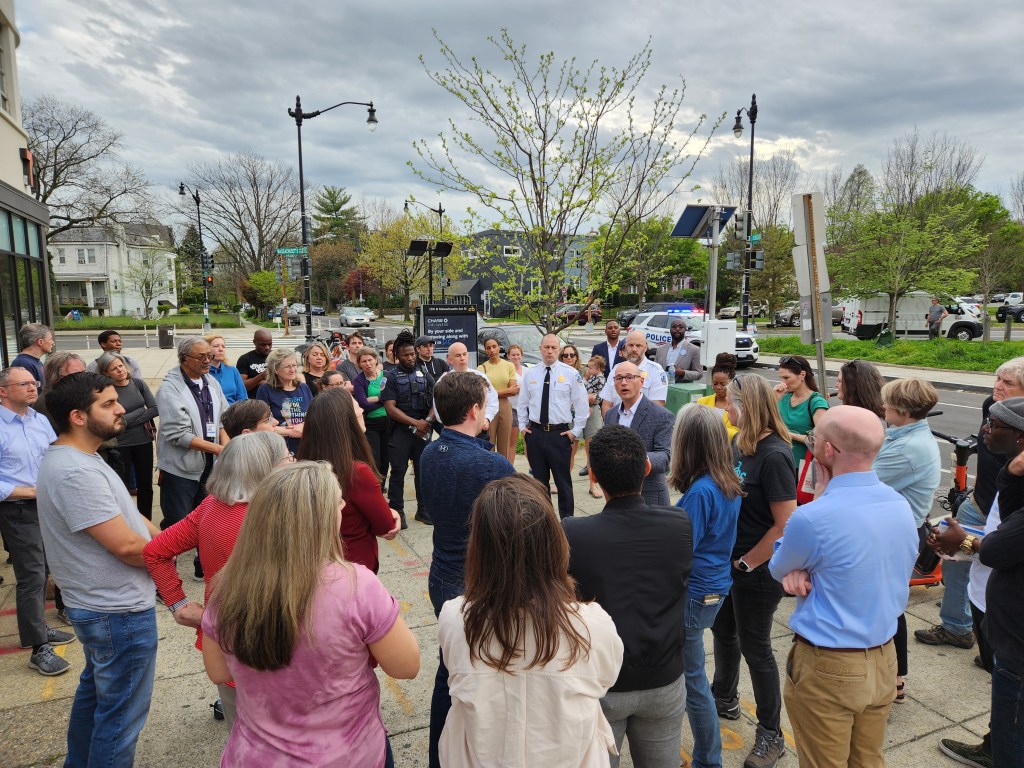
MPD Deputy Chief Kyle (second from left) addresses residents on shootings in Hill East. L-R, MPD 1D Commander Colin Hall, (Kyle), MPD 1D Lt. Seth Anderson and MPD 1D Captain David Augustine (in business attire) – behind him in green top is ANC7D Commissioner Ashley Schapitl.
Here’s an image showing the crowd size at the sidewalk meeting.
MPD Details Response to Hill East Shootings
by Larry Janezich
Posted April 11, 2024
At 6:00pm on Wednesday night, some 50 neighbors around 15th and Independence SE, gathered in front of the 7-11 at that location for an MPD “safety walk.” They turned out because they were alarmed about a spate of shootings in the 1500 – 1700 blocks of Independence Avenue, SE, and wanted to know what MPD was doing about it. ANC7D Commissioner Ashley Schapitl announced the upcoming walk at ANC7D monthly meeting on Tuesday night. (Since redistricting last year, the neighborhood is in Ward 7 but still policed by MPD’s First District.)
A lot of MPD brass turned out: Deputy Chief for Patrol Services Ramey Kyle and from the MPD First District, Commander Colin Hall, Capt. David Augustine, Lt. Seth Anderson, and a couple of MPD officers. In addition, local officials and candidates who showed up included: ANC7D Chair Wendell Felder, 7D Commissioners Ebony Payne, Brian Alcorn, and Ashley Schapitl. Also present were Ward 7 Council candidate Eboni-Rose Thompson (Felder and Payne are also Council candidates), and Brynn Barnett, Chair of ANC7D’s Public Safety Committee.
WUSA and DC Now television news crews showed up.
Residents expressed their deep concerns and fear – sometimes emotionally – about the increase in gun violence in the community. There have been two incidents recently – one in front of the 7-11, and another at 17th and Independence. Some of the neighbors related accounts of their home being penetrated by bullets.
Deputy Chief Ramey Kyle: MPD has put a lot of resources into the area. Regarding two recent shootings, that has been one arrest and there’s one arrest warrant out. In addition, we have “a lot of other things working in the neighborhood.” We have made key arrests – the shootings were targeted and not widespread and appear related to outsiders coming into the neighborhood. There was a spike in crime last July – since then it’s gone down. We believe the shootings in this area might be a neighborhood dispute. There are not a lot of people involved – sometimes very petty disputes and access to guns results in violence. He said he talks with Violence Interrupter supervisors two or three ties a day and violence interrupters have been in the neighborhood.
Asked about a vacant house on 17th Street being related to the shootings and whether it was possible to evict the occupants Augustine said that what MPD can do is address actionable stuff – warrants based on probably cause. He said he was not aware of any pending eviction notice regarding the house.
The declaration of a property as a nuisance property and the issue of eviction fall under the purview of other agencies, including the Office of the Attorney General and the deputy mayor’s office.
Augustine emphasized that what MPD can do in impart visibility to the community and stressed the importance of providing as much detail as possible when calling 911 to help the call center raise the call to a higher priority.
Commander Hall discussed the nature of the whole plan to address criminal justice issues in the area which involves micro beats, increased bike patrols, involvement of the Crime Suppression Team and the Violent Crime Suppression Division, and traffic enforcement and arrests. He said that Operation Atlas which focuses resources on neighborhood where violent crimes have occurred was involved. Finally, he said that a multi-agency walking tour of the neighborhood has been scheduled for Thursday to address in real time some of the environmental and quality of life issues in the neighborhood.
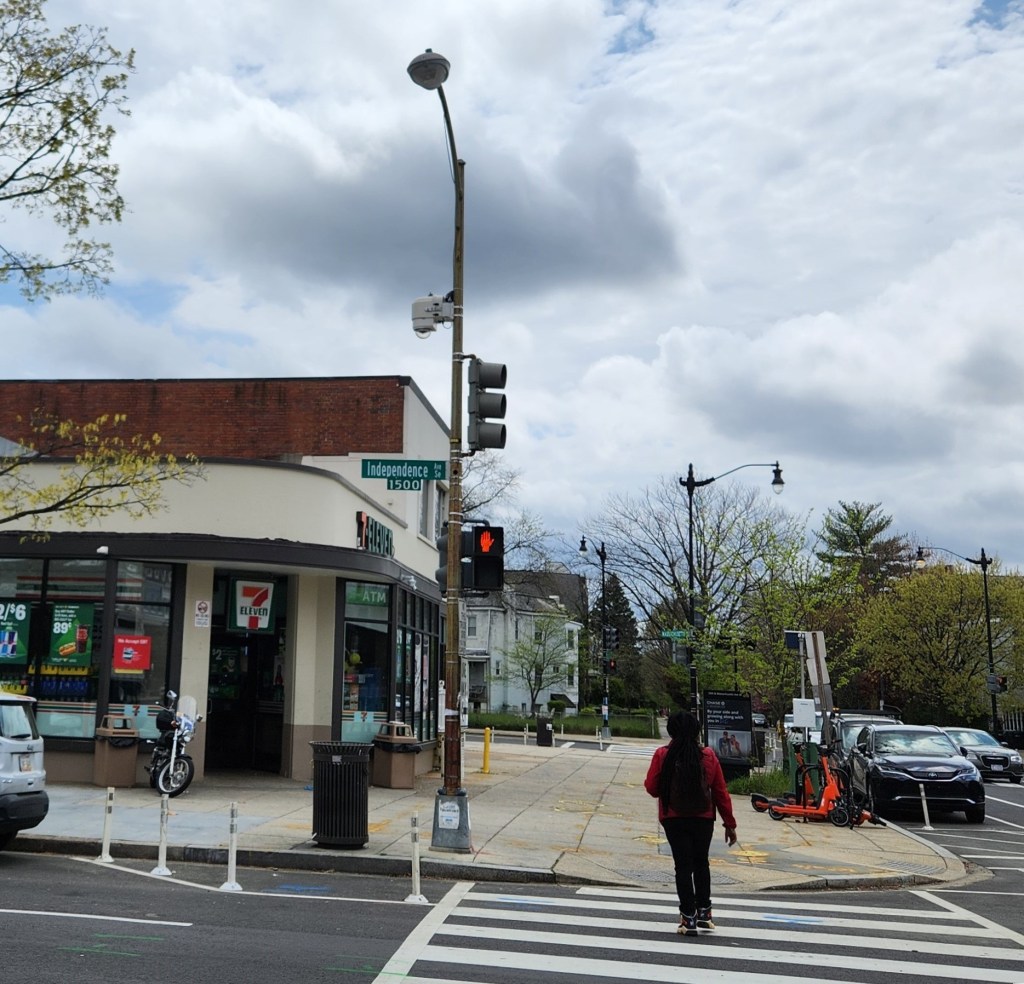
Hall noted that the recently installed 360 degree camera on a light pole at the corner of 15th and Independence helps solve crimes – it “picks up the bread crumbs of crime” and sometimes prevents it. He says MPD craves information and believes they have a great connection with the community which is something they want to build on.
The street corner Q&A period lasted an hour. There have been several meetings or briefings related to public safety this month and one consistent message from MPD is that crime is down significantly compared to the first quarter of 2023 but the crime numbers are likely to show an uptick as warmer weather approaches. One of the best ways for residents to raise their concerns and address MPD and other public safety officials directly is at the monthly First District Citizens Advisory Council virtual meetings. These meeting provide a wealth of public safety information plus the presence of public officials who answer questions from the public. Given that, it’s surprising so few residents with concerns about crime participate or attend. Here’s the link to the 1st District MPD CAC: https://1dcac.com/
Next: MPD/City Agencies focus on the “nuisance” house neighbors call the target of driveby gunshots.
Comments Off on MPD Details Response to Hill East Shootings
Crime Update from Matthew Graves, US Attorney for DC – Tuesday night, April 2, Matthew Graves, US Attorney for DC, appeared at the MPD First District Community Advisory Committee virtual meeting to talk about his office’s enforcement policies and other criminal justice issues. He took questions, and near the end of the meeting, summarized his presentation – as follows:
“I completely understand the…concerns and the frustrations of what everyone – myself included – is experiencing in the community… and that crime is not something you can necessarily address with numbers. Commander Hall and I can tell you all day long that the numbers are going down dramatically in a kind of unprecedented fashion – in part because of the law enforcement actions we are collectively taking – but until people feel it, it’s not go to resonate. So all we can do is continue to employ tactics we’ve been employing which include arrests. But another thing we’ve been doing that’s having an impact is proactively going at the drivers of violence and doing everything we can to get them off the street…. That often looks like a federal prosecution for illegally carrying firearms [or) illegal drug distribution. That’s what we can prove – that’s what we can do that gets them off the streets and we’re doing that – and we’ve taken 100s of people who are very dangerous individuals off the streets that way. That’s why if you look at the jail population right now it’s at a relative recent record high … and it’s not just the number of people in jail – when you look and Department of Corrections statistics on what people are in jail for, I don’t think … we’ve had a greater percentage of individuals in jail for serious violent offenses or firearms offenses…. And I think some of that explains in part why you’ve seen a dramatic difference between the violent crime numbers in the summer and the violent crime numbers now. [We] just have to continue to stick at it and hope that as the trend lines continue … [and] people feel a different way than they felt in 2023.”
Graves will speak again at ANC6B’s Public Safety Committee on April 23. More info to come on CHC’s Week Ahead. Meanwhile, here’s a link to MPD’s District Crime Data at a Glance: https://mpdc.dc.gov/page/district-crime-data-glance
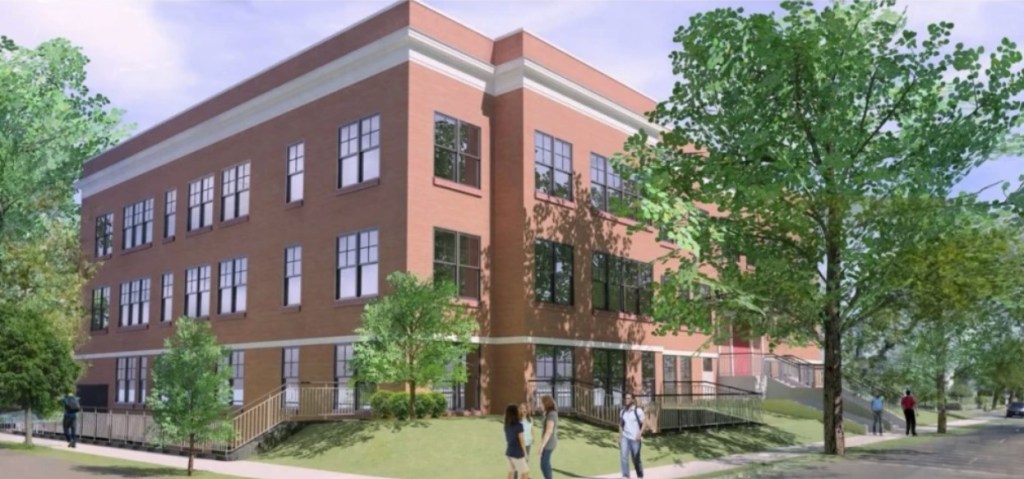
Another Delay for Hilleast Boys and Girls Club Development – Morningstar Development’s plan to develop the Eastern Branch Boys and Girls Club into a 34 affordable unit apartment building has hit a snag. The Board of Zoning Adjustment (BZA) has postponed the Zoning Adjustment hearing scheduled for April 24. BZA says it wants Morningstar to resolve a map amendment issue through the Zoning Commission before BZA takes up the requested zoning adjustment. The Zoning Commission hearing won’t occur until June. Morningstar won the right to develop the city-owned property in 2017. The Eastern Branch Boys and Girls Club is at 261 17th Street, SE. Here’s a link to Morningstar’s presentation to ANC6B in October 2021. The architect’s rendering above is from that presentation. See here: https://bit.ly/3AkTYz8
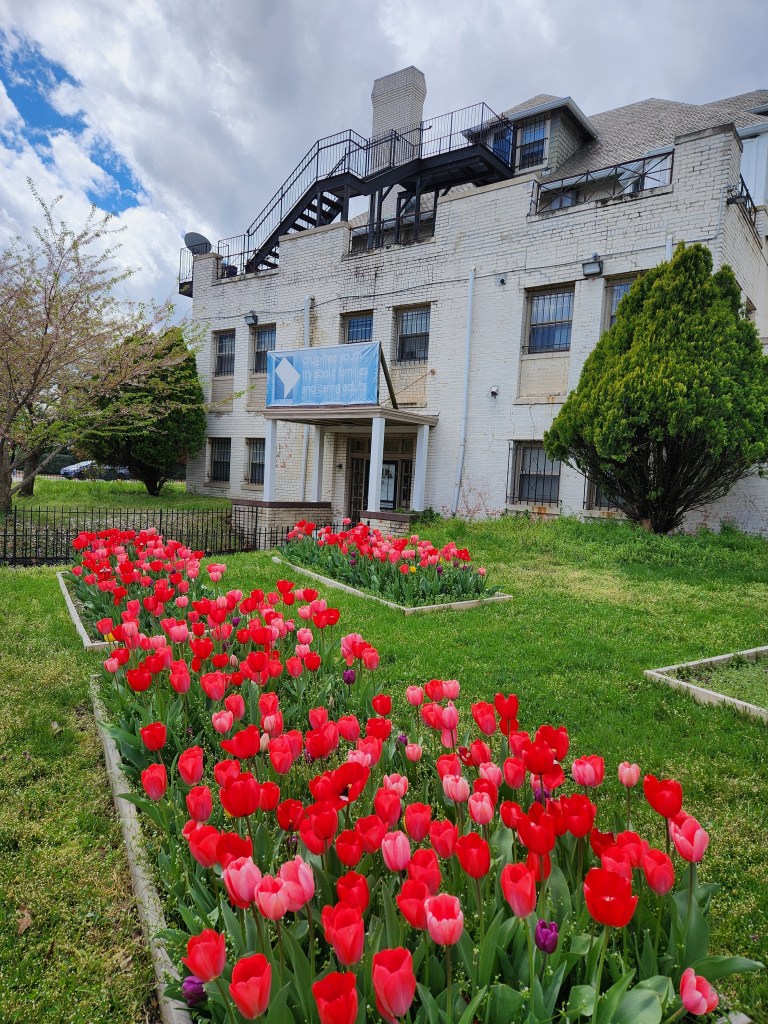
Here’s another example of the on-going community-building work being done by Guerrilla Gardeners – Jim Guckert, founder and Executive Director of Guerrilla Gardeners, in collaboration with Sasha Bruce Youthwork, established a training program in landscape maintenance and urban agriculture at the Sasha Bruce House House campus, 11th and Maryland Avenue, NE. The photo shows tulips from some of the 5,000 bulbs Youthwork project members planted. Guckert says, “These guys are willing and available to do any kind of yard work. They are looking for entry level employment as well. During their internship we focused on workplace skills that are translatable for virtually any kind of opportunity.” Contact Guckert at https://guerrillagardenersdc.org/ Guerrilla Gardeners is a non-profit organization focused on the beautification and maintenance of public parks and gardens throughout the District.
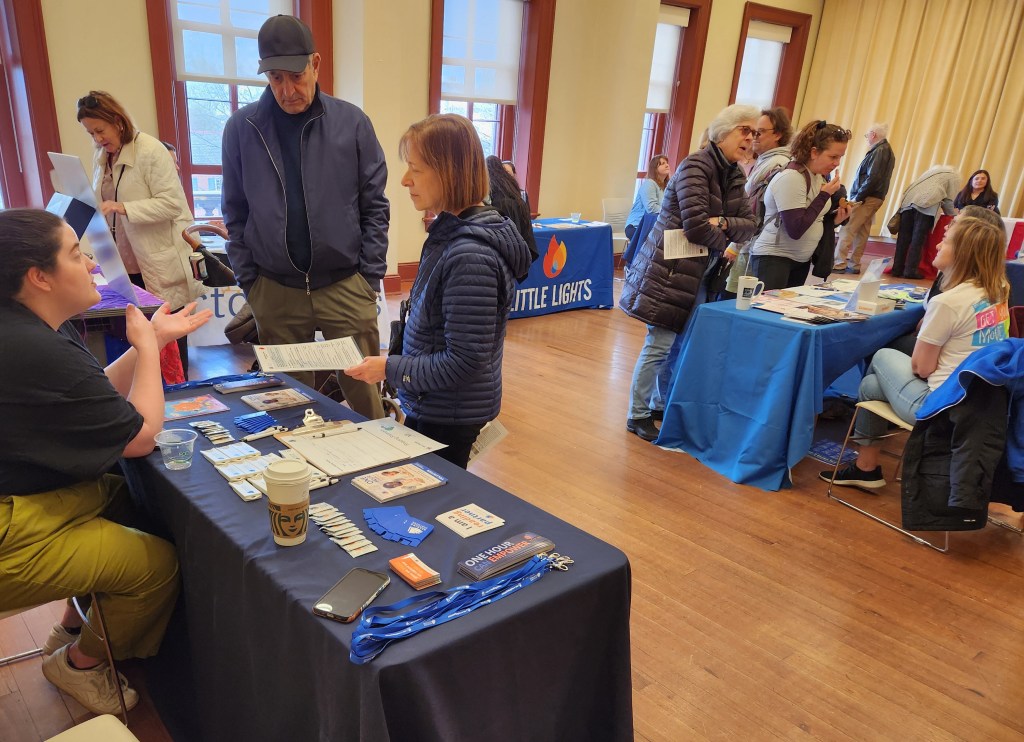
Saturday afternoon at Hill Center – The second floor of Hill Center was taken over by Volunteer Capitol Hill 2004. VCH was established in 2013 by the Old Naval Hospital Foundation and is an annual event designed to showcase the variety of opportunities for volunteer service. Organizations which participated: 13th Street Park & Garden, AARP Driver Safety, Barracks Row Main Street, Capitol Hill Restoration Society, Capitol Hill United Methodist Church, Capitol Hill Village, City Wildlife, Community of Hope, DC Tutoring and Mentoring Initiative, Eastern Market Advisory Committee, Food Rescue US, Hill Center, Horton’s Kids, Kids Connection Haiti, Little Light Urban Ministries, National Capital Bank, Opera Lafayette, Ruth Ann Overbeck History Project, Ward 6 Democrats, and Washington Urban Debate League.
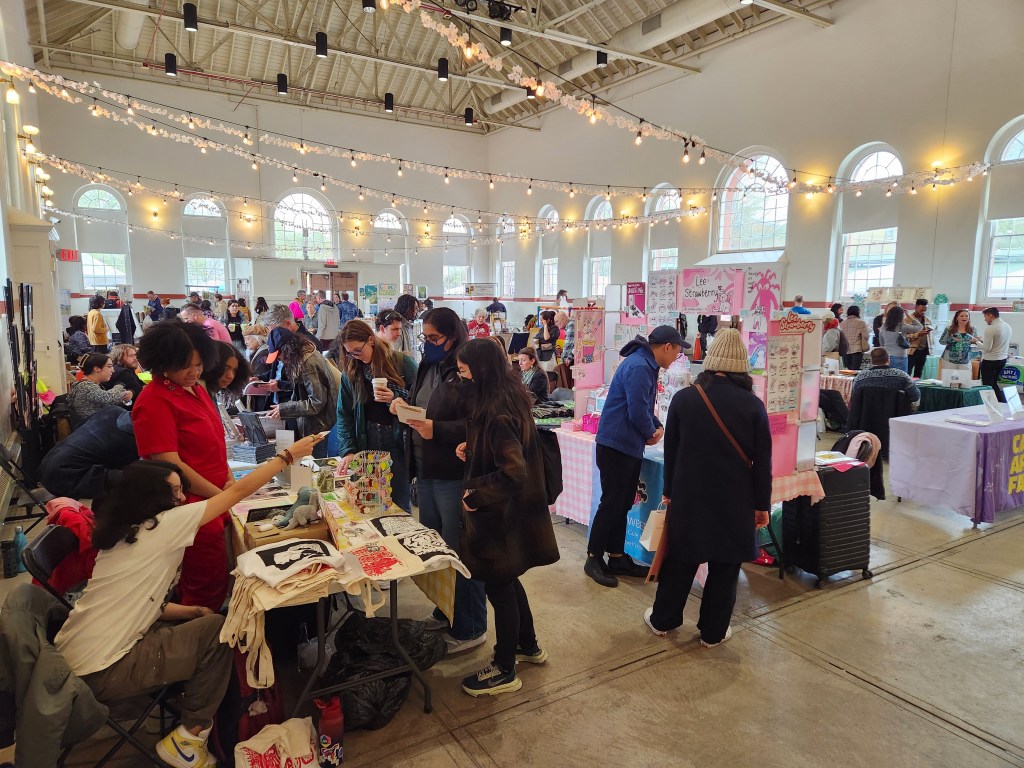
Saturday afternoon at North Hall, Eastern Market – Here’s a shot of the Capital Art Book Fair, an annual event organized by East City Art, which brought together publishers, artists, collectors, and art enthusiasts to showcase and celebrate the world of art books. The Fair serves as a platform for artists, publishers, and independent bookmakers to exhibit and sell art-related publications, which can include artist monographs, exhibition catalogs, zines, photography books, graphic novels, and other forms of printed material which double as fine art. The fair features a diverse range of exhibitors, including established publishing houses, independent publishers, art institutions, galleries, and individual artists. Go here from more on East City Art: https://www.eastcityart.com/
ANC6B will hold a virtual meeting at 7:00pm. Note: This meeting date has been adjusted to avoid conflicts with holidays, religious days, or other events.
Capitol Hill Wine & Spirits; 323 Pennsylvania Avenue, SE; Renewal of a Class A Liquor License
New Congressional Liquor; 404 1st Street, SE; Renewal of a Class A Liquor License.
Alley Signs Behind 700 Block of C Street, SE.
Speed Humps on 600 Block of I Street, SE.
Letter to DDOT Requesting Study of Future Design for I-695.Planning & Zoning Committee Consent Items.
Public Safety Committee Consent Items.
Presentations:
Ward 6 Councilmember Charles Allen – Discussion of the FY2025 Budget.
Transportation Committee
Planning and Zoning Committee
633 E Street, SE, Rear Project: To construct a second story addition, and convert to a principal dwelling unit, an existing, semi-detached, commercial building in the RF-1 zone.
Report on alley closing community benefits agreement, Square 762.
Report of the Committee
Southeast Library Task Force
Update on Traffic Issues Around SE Library.
Report of the Task Force..
Report for the Public Parks and Recreation Spaces Task Force
Public Safety Committee
Motion to change date for next meeting to April 24.
Testimony in Support of Bill B25-0536: The Home Purchase Assistance for 911/311 Call-Takers and Dispatchers Amendment Act of 2023.
Report for the Public Safety Committee.
Eastern Market Community Advisory Committee
Report of the Committee.
ANC6B Administrative Matters
Adjust April Date of Public Safety Committee to Avoid Conflicting with Second Evening of Passover. Suggested New Date: April 24th.
Planning, Zoning, and Economic Development Committee
Application of Heritage Foundation for zoning relief to continue operation of nonadjacent parking lots in the alley complex bounded by 3rd, 4th, D and E Streets, NE.
Motion that ANC6A approve a grant to Miner Elementary School PTO in the amount of $1,000.00 to fund the renovation of a turtle habitat.
Motion that ANC6A send a letter to ABCA to protest the license application of Verg Enterprises LLC at 1230 H Street, NE.
Motion that ANC6A take no action with respect to the application for renewal of a Class A Retail Liquor License by 7 River Mart at 250 11th Street, NE.
Motion that ANC 6A take no action with respect to the application for renewal of a Class A Retail Liquor License by Exotic Wine and Spirits at at 801 Maryland Avenue, NE.
Motion that ANC 6A send a letter of support to the HPRB re new two-story and basement rear addition to an existing two-story rowhouse at 216 11th Street, NE.
Motion that ANC 6A send a letter of support to the BZA Request for a Modification of Consequence from Board of Zoning Adjustment Order to construct a new detached, two-story, accessory garage with second story dwelling unit to an existing, attached, two-story principal dwelling unit at 1127 G Street, NE.
Motion that ANC 6A send a letter of support to the BZA re Request for a Special Exception from the lot occupancy requirements to construct a two-story with cellar, rear addition, to an existing, attached, three-story, principal dwelling unit at 235 10th Street, NE.
Standing Committee Reports:
Community Outreach
Alcohol Beverage and Cannabis
Transportation and Public Space
Motion that ANC 6A send a letter to DDOT Acting Director Sharon Kershbaum, Ali Shakeri, DDOT Infrastructure Project Management Division and Ward 6 Councilmember Charles Allen requesting that the crosswalk be restored at Florida Avenue and M Street NE so that there is a way for west bound bicycles and pedestrians to access M Street NE and the NOMA/Gallaudet metro station and request that the traffic signal division review and adjust signal timing to further slow driver speeds to the existing speed limit on Florida Avenue NE.
Economic Development and Zoning
New Business
Single Member District reports .
Community Comments.
Saturdy, April 13
The NE/SE Libraries Joint April Book Sale to benefit both the Friends of the Northeast and Southeast Libraries is scheduled for Saturday, April 13 from 10-3:00pm, at the Northeast Library.
Capitol Hill Corner would also like you to know about:
Artomatic continues through April 28 at Artomatic, 2100 M Street, NW. For more, go here: https://www.artomatic.org/
Comments Off on The Week Ahead … and Some Photos from the Past Week










 CAPITOL HILL CORNER