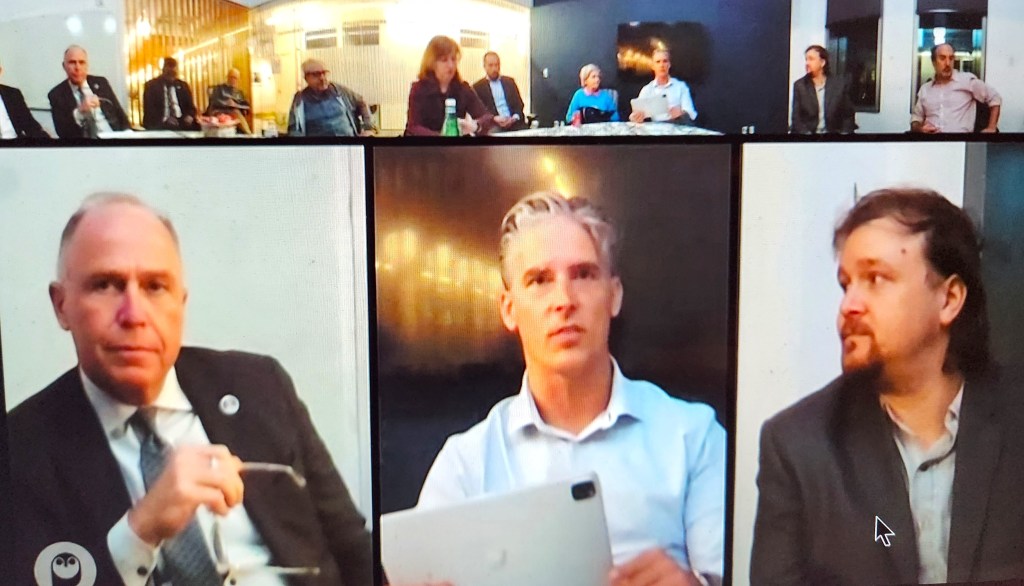
L-R, DC Attorney General Brian Schwalb; Commissioner Brian Gorman, Chair, ANC6B Public Safety Committee; Commissioner Sam Pastore.
Office of DC Attorney General Under Seige, AG Schwalb Tells ANC Committee
by Larry Janezich
Posted October 28, 2025
DC Attorney General Brian Schwalb attended ANC6B’s Public Safety Committee meeting Monday night. He summarized what his office does for the city: serving as its law firm, serving as a public advocate defending and protecting the public interest, and protecting public safety – which he said was broader than prosecuting crime.
He defended the independence of the Attorney General’s Office noting that “our Mayor has never been a fan of an independent Attorney General” but it’s a necessary check on executive power. Currently, he said, his office was very much under siege and an attack from the federal government. For example, after filing lawsuits against the federal government for taking over the MPD and deploying out-of-state National Guard in the city, Schwalb said a member of congress introduced a bill – in collaboration with the White House – to change the independent elected DC attorney general to a presidential appointed attorney general with no Senate confirmation. The proposed law would make the attorney general accountable to the President – which allows for the office to be weaponized. The bill has passed the House Committee on Oversight and Government Reform and will come up on the House floor at the discretion of the Speaker of the House.
He cited another bill which reflects the administration’s hostility to the District – supposedly in the interest of public safety which Schwalb termed a “ruse” used to attack home rule – the Judicial Nominations Reform Act which would abolish the District’s Judicial Nomination Commission which currently vets and recommends candidates for DC’s local courts. The bill would shift shift this power to the President with confirmation by the Senate.
He also pointed to the House of Representatives’ passage of the Juvenile Sentencing Reform Act that would – at the discretion of the US Attorney General – lower the age from 16 to 14 for prosecution of District juveniles as adults for some violent crimes, including murder, first-degree sexual assault, first-degree burglary, and robbery while armed or assault with intent to commit any of these offenses.
Schwalb criticized the District’s bifurcated criminal justice system which provides for the prosecution of adults by the District’s US Attorney and juveniles by the DC Attorney General. He says we need a local prosecutor accountable to the people of the District.
He said that there are 16 bills* before Congress that would change the way home rule operates in the District and debate on all of them is on-going. He urged residents to support home rule.
Appearing under a time constraint, Schwalb took several questions from members of the public and the Public Safety Committee. On the issue of enforcement against reckless moped drivers, he offered criminal prosecution where warranted and a potential investigation of the questionable operation of problematic third party providers – neither suggestion provided much satisfaction to the father of a child who had received a concussion from a recklessly operated food delivery moped. (See CHC post here: http://bit.ly/3WtcTW0 ) Similarly, he could not offer much insight with respect to a question about the performance of Department of Youth Rehabilitation Services owing to the “difficulty in measuring recidivism,” or much hope with respect to a question of progress on renovating the DC Jail, noting “it’s in our interest to get jail repaired – but not easy with tight dollars.”
*In addition to the bills affecting home rule mentioned by Schwalb, some of the other 16 bills pending in Congress which would affect DC home rule include:
- Repeal of policing legislation: Overturns police reform legislation the D.C. Council passed after the murder of George Floyd.
- D.C. Policing Protection Act: Expands the circumstances under which police officers are allowed to engage in vehicular pursuits.
- Amendments to the Youth Rehabilitation Amendment Act: Would eliminate judicial discretion to sentence eligible youth offenders below a mandatory minimum and restrict youth offender status for individuals convicted of certain crimes.
- Repeal of the Incarceration Reduction Amendment Act: Nullifies a D.C. law that allows juveniles to petition for early release after serving 15 years.
- Bail system overhaul: Requires pretrial detention for anyone charged with a “violent or dangerous offense,” including some felony drug charges, and brings back the use of cash bail for certain crimes.
- Criminalizing homelessness: Makes it illegal to sleep in public places, including in a car.
 CAPITOL HILL CORNER