
Hine Project Architect Amy Weinstein Briefs Historic Preservation Committee Members - Stanton Development's Kitty Kaupp Looks On
Restoration Society Historic Preservation Committee Gets First Look at Revised Hine Drawings:
Members Give Lukewarm Welcome to Some Proposed Changes
by Larry Janezich
The Restoration Society’s Historic Preservation Committee got a peek at Stanton/Eastbanc’s revised plans for the Hine development Tuesday night. Project architect Amy Weinstein briefed the committee at its regular monthly meeting.
Weinstein described the major changes she has in mind for the project while emphasizing that it is still a work in progress.
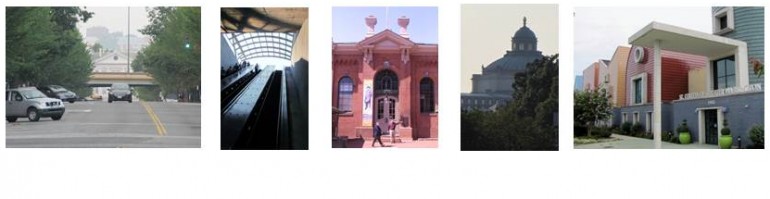
Current thinking is that the façade of the 8th Street residential building should look like “terrace housing” with a unified design. Weinstein cited several examples of terrace architecture, pointing specifically to “Schneider’s Triangle” near Washington Circle, referencing its variety and interesting massing. http://www.flickr.com/photos/anomalous_a/4290184760/ The color palate of the 8th Street residential building will be red brick, purple red brownstone, and real slate, with the entrance of the building set off by grey brick. No changes to the height or basic structure of the residential building were detailed at the meeting.
The 8th Street building facing D Street will retain its modern façade. Bay windows projecting four feet on upper floors have been added, and the columns crowning the top story will be reduced to balustrade level, bringing down the buildings height. The façade will be gray brick. A committee member said that the grey brick courses separated by a course of white brick suggested a stack of concrete blocks. Another raised the issue of the ungainly tower on the southwest corner of the building which houses the air-conditioning. Another committee member questioned the “change in language” from the 8th Street residential Victorian façade to the modern façade of the 8th and D office building. Weinstein defended the modern look, saying, “I believe as we move forward in the Historic District, we have to find a way to be modern and still be respectful.” Questioned about the placement of the windows in the modern façade as not in keeping with other aspects of the project, the architect said she respectfully disagreed, and that there was a place for “playfulness” and “idiosyncrasy.”
With respect to the use of the ground floor space in the 8th and D building, Weinstein says that three possibilities are being considered: Shakespeare housing, office space, and “light” retail.
The 7th floor of the 7th and Pennsylvania office building will be set back 12 feet and the penthouse will be minimized, providing the perception of a lower building; as of now, no floors have been eliminated entirely. A glass railing on top of the 6th floor will enclose a roof top “communal” roof deck. The asymmetrical rotating columns on the 7th Street office building remain.
Stanton Development will go back to the Historic Preservation Review Board (HPRB) on June 30th for historic preservation review of the 8th Street residential building, the 8th and D Street office building, and the 7th Street office building. Weinstein characterized Stanton’s efforts in the upcoming reappearance before HPRB as responding to HPRB’s comments – “not everything, but what would work for us.” Stanton will file the revised plans with HPRB on June 14th or 15th, to allow time for HPO staff analysis. ANC6b will hear from the developers on June 21st and consider a resolution of recommendations to HPRB on that date.
In July, the developers will return to HPRB with revised plans for the 7th Street residential building, the plaza, and the North residential building.
Following the presentation, the committee went into executive session to discuss the Hine case and other matters before the committee.
Asked if the committee would make a recommendation in light of the fact that the drawings they saw tonight were still a work in progress, committee chair Nancy Metzger said “I don’t know what we’re going to do. We may make comments to the developer based on what we heard tonight.” Asked if the developers would appear before the committee prior to the HPRB meeting or if the committee would meet again before the HPRB meeting, Metzger responded “no,” but “when the drawing are filed with HPRB we will discuss them by email,” and, she implied, make a recommendation to HPRB at that time.
In addition to Chair Nancy Metzger, other members of the committee who attended tonight’s session included Judith Capen, James Dean, Shauna Holmes, Marisa Lewis, and Georgina Ardelan.
The Special Call Meeting on the Hine Development Project on June 21st will be at the Peoples Church, located at 535 8th Street, SE. The meeting will start at 7:00pm.


Pingback: Morning Links: The Future is More Expensive - Housing Complex - Washington City Paper
There is a place for “playfulness,” “idiosyncrasy,” and the ” whimsy” from the last review, but I’m just not seeing them, or maybe Weinstein isn’t describing the new plans well enough. In any case, yes, there can be modern construction, but Weinstein isn’t being respectful at all. In fact, designing a single building with several different personalities reminds me of Jenkins Row, not at all something for which to aspire. Not not something that fits in with historic Capitol Hill. Why can’t it look more like the old naval hospital or the eastern market building? Or even Butterfield Houses?
MC, I agree with you that taking inspiration for Butterfield house (even with a modern looking glass and brick 1st story retail level) would be a welcome change. For some reason the folks working on this can’t move past the terrible architecture they placed across the street despite it being a wart on Capitol Hill’s face.
It is more obvious now than ever in the course of the Hine redevelopment process that Amy Weinstein is incapable of designing a project of this size that is compatible with the historic nature Capitol Hill. She just does not get it – and moreover, has given every indication she does not want to ‘get it.’ She wants to build what she wants to build and in the meantime the community and historic interests are a thorn in her side to be suffered through.
The smaller in-fill structures Weinstein has already designed and executed on Capitol Hill, while unattractive at best to most, at least do not overwhelm the surrounding neighborhoods (perhaps with the exception of Stanton Park – how ironic). An entire city square filled with Weinstein’s design will not only blot out the sun and sky but offend the eyes from every corner of the “heart of Capitol Hill.”
If its true that the city’s requirements for the project impede the developer’s ability to design structures of compatible height and massing, then its time to go back to the city and change those terms. Economic times and assumptions have dramatically changed since the award of the right to develop Hine. The developer should be allowed sufficient flexibiliy to design a truly compatible development, which for good or for ill will dominate our neighborhood forever.