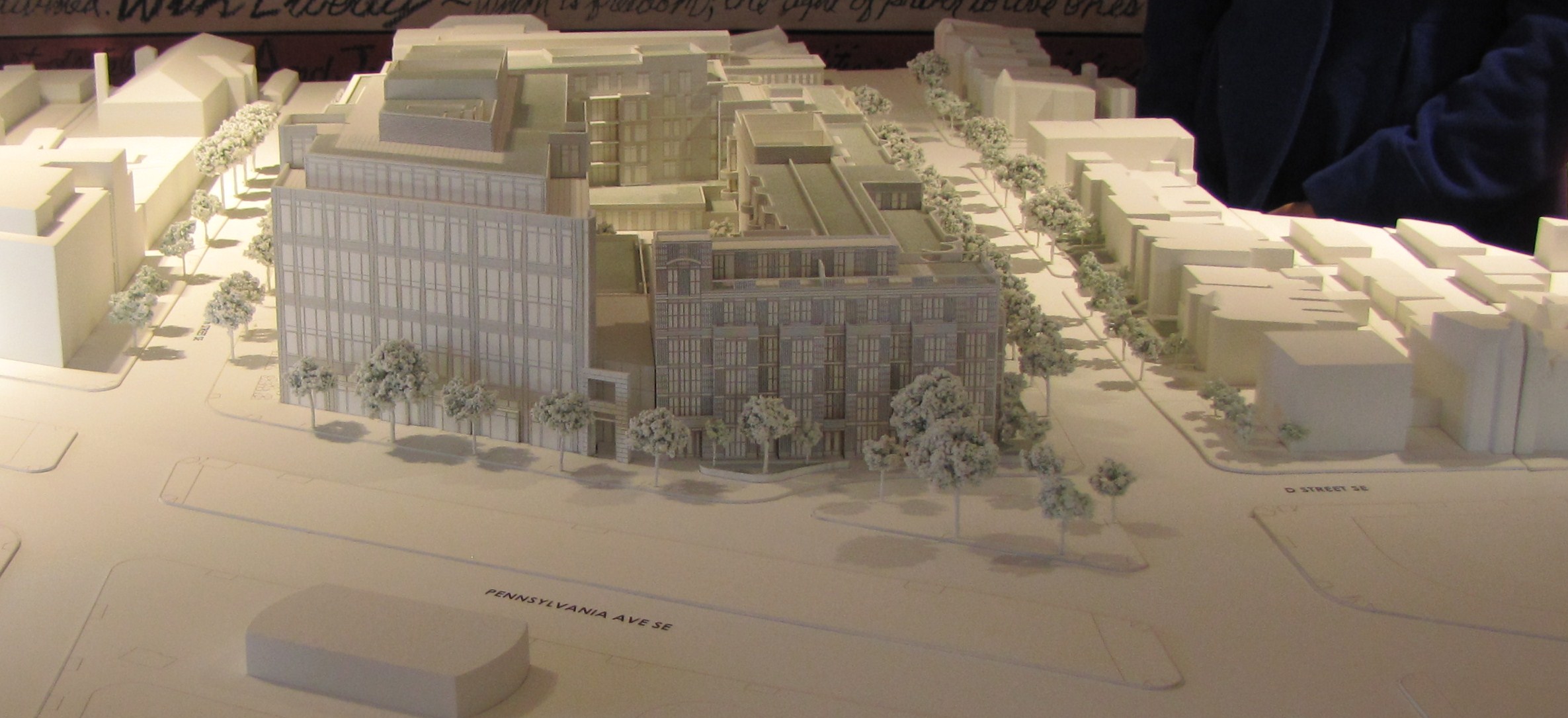
The Hine Development – Looking north from above Pennsylvania Avenue – Eastern Market is in the upper left hand corner.
Editorial: The Hine Project: Part 2 – What We Lost and What We Gained
DC as A Developer’s City
by Larry Janezich
On August 14, the DC Court of Appeals affirmed the decision of the Zoning Commission on the Hine Development, ruling against the petition of the Hine Coalition urging reconsideration of the Zoning order which would permit construction on the site.
On August 28, the group played their last legal card and petitioned for a rehearing before the full nine-member Court. The group’s attorney, Oliver Hall, advised in a note to the Coalition, that petitions for rehearing are rarely granted and there is no way to know how long that might take.
Here, in summary, is what the residents of the city and the Capitol Hill community lost or will likely lose as the result of the Hine deal between the city and Stanton East Banc (SEB):
- A junior high school, closed with little or no input solicited from the families Hine was serving at the time or those it might serve in the future, and one that, had it remained open, could have been a key node in the much-needed public middle school revival effort taking place on Capitol Hill, a revival which increases property values, invests in the future of our city, and improves the neighborhood’s quality of life.
- A reasonably-sized Hine development project compatible with size and scale of the neighborhood and the Capitol Hill Historic District.
- Much of the weekend flea markets as we know them. Sunday’s flea market manager, Mike Berman, estimates perhaps only one third of his market will fit on the space to be provided on 7th Street during the 27 month construction period. Given that his market in its current size would not fit on the completed site, Berman says he is actively talking to other venues that can accommodate more of his vendors and considering a permanent relocation to those sites. Significantly, the number one priority of the community in all of the meetings on the Hine project has been preservation of the flea market.
- Any significant open, recreational, individual, community or green space on the site.
- Trust in our city’s political process and its bureaucratic and civic institutions.
- A balanced mixed use project. In February, 20ll, citing a limp economy, SEB announced a re-orientation of the project away from being primarily office space to being primarily high-end residential. The developer increased the allotment of square footage for residences by 114,021 square feet and upped the number of units by only 8. This reallocation meant a substantial increase in the average square footage and the price of the residential units, away from affordable and middle class housing and towards luxury, high-end apartments and condos.
Here’s how the Hine Project changed between the developer’s March 1, 2009, Best and Final Offer selected by the Deputy Mayor as the winning bid, and the final Zoning Commission PUD application submitted by Stanton East Banc on November 23, 2011:
Best and Final Offer, 2009 PUD Application, 2011 Change
Total Square Feet 401,648 464,276 +62,630
Retail s.f. 48,285 46,699 -1588
Office s.f. 213,197 163,392 -49,809
Residential s.f. 140,166 254,187 +114,021
No. Residential Units 150 158 +8
Parking 391 260 -131
On December 23, 2012, the Office of DC Counsel issued an opinion that the changes did not constitute grounds for re-bid of the project saying that it was within the authority of the Deputy Mayor’s Office to approve them.
So here’s what we end up with:
- A 90 foot high out-of-scale project, approved at every level of city government, in disregard of the city’s zoning and Historic District standards; in short, a Ballston/Clarendon type development, out of character with the neighborhood.
- A large complex of mostly very expensive residential units – which will undoubtedly be marketed by Stanton partner Kitty Kaupp and her agent/broker associates at Coldwell Banker, many of whom were the residential “voices” filing individual notes in support of the project while failing to identify their own financial stake in it—and, when Capitol Hill Corner identified it for the city, the city did not care.
- A likely change in the involvement of the local developer partner of the project – although Anthony Lanier of East Banc says he has never given up management/ownership of a development once completed, Stanton has suggested they might not be an actively involved continuing partner in the long term management of the property.
- Segregated affordable housing in the North Building which is inferior in design and amenities to the South Building – a fact that casts an ugly pall over the complex, and the neighborhood.
- A potential upgrade to market value (and hence loss) of the affordable housing units in the North Building after 40 years (the Appeals Court ruling raised questions about this).
- Community benefits credited to Stanton East Banc but paid for out of the pockets of DC taxpayers, including the reopening of C Street, a 24 child day care center, office space for ANC6B, $75,000 for a nearby playground and $50,000 in improvements to the Metro Plaza.
- Stanton East Banc control of the newly reopened C Street between 7th and 8th Streets which will be available for vehicle traffic on weekdays (when not used for Hine Development-sponsored street events that impose noise and crowds on the residents of the Hine project as well as existing residential and business neighbors – to its credit, ANC6B has negotiated a voice for itself and the nearby neighbors regarding how the street can be used).
- A retail plan for the project, the components of which are unclear but Stanton has hinted athigh-end boutique retail. Some retail – such as the Rodman’s wine and discount gourmet food outlet mentioned by Stanton as a potential tenant – would be in head-to-head competition with neighborhood institutions like Eastern Market or existing 7th Street businesses. High prices per square foot for leasing retail space will only be affordable for chain outlets or restaurants, contributing to the homogeneity of the neighborhood. Stanton, meanwhile, given its other ownership of real estate on 7th Street between C Street and Pennsylvania Avenue will monopolize that available retail space, with obvious noncompetitive results.
From an initial developer selection process which invited public participation but was marred by conflict of interest, to the Historic Preservation Board decision rubber stamping the Amy Weinstein plan, to the ANC’s efforts to downsize the project during the Historic Preservation Review and Public Unit Development (PUD) process while being hamstrung both by insufficient information and lack of backing by CM Wells, to a casual – some would say cavalier – Zoning Commission hearing disadvantaged by insufficient information and characterized by indifference on the part of commissioners as well as a willingness to defer to other city agencies, Stanton/East Banc’s proposal for the Hine development has advanced from planning to the verge of construction.
This advance has come by virtue of giveaways and allowances made by the Deputy Mayor’s Office, ineffective regulation and oversight by the city’s agencies and community civic organizations, and a hands-off approach by City Councilmember Tommy Wells, who, over time, received considerable financial support from individuals and corporations affiliated with the Hine Development.
Moreover the Court of Appeals’ ruling in favor of the developer of the residents’ appeal of the Zoning Commission decision to approve the height and scale of the project, confirms a practice under which projects that enjoy political favor can move through the city’s approval process without a complete and transparent record, without serious examination and required scrutiny.
Given the record on the Hine project, an alternate and perhaps preferable approach would be to remove all trappings of public input from the development process – because that is what they are – and instead require the councilmember and the mayor to take ownership of the process from start to finish.
As it stands, the record on Hine has underscored the recent reporting of WAMU radio station, where it was listed as one of the examples: Washington DC truly is a developer’s city. (See here: http://bit.ly/1oHHnzu)
It is noteworthy that in all of the commentary in support of the Hine Development no one is trumpeting a superb design. The gist of the favorable commentary on Hine seems to be, it’s flawed, but at least it’s better than what is on the site now, and since it will provide density near Metro, that’s good enough.
Recently, CHC has heard some residents say – some grudgingly – “it’s time to move on, let’s just get on with it.” The residents who launched the appeals process have been labeled obstructionists, and blamed for delaying the project at the cost of some $4 million in lost revenue to the city. It’s not at all clear that the delay is unwelcome by the developer. FOIA documents show that financing was not in place when the project closed, which is usually the standard procedure and political intervention allowed the developer to close without it.
If the community has suffered from the delay in the project occasioned by the litigation and if the developers were truly inconvenienced by the delay, and if the city has lost $4 million, it would seem a small price to pay for sending a message to the city and the developers that there is a penalty for riding roughshod over the people who will be most affected by the development when their voices are dismissed or discounted. Residents have a right to feel duped; the political process has failed them.
The Hine Development is a shabby return on our investment, more reflective of the city’s compromised politics than residents’ longstanding commitment to this great neighborhood.
(Ed. Note: The Hine Project: Part 1 – How It Happened: DMPED, Stanton/Eastbanc, Local Politics, and Tommy Wells
can be found here – http://bit.ly/1rdjDVQ)







 CAPITOL HILL CORNER