Bid to Expand “Residence” near Capitol Building Ensnarls ANC Zoning Committee
by Larry Janezich
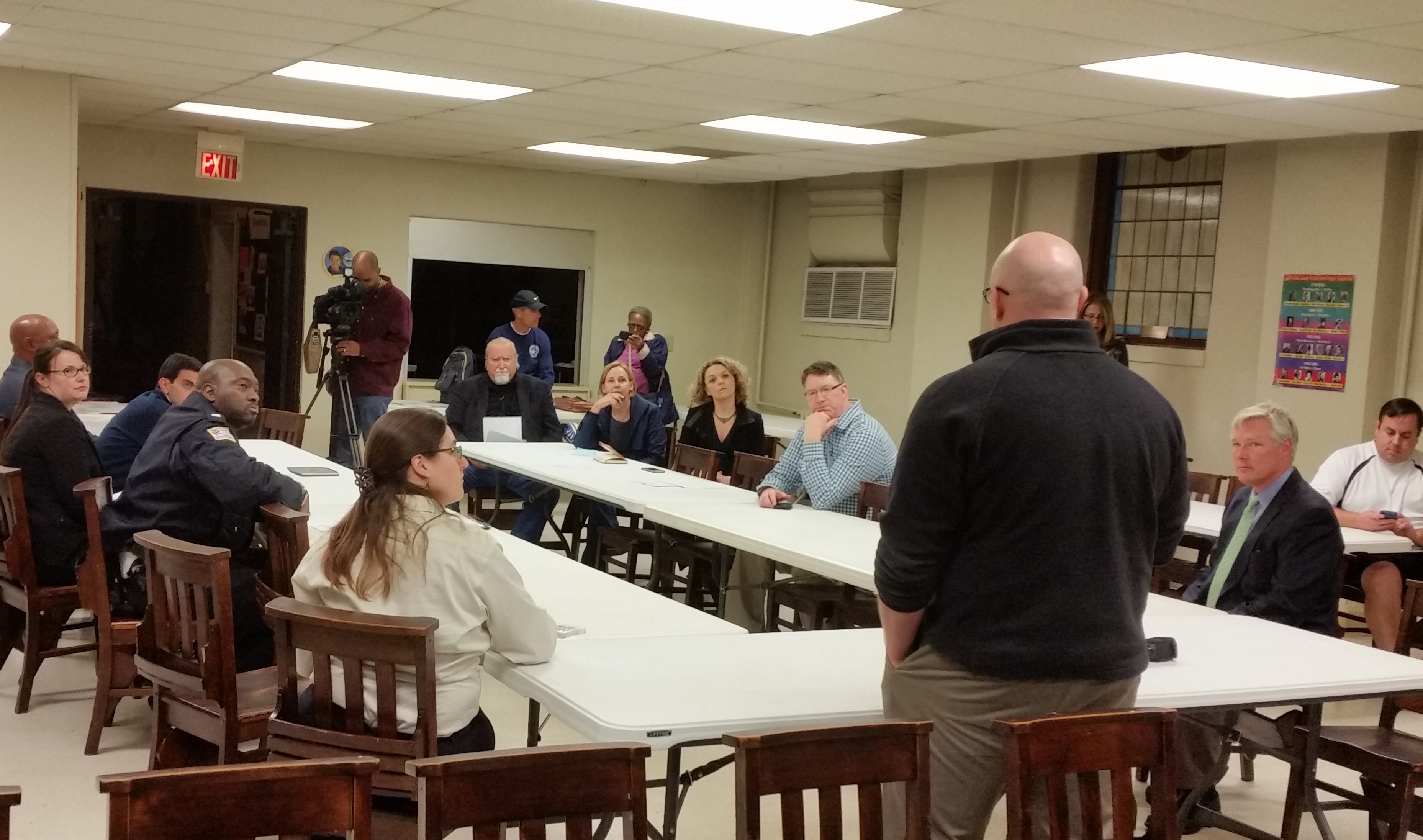
Tuesday, night, ANC6B’s Planning and Zoning Committee found itself entangled in a contentious dispute over a request to set aside zoning regulations to allow a new third story on the rear of a townhouse which is the office of a non-profit business. The building, at 160 North Carolina Avenue, SE, sits on a residential block a stone’s throw from the US Capitol Building. Nearby neighbors, who live on the historic residential block, are vehemently opposed to the addition.
The facts of the matter are as follows:
- Aaron Presnall has applied to set aside zoning regulations for the new construction on an existing one family dwelling. The building is the office of The Jefferson Institute, an international nonprofit, which holds the deed to the property. Presnall and his wife are the only employees, and claim the property as their primary residence – though they actually have lived in live in Chevy Chase, where their children attend school, since 2012.
- The criteria for setting aside regulations include the requirement that the applicant demonstrate that existing regulations provide an “exceptional and undue hardship upon the owner of the property.” BZA may grant a request for relief, only if “the relief can be granted without substantial detriment to the public good…”
- According to Presnall’s architect, if the request to relax the regulations is denied, there are other options to build by-right, but those ideas, he said, had not been “fleshed out.”
Neither Presnall nor his architect were prepared to discuss in detail the basis for the claim of “undue hardship.” Presnall’s stated reason for expansion of the residence is to accommodate his growing family – disregarding that they apparently do not live there now, and Presnall did not tell the Committee he intended to move them there.
Neighbor Lawrence Johnston, spoke in opposition to the application, on behalf of himself and the dozen or so neighbors in attendance. Johnston pointed to numerous discrepancies in the application, emphasizing that it was the belief of the neighbors that the family had never lived there, and that it was actually and primarily the business office of The Jefferson Institute – as evidenced by the plaque on the front of the building. He also pointed to the precedent setting nature of the request, claiming that approval of the requested variances would create an unacceptable precedent in a historic district.
Finally, Johnston asserted that the Presnall had not met the statutory test for a variance, citing the opinion of the Capitol Hill Restoration Society. A report of the CHRS Zoning Committee which reflects the opinion of the CHRS states: “The plan is to raise the existing rear sloping roof to 35 feet so it is not visible from the street. The lot is large and contains 2425 square feet. The house and garage already occupy 80% of the lot (1940 square feet). The house currently has 4 bedrooms and one full bath. When completed, there will be two full baths and three bedrooms. The applicant is a family of two adults and two children. The committee believed that the house was very large and that the applicant did not meet the test for a variance. Refinishing the basement can provide for any amenities that applicant may want.”
The debate on the issue was heated. The Planning and Zoning Committee chair and former chair, Commissioners Nick Burger and Kirsten Oldenburg, supported approving the request for a variance. Other commissioners on the committee including Chander Jarayman , Denice Krepp, Daniel Chao, and Diane Hoskins all expressed opposition to the application.
Burger moved to recommend that the full ANC support the request and to add language to a letter to BZA to express concern about the legitimacy of the occupancy permit for operating a business in the house (which is contingent on the building being the primary residence of the owner). Burger told the committee that he was sympathetic to the neighbors’ concerns but, “My view is that this is a zoning case, and not a particularly exceptional one. We have approved other requests that have had a lot more impact…I believe the applicant has passed the zoning test requirement.” Oldenburg justified her support, saying, “I don’t want to go down the road that if we don’t live there you can’t change it.” Resident member and former ANC6B Chair Ken Jarboe warned that the ANC had to consider the case “within the context of the regulations…we can’t be arbitrary and throw the regulations out the window.” He said the other issues raised beyond interpreting the zoning regulations were irrelevant.
These remarks didn’t sit well with their fellow commissioners. Jayaraman said the committee had to look at the entirety of the case, saying he did not think the applicant had met the requirements for relief. He was joined by Krepp who said it would be a “disservice to our constituents if we do not take a broader view.” Chao also disagreed with the notion “that we have to operate within the box.”
Commissioner Diane Hoskins said she thought the role of the ANC Burger was suggesting “is too narrow – it handcuffs us and makes the role of the ANC less relevant.” Hoskins moved to recommend that the full ANC oppose the application pending receipt of additional information regarding the need for a variance.
The Hoskins amendment to the Burger motion was agreed to 7 – 4 – 1, with Commissioners Hoskins, Krepp, and Jayaraman, Chao, and Ridge supporting the amendment, and Commissioners Burger and Oldenburg opposed. Commissioner Samolyk – in whose single member district the property resides – abstained. (The other five votes in the total were cast by resident members.) The matter now goes to the full ANC for consideration at its next meeting where only Commissioners may vote.
Capitol Hill corner spoke with Gary Peterson, chair of the Capitol Hill Restoration Society’s Zoning Committee regarding the Society’s opposition to the request for a variance. Peterson is a former Department of Justice attorney specializing in eminent domain, and is an expert on DC zoning regulations. The CHRS generally takes a harder line about new construction in the Historic District.
Peterson said, “The problem is that the applicant has not shown the hardship. The house has a huge basement which the applicant actually uses as a bedroom. It’s an immense house. You can’t get increased space just because you want it. It’s a four-bedroom house for two adults and two children, where’s the hardship? What is the hardship preventing them from being able to use this house?”
ANC6B will meet on Tuesday, March 8, at 7:00pm in Hill Center.
For the BZA Rules of Practice and Procedure go here: http://dcoz.dc.gov/bza/rules.shtm