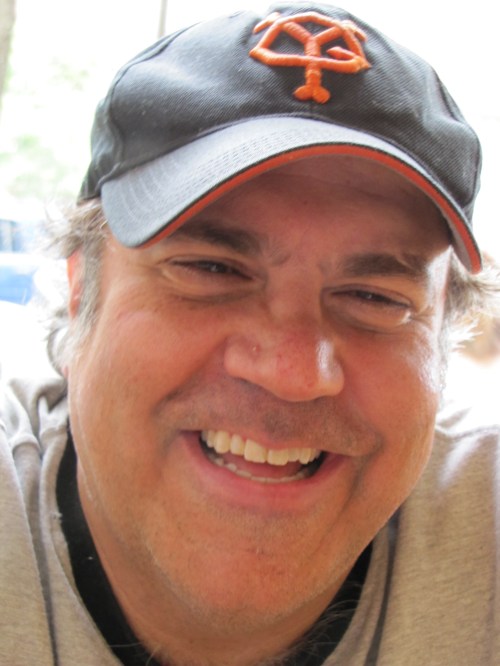
Joe Englert, H Street Restaurateur and Developer
Economic Gentrification of the Atlas District – Perspective: Joe Englert, H Street Restaurateur/Developer
by Larry Janezich
From Wikipedia:
“Joe Englert is a Washington DC area restaurateur.[1] He became known in the early 1990s for creating quirky themed bars, restaurants and entertainment venues on U Street[2]
In 2006, he began a venture to revitalize the Atlas District along H Street NE and turn it into a nightlife destination.[3] Englert purchased eight properties along on H Street to coincide with the city’s plan to renovate and reopen the long defunct Atlas Theater.”
CHC interviewed Englert after he suggested that CHC consider an article on how anti-business some ANCs had become. CHC thought the best venue for this view would be an interview with Englert himself.
During that interview, Englert revealed that he is a writer as well as a restaurateur. He’s currently writing an article for publication about a realist painter who lives near H Street, NE, who Englert characterizes as a “chronicler of the struggle between urban decay and renewal.”
It’s clear after talking to Englert that he sees himself in that same vein.
He says, “I was much more idealistic when I started H Street. I saw restaurants and bars as a way to get people back on the streets. I thought the end result would be more amenities – a swimming pool, art studios, public meeting places.”
Englert told Washingtonian magazine in May of 2012 that his vision for H Street was a lot of businesses –“the bike store, the rollerblade store, the mom and pop clothes emporium, the small deli…not just restaurants, but bakers, chocolate shops, museums, flower shops.” Asked last week what happened, he replied, “Somewhere, you run out of steam and money and are surrounded by fewer like-minded people. You can’t beat the market.”
In the magazine article, defending his aggressive move to bring renewal to the H Street strip, (some said at the expense of long time H Street retailers) Englert said, “What have others been doing except for joining alphabet groups and simply talking, not doing?”
The “alphabet groups” appear to be a reference to the Advisory Neighborhood Commissions (ANCs) – the lowest level of political organization in the city, and the first hurdle for developers to surmount in pursuit of liquor licenses, and historic preservation and zoning applications.
He says he’s been reading a lot about who designs cities. What interests him is the question, “What is the city and what can we expect from it?” He says he thinks they are being designed by “urban hipsters who ride bikes and want dog parks.” Englet says it’s harder and harder to have a relationship with ANCs. [Current] “ANC Commissioners are less willing to give-and-take and negotiate. They have a rock-hard concept of what the city should be like…the make-up used to be more varied.…now you don’t see the breadth and experience and open mindedness.”
Englert understands that his activities on H Street as an agent of change are responsible for the negative reaction to increased nightlife activity of nearby neighbors. His response: “People move in steps away from long established commercial corridors and expect the commercial outlets to bend to their will. I would do everything to make neighbors feel welcome – sound proof glass – 24 hour access on cell phone. People want peace – not to fight with the neighbors. The ANC paints with a broad brush.”
CHC has reported on how some establishments have violated the trust of the neighborhood and the ANC (like Lounge XII – see CHC posting here: http://bit.ly/1p04lfs). Englert says he thinks that “everything should be case by case.”
He also understands that his success in making H Street a food and drink destination (a playground for adults, some have said) has made it difficult for non-food business to survive. Owners of H Street buildings – as has happened with landlords on Barracks Row – ask rents beyond the reach of small retail. Englert asks, “Can retail really exist in 2014 when banks and lenders know that the highest and best use of a place is alcohol?” He cites figures that suggest that in order to support retail on H Street it would require a population of 30,000 within a one mile radius, and asks, “Without density, how can Capitol Hill change?” Asked how Old Town Alexandria sustains retail without Metro and density, he has “three theories – tourism, long established rents, and difficulty of entry for alcohol licenses in Virginia.”
He told CHC, “I think the only way retail can work now is if it is collaborative and coop in nature – a big foot print, low cost per square foot. Team up with a bar or coffee shop and have lots of spaces, modeled on an antique market coop.”
The changes Englert helped bring to H Street have advanced gentrification in the Atlas District, and in some ways, he is not happy about that. Englert says, there are no group houses anymore – they’ve migrated. That indicates to him that a tipping point has been reached. He asks, “How rich are the people moving to Capitol Hill? At some point, will (lack of) schools kill gentrification? How many families can own a $2 million house and still shell out $60,000 a year to send a kid to a private school – or have the will or the nanny to do a 20 mile round trip to insure their kid gets a ‘rightful education’? Does that mean gentrification will stall out without finding a way for people other than the rich to survive here? The question is, will Capitol Hill become a mini London or mini San Francisco where a plumber or electrician can’t survive within 50 miles?”
Still, he reasons, DC is very big – people are being pushed out from the center but out there, affordable housing is still available. “It’s a big place man – but it doesn’t make it any more palatable that there’s not a place for everybody.”
For Englert, H Street has become less interesting as the result of the prospect of Whole Foods opening an outlet here, but, he says, the nearby “industrial nature of the community going toward Florida Avenue, the railroad tracks near the old Uline Arena, Union Market and the warehouse district lend an interesting panorama.” Has he looked at Bladensburg Road or Anacostia? He says, “That’s a lot of years away.”
For Englert, “Capitol Hill is the most interesting place in the city.” Cleveland Park (where he lives) he calls “monolithic,” referencing the “tyranny of the two lawyer family and hyper achievers. People don’t mix – there’s less diversity.” When it’s pointed out that Capitol Hill is becoming less racially diverse because of gentrification, Englert says he sees “more socio- economic diversity here than anywhere else.”
“I see it as bar owner – it’s intergenerational. Sure, you have 28 year olds at happy hour, but during the day and on weekends, you are more likely to meet someone unlike you in a bar on Capitol Hill. He has opened several places on Pennsylvania Avenue, SE, and says, “Pennsylvania Avenue is America’s Avenue – people walk past the Capitol and stop into one of my places for a coke and a side of fries. That’s the way you meet people.”
Following is an updated list of some of the bars currently owned by Englert: Argonaut, Vendetta (formerly the Palace of Wonders and The Red and Black), Rock and Roll Hotel, Granville Moore’s, H Street Country Club, The Big Hunt, DC 9, Trusty’s and Capitol Lounge. Englert also owns the building housing Lucky Bar. Some of the venues he formerly was involved in include: The Pour House, Pug, Sticky Rice, Enology Wine Bar, and State of the Union.
(Ed. Note: During the interview for this piece, several themes emerged which struck this reporter as reminiscent of ideas expressed in a recent CHC article on the residential gentrification of Hill East. (See here: http://bit.ly/1vfnhyZ) The previous article and this one both contain references to similar ideas. These include, the unintended consequences of bringing change to a community, the surprise that changing a place makes it less interesting to those responsible for the change, and the inevitability of “the market.” Finally, though this article makes no reference as did the first article to Andre Duany’s three waves of gentrifiers – the risk oblivious, the risk aware, and the risk adverse, the current piece is replete with those unstated references.)


 CAPITOL HILL CORNER