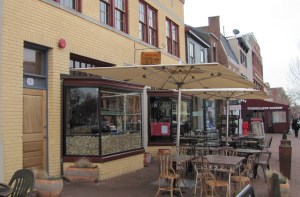
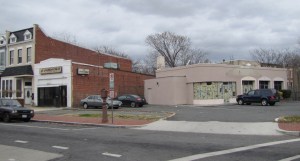
The unmarked door at left is the unassuming entrance to Harold Black Speakeasy and the now-closed Suna
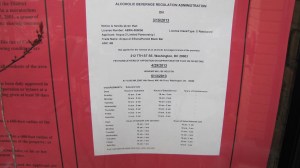
Neighbors Say Acqua Al 2’s Pop Up Restaurant and Speakeasy Violate DC Code;
Al 2 Liquor License Up for Renewal Before ANC Committee Tonight
by Larry Janezich
Nearby neighbors of Acqua al 2 (AA2) at 212 7th Street, SE, charge that its two recently opened adjuncts, “Suna” (which closed March 10 after four months) and the speakeasy, “Harold Black Bar” operated without a liquor license.
Neighbors have taken their complaints to ANC6B and to DC’s Alcohol Beverage Review Administration (ABRA). Chief among their concerns is that the AA2 operated and may still be operating in violation not only of its voluntary agreement with the neighbors, but also with DC Code. The restaurant’s liquor license is currently up for renewal before both bodies.
At issue are two new establishments on the second floor of the restaurant – the recently closed Suna and (according to co-owner Johnny Spero quoted in the food blog EATER at http://dc.eater.com/tags/suna) the still-operating speakeasy “Harold Black Bar.”
Neighbors contend in their written complaint that in March 2012, when AA2 requested modification of their license to extend their hours of operation and expand the restaurant, the restaurant owner said that this expansion would only be used occasionally for private parties. A Voluntary Agreement (VA) was written and signed to accommodate these requests.
Subsequently, a separate restaurant named “Suna” with its own kitchen, and a third operation, “Harold Black Bar” were also established on the second floor, neither of which can be accessed from the restaurant downstairs. Instead the entrance to these two operations is through an unmarked door at a separate address, 214 7th Street, SE. AA2 is at 212 7th Street, SE.
In addition, neighbors say that during the voluntary agreement discussions, there was no mention or consideration of another restaurant, kitchen, or separate bar on the second floor.
AA2 has applied for a liquor license renewal and added the following trade names to the same license: Suna/Harold Black Bar, apparently an ex poste facto admission of the need to obtain specific licensing for those establishments.
Neighbors point to DC Code, which states in section 600.3: “An additional trade name shall not be used to identify a location separate and apart from the licensed premises. When a licensed establishment uses an additional trade name, its patrons must be able to access the area of the licensed premises identified by the additional trade name from the area of the licensed premises identified by the original trade name.”
In addition, neighbors say AA2 is not currently in compliance with the voluntary agreement where it is written that: “No patrons will be allowed in the garden, nor will the area (approximately 312 square feet total, currently used for storage) to the rear of the 2nd floor be open to patrons.” Their letter to ABRA says, “In fact their new restroom, which is accessible to patrons, is located in the rear of the 2nd floor facing our windows.”
Suna was closed in early March after only four months, a week before a savage half-star review by Tom Sietsema was published in the Washington Post, but the review apparently had nothing to do with the closing which was never explained by owners. Neighbors worry that, if a new license is granted, they do not know what kind of operation will replace it. As has been reported elsewhere, both Suna and the speakeasy Harold Black Bar fostered the mystique of in-crowd exclusivity; neither had signage, and Harold Black—a bar—nonetheless required reservations. The bar’s phone number was unpublished and the procedure for making a reservation was ritualistic, as detailed in City Paper, which also published the bar’s reservation phone line number.
See Young and Hungry at: http://www.washingtoncitypaper.com/blogs/youngandhungry/2013/01/10/gin-and-bear-it-its-not-so-easy-getting-a-drink-at-d-c-s-newest-1920s-themed-bar/
Subsequently, Harold Black cut a deal with CityEats to take reservations through their website. However much the business seeks to mimic the underground or “pop up” feel of the latest fashionable eating trends, the reality is that they appear to have been operating in a brick and mortar fashion and serving alcohol on premises. Other than preventing or punishing violence in and around the premises, it is difficult to think of a better example of the kinds of behavior that alcohol liquor licensing was established in order to address.
ANC 6B’s will meet tonight to discuss this issue (and other licenses) tonight at 7:00 in the Hill Center.
 CAPITOL HILL CORNER