Updates on Rumsey, Sherwood, and Kingman Field/Dog Park
by Larry Janezich
Posted May 26, 2026
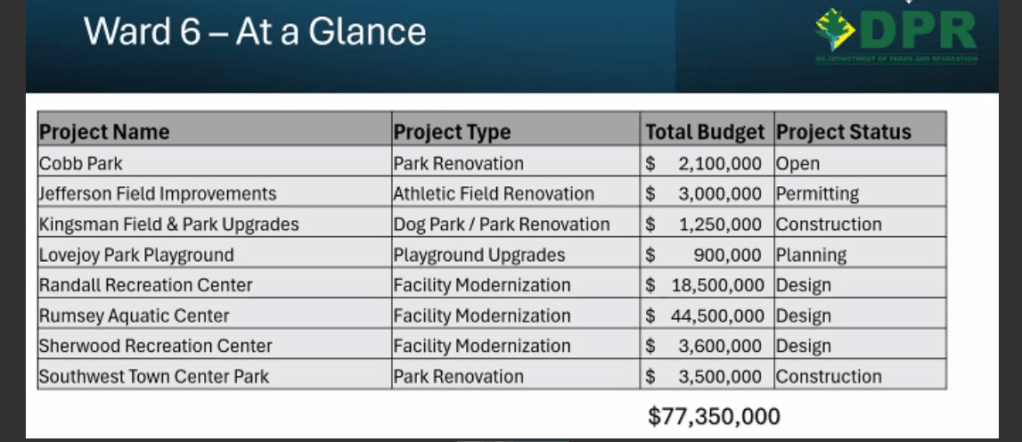
May 21, the DC Department of Parks and Recreation held a virtual meeting to update the community on the 8 current on-going capital projects in Ward 6.
Among them are three in ANC6B and ANC6A:
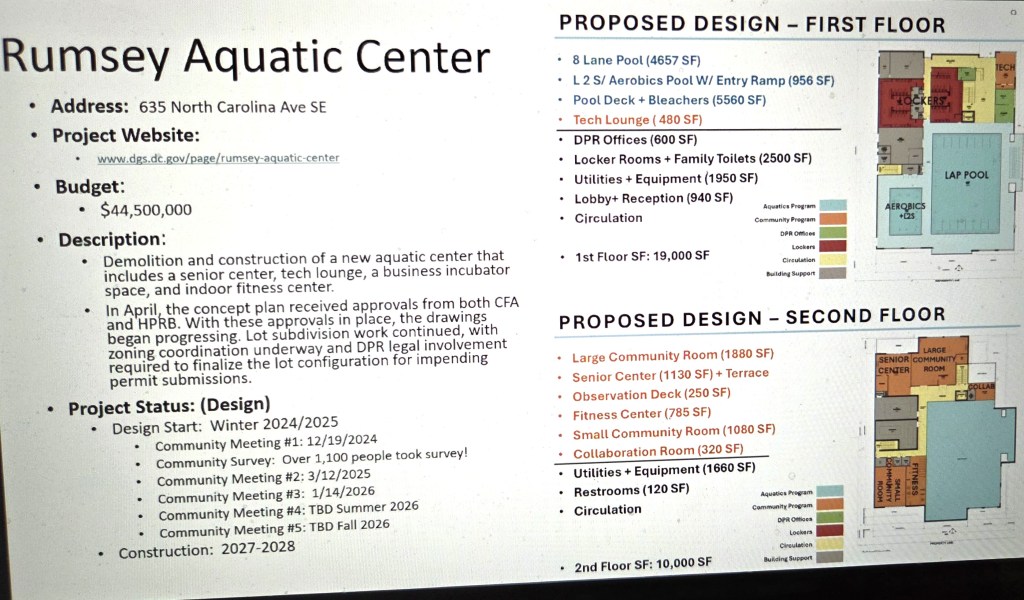
Update on Rumsey Aquatic Center: DPR continues working through the design process. As of April, approvals by the Commission on Fine Arts and the Historic Preservation Review Board have cleared the way for design work to continue. There will be two more community meetings on this project and DPR says they will “let everyone know when the meeting will be. DPR is looking for construction to occur between 2027 and 2028. Pool design is under review and efforts are being made to to get as much water as possible. Mitigation of issues associated with alley and vendor access is underway. ANC6B’s Parks and Public Spaces Taskforce will discuss the update and a proposed letter to encourage any community meeting proposed over the summer be scheduled at a time other than August. The image of the proposed design does not reflect recent changes which will be presented in the next community meeting.
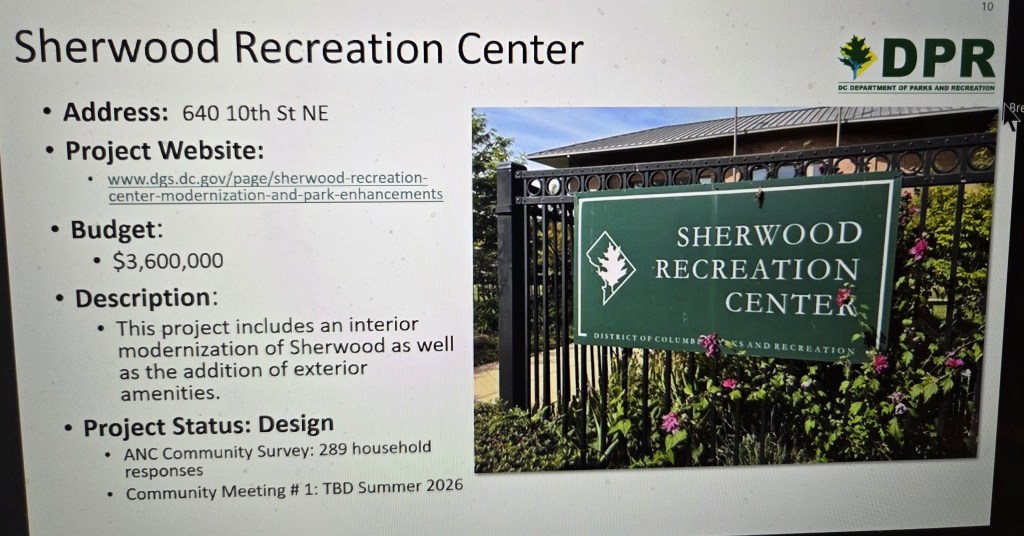
Update on Sherwood Recreation Center: DPR is going through the process of hiring a design/build firm to start the design. Once the design is vetted with the community and agreement reached, the design/build team can go into construction. DPR will work with ANC6B and community and will have community meeting in August. This will provide an opportunity to give the design team the results of the survey and to work up an initial concept. DPR will have a total of three community meetings to talk about designs and provide an opportunity for feedback.
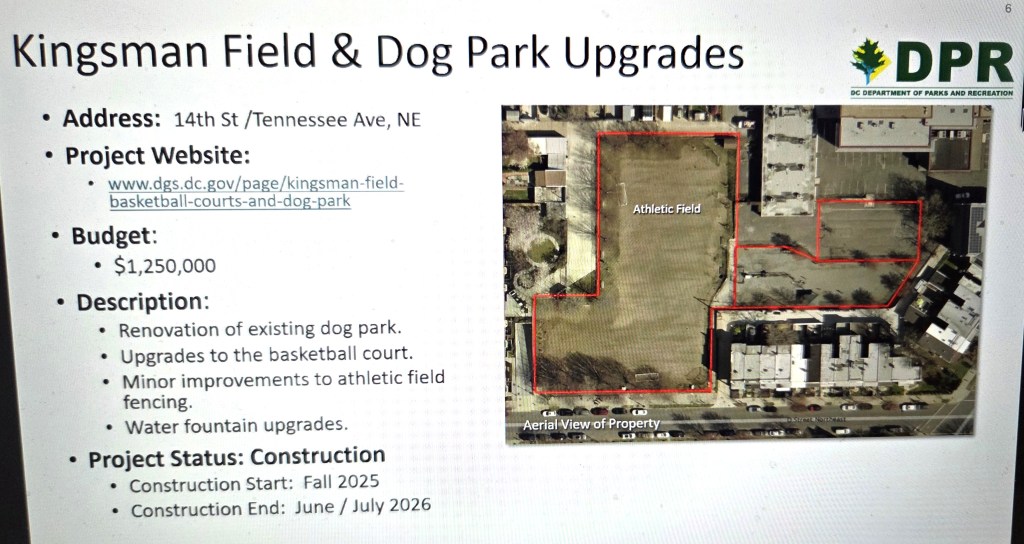
Kingsman Field and Dog Park Update: Project is construction and nearing completion which is rain dependent. DPR’s goal is completion of all work by end of June but that may push into July, depending on weather.
Here’s a list and status report on all eight projects.
Comments Off on Updates on Rumsey, Sherwood, and Kingman Field/Dog Park
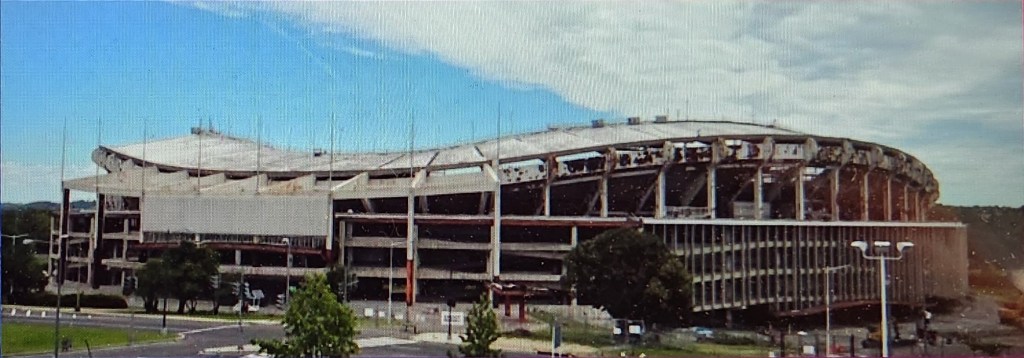
Development of the RFK Stadium site is like building a small city: a vast, waterfront parcel in the heart of the capital.
Contrary to Mayor Bowser’s public assertions, the legislation transferring ownership of the site to DC does not require the construction of a stadium.
Then why build one?
Some people will always be against a stadium. Citing the missed chance to redevelop this parcel as mixed-use development, Greater Greater Washington calculates an “opportunity cost” totaling $3.3 billion over the course of the next 30 years. Other opponents regard the NFL as an abomination, or maybe an enormous NFL stadium which stands empty and idle most of the year as a bad investment of taxpayer dollars.
Likewise, some people will always support a stadium on this site, particularly one that returns the Washington Commanders to DC. Presumably Mayor Bowser numbers among this group, given the remarkably poor deal she negotiated with the Commanders.
Setting aside these two ends of a spectrum, I’d guess that most people fall somewhere in between. This editorial is directed to them, particularly to Capitol Hill/Hill East residents.
A Stadium, But Not on These Terms
It is not surprising to learn that the city will be on the hook for the “horizontal” costs, or the necessary infrastructure improvements, entailed in stadium construction.
But the term sheet presented by Mayor Bowser also includes a taxpayer subsidy for “vertical” costs: stadium construction ($500 million) and parking garages ($356 million). Somewhat lost in the outcry over this direct subsidy to billionaires are the indirect costs of the deal, including the property tax that the city will waive for the developers; the sales tax that will be collected but won’t go to the District; and the interest payments on bonds that the city will need to carry to complete this project.
Rather than defend the terms of a poorly negotiated deal, Mayor Bowser has done her best to ramrod it through the Council as currently written. According to the term sheet, an “exclusive negotiation period” between the District and Commanders will expire by July 15 – or it will expire if the Council makes any significant changes to the term sheet. According to Greater Greater Washington, Council chair Phil Mendelson “is signaling” that he will let the deadline pass so the Council could review the deal properly and insist on better terms. After all, to consider the baseball field, the Council had 11 months; the Council discussed the deal on Audi Field for 7 months.
DC has suffered enough of high-handed treatment of late. It’s a shame that, in this, her legacy-making move, Mayor Bowser has decided to treat the Council with such contempt. As it currently stands, given that the Mayor has tied the stadium deal to the budget, the Council cannot even hold a hearing focused only on the RFK stadium deal.
A Stadium, But Not at This Time
Regardless of the fate of the national economy, DC is now headed for a localized recession, owing to the devastating employment effects of the Trump Administration’s cuts to the federal government.
Recently, in the wake of these cuts, Moody’s downgraded DC’s bond-rating, meaning that a stadium constructed under the Trump administration will cost more than one built under an administration run by Kamala Harris.
More important, even if Congress passes DC’s Local Budget restoring the city’s money, the city still faces an enormous budget shortfall – meaning, there will be steep cuts to city government.
In her just-released budget, Mayor Bowser has shifted some payments to next fiscal year and declared a hiring freeze in an attempt to blunt the effects of this shortfall. But already a new DC jail is gone from the budget. Notably, the Council has shunted aside the Mayor’s economic forecast for the stadium and commissioned their own.
Amid turmoil and retrenchment, it is difficult to say what this stadium will “cost” the city in terms of what is defunded as a result of its construction.
A Stadium, But One That Works for the Neighborhood
Economic researchdemonstrates that stadiums do not generate “new” growth or revenue. In the best-case scenario, they just focus growth on a certain location.
Stadiums might be worthwhile if they are used to kickstart the revitalization of a particular neighborhood, but, even then, there exists a very real danger of overreach. An astonishing number of empty storefronts currently surround Capital One Arena, a more active stadium located in a much more commercial neighborhood. Public officials assured us that the keeping the Leonsis’ teams and a promised stadium renovation would bring tenants back; so far, that hasn’t happened.
By and large, Hill East is not a neighborhood in need of revitalization. The kinds of things that Hill East might need or want would be best served by a mixed-use development, not a stadium.
In light of just what little purpose a stadium can serve, the hulking parking garages planned under the current term sheet are an affront to the neighborhood. No stadium in the heart of a city built in the 21st century should be based on automobile traffic. In this and in other respects – particularly in regard to the environment – the Mayor has declined to seize this opportunity to construct a stadium of the future.
Instead, she wants to build a 20th century stadium while the city strains under the weight of a 19th century presidency.
My Verdict on the Stadium Deal
In more stable times, the case for stadium construction would be stronger, particularly given the fact that the city has slow-walked Phase II of the Reservation 13 development, effectively tying its fate to RFK.
At this time, facing the Trump administration, a strong case could be made for RFK redevelopment without a stadium, which would create new housing and neighborhood resources, generating growth and revenue.
In more stable times, the case for a stadium would be stronger if it were a 21st century stadium that better harmonized with the surrounding neighborhood.
But it is bad luck for the Commanders ownership that their bid for a new stadium coincides with a crisis moment in DC history, the likes of which I have not seen since the 1980s.
The only way to make the case for an NFL stadium at RFK at this particular moment is if the public subsidy for vertical construction is reduced to $0; the DC Local Budget Autonomy Act passes Congress and is signed by the President before the DC City Council votes on the stadium deal; and the stadium development makes better use of public transportation and green technology.
Maybe the DC City Council will move the dial on the public subsidy and a more imaginative development, both of which are under their control. But the Commanders’ owners, who profess to love DC, would do well to pledge the necessary resources to move Republicans in Congress to respect our city a little more.
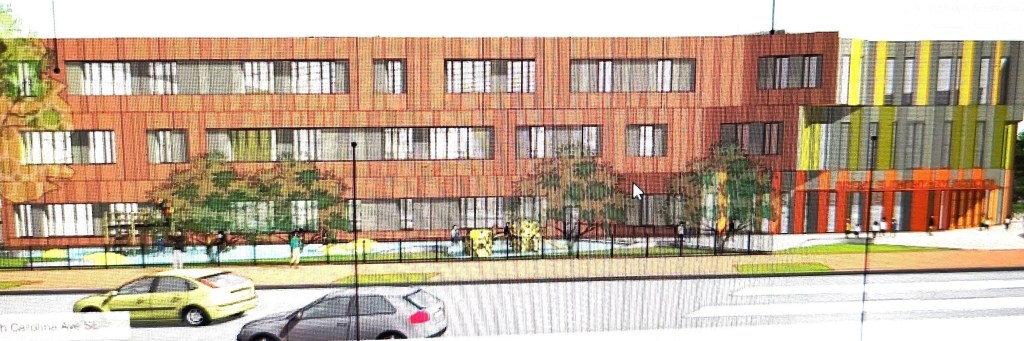
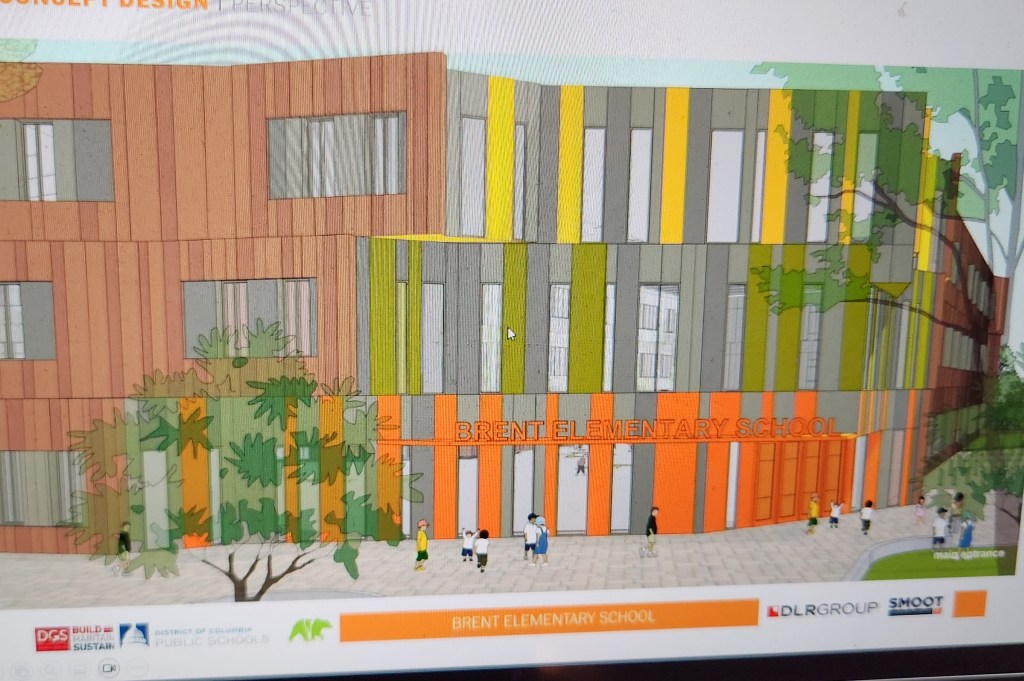
Architect’s rendering of the new Brent School seen from North Carolina Avenue. The entrance is at the right.
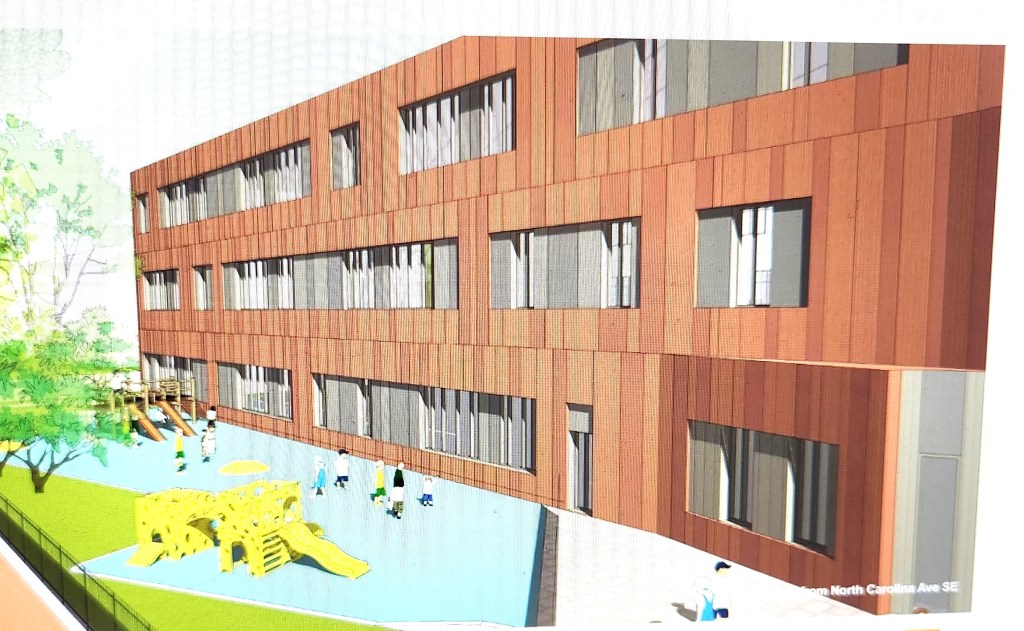
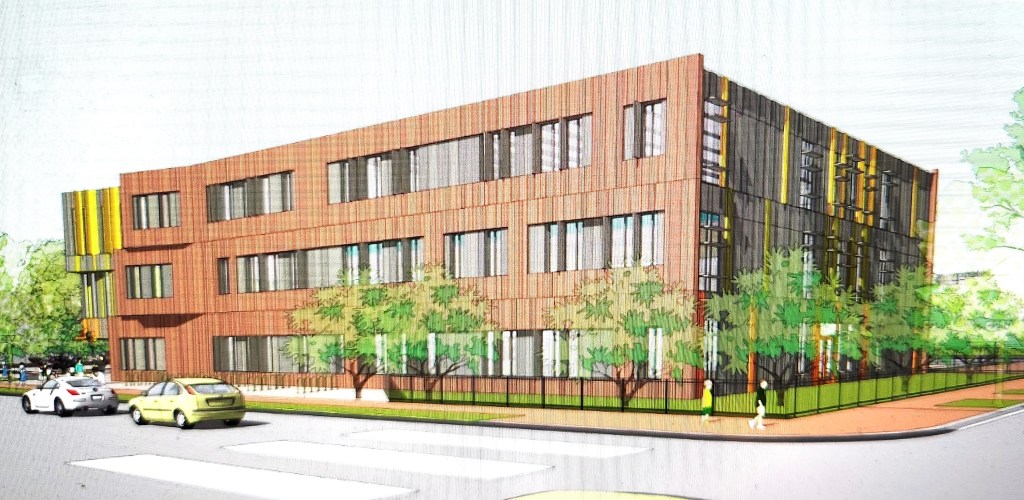
View from North Carolina Avenue and D Street looking southwest. To maximize use of space a play area for younger students is located facing North Carolina, while the play area for older students is behind the school.
Here’s a closer view of the entrance.
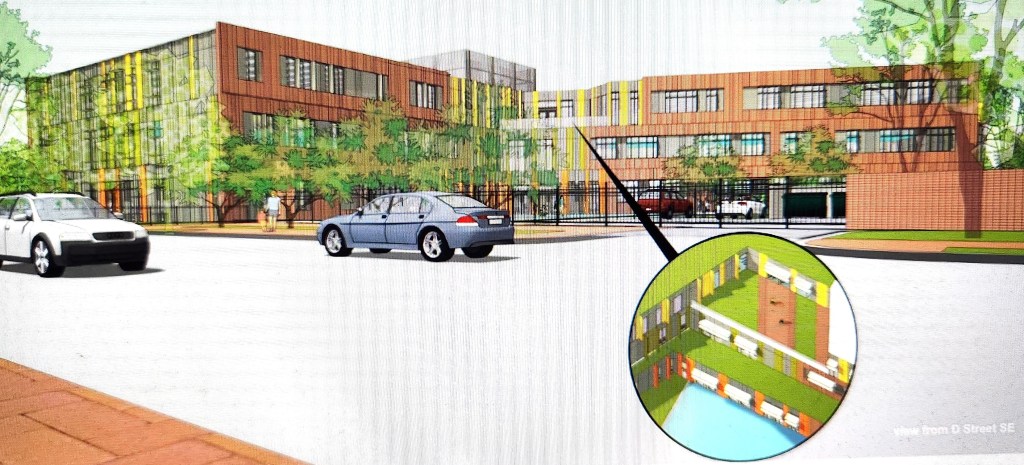
The view from the corner of 3rd and D Streets looking northeast. (D Street shifts south a block after it intersects North Carolina Avenue.)
The view from D Street looking northwest showing the location of the play area for older students.
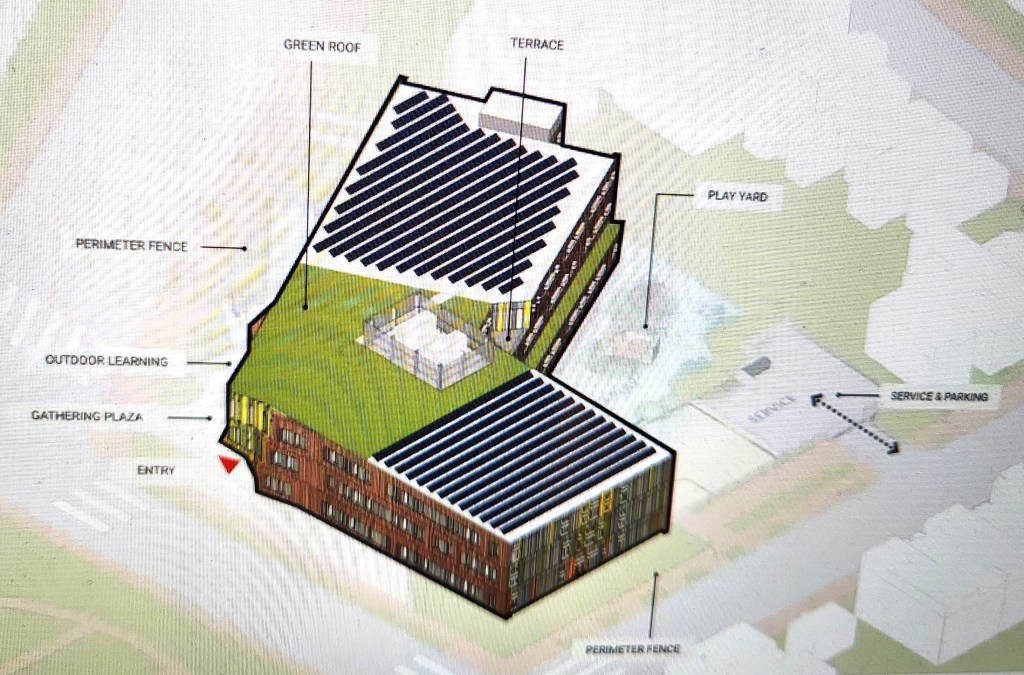
Here’s a rendering showing the building’s footprint.
Images of the New Brent School and Project Update
by Larry Janezich
Posted November 16, 2024
At last Tuesday night’s ANC6B meeting, Erika Lehman from the DLR Group design team presented the plan and architectural renderings for the Brent School modernization project. The school is located at 3rd and North Carolina SE. The raze-and-construction timeline anticipates that the new building will be ready to open in the fall of 2007.
DLR Group will take over occupancy in August of 2025. Demolition will be complete by the end of the year and construction of the new building will begin thereafter. During the closure, students will attend the former Meyer Elementary School at 2501 11th St NW. Free busing will be provided and depart from a location near Brent.
Project Overview – Brent’s modernization will include:
Upgraded classrooms and community spaces with improved technology.
Enhanced safety features – modern security systems and updated building infrastructure.
Green spaces – new outdoor areas for play and learning