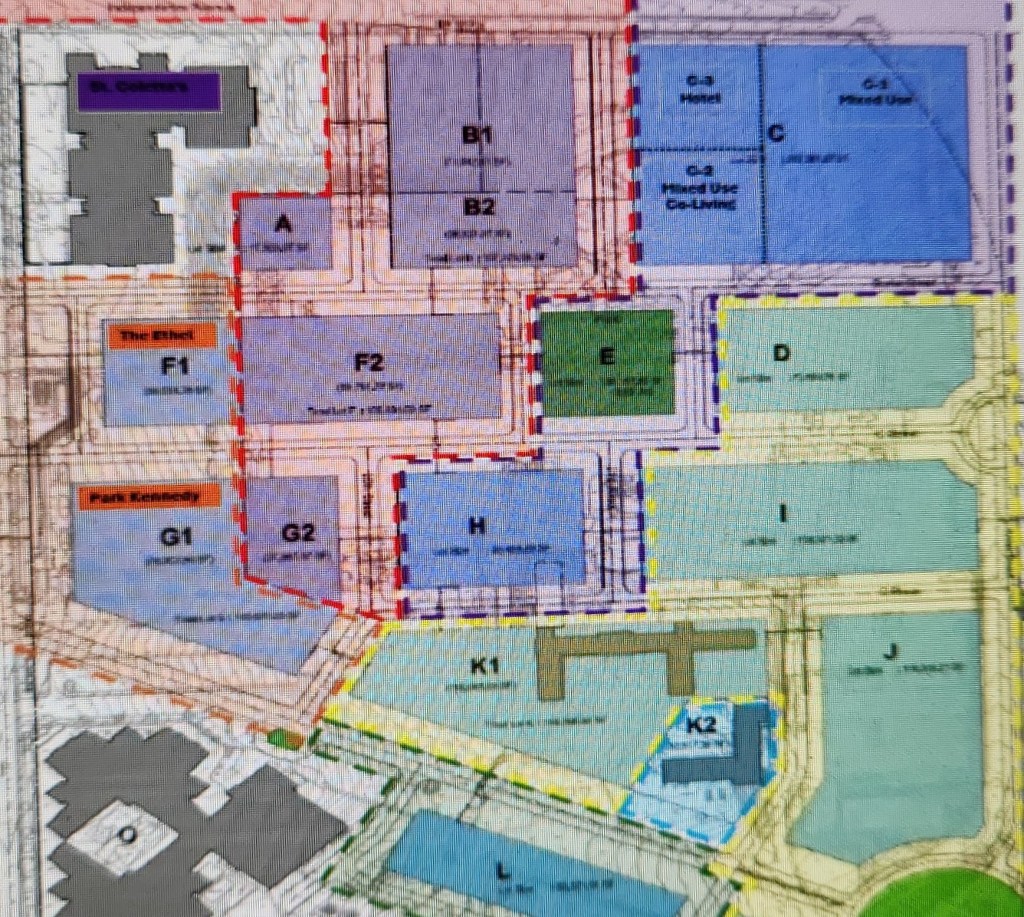
Hill East Development Disposition Map showing location of parcels to be developed.
Wednesday night, Daryl Thomas from the Office of the Deputy Mayor for Planning and Development (DMPED), gave an update on the development of Res 13 Phase II to ANC7D’s Committee on Economic Development and to Hill East residents.
Despite rumors to the contrary, Thomas assured that Res 13 Phase II “definitely is not stalled – we have been very much into a lot of infrastructure work on the campus. This work consists of engineering in addition to relocation of a major 72 inch sewer line.” The pipeline lies 40 to 50 feet below ground and extends from Massachusetts Avenue to Independence Avenue. He added, “… this sewer line is a precursor for all the remaining work that needs to be done. We have started the roadway design review. Once the sewer relocation work is done then the city can come in and we can start constructing the roadways that surround the development parcels …” Thomas said he expected the pipeline relocation to take a year.
In 2000 the city released RFPs for the Phase II redevelopment of Res 13. Phase II was divided into two different bundles, Bundle One (Parcels A, B-1, B-2, F-2 and G-2 – see map above), and Bundle Two (Parcels C, E. and H). Some parcels in Bundle One have been approved by the Zoning Commission and building design is underway. Bundle Two ran into infrastructure issues including the sewage pipeline and utility relocation, and that has forced them to redesign their first phase of building which has prevented them from going to Zoning for approval.
Developers hoped to break ground in 2024 but infrastructure and finance issues pushed that date ahead to 2025. Last night’s presentation suggested there may be another delay – at least in Bundle Two – until 2026 or later. Phase III (in yellow) is a planned third phase of the development which has not launched yet.
Thomas did not offer a projected timeline for completion of development on any of the parcels. None of the developers participated in the briefing.
Thomas also offered a status report on the status of Phase I, where two mixed use buildings have been completed. He reported that Sala Thai Restaurant, Duffy’s Irish Pub, and Alphabet Daycare have leased retail space in the Park Kennedy, one of the two Phase I mixed use buildings. One retail space remains. He said that none of the retail spaces has yet been leased in Phase I’s second mixed use building – The Ethel.
During the Q&A, Thomas was asked if development would be coordinated with construction of the proposed NFL Stadium on the RFK site and with construction of a new DC city jail. He noted that neither of those projects has been approved yet and once they are, DMPED would be working “hand in hand” with the developers of those projects.
Comments Off on Update on Development of Res 13 Phase II
Development of the RFK Stadium site is like building a small city: a vast, waterfront parcel in the heart of the capital.
Contrary to Mayor Bowser’s public assertions, the legislation transferring ownership of the site to DC does not require the construction of a stadium.
Then why build one?
Some people will always be against a stadium. Citing the missed chance to redevelop this parcel as mixed-use development, Greater Greater Washington calculates an “opportunity cost” totaling $3.3 billion over the course of the next 30 years. Other opponents regard the NFL as an abomination, or maybe an enormous NFL stadium which stands empty and idle most of the year as a bad investment of taxpayer dollars.
Likewise, some people will always support a stadium on this site, particularly one that returns the Washington Commanders to DC. Presumably Mayor Bowser numbers among this group, given the remarkably poor deal she negotiated with the Commanders.
Setting aside these two ends of a spectrum, I’d guess that most people fall somewhere in between. This editorial is directed to them, particularly to Capitol Hill/Hill East residents.
A Stadium, But Not on These Terms
It is not surprising to learn that the city will be on the hook for the “horizontal” costs, or the necessary infrastructure improvements, entailed in stadium construction.
But the term sheet presented by Mayor Bowser also includes a taxpayer subsidy for “vertical” costs: stadium construction ($500 million) and parking garages ($356 million). Somewhat lost in the outcry over this direct subsidy to billionaires are the indirect costs of the deal, including the property tax that the city will waive for the developers; the sales tax that will be collected but won’t go to the District; and the interest payments on bonds that the city will need to carry to complete this project.
Rather than defend the terms of a poorly negotiated deal, Mayor Bowser has done her best to ramrod it through the Council as currently written. According to the term sheet, an “exclusive negotiation period” between the District and Commanders will expire by July 15 – or it will expire if the Council makes any significant changes to the term sheet. According to Greater Greater Washington, Council chair Phil Mendelson “is signaling” that he will let the deadline pass so the Council could review the deal properly and insist on better terms. After all, to consider the baseball field, the Council had 11 months; the Council discussed the deal on Audi Field for 7 months.
DC has suffered enough of high-handed treatment of late. It’s a shame that, in this, her legacy-making move, Mayor Bowser has decided to treat the Council with such contempt. As it currently stands, given that the Mayor has tied the stadium deal to the budget, the Council cannot even hold a hearing focused only on the RFK stadium deal.
A Stadium, But Not at This Time
Regardless of the fate of the national economy, DC is now headed for a localized recession, owing to the devastating employment effects of the Trump Administration’s cuts to the federal government.
Recently, in the wake of these cuts, Moody’s downgraded DC’s bond-rating, meaning that a stadium constructed under the Trump administration will cost more than one built under an administration run by Kamala Harris.
More important, even if Congress passes DC’s Local Budget restoring the city’s money, the city still faces an enormous budget shortfall – meaning, there will be steep cuts to city government.
In her just-released budget, Mayor Bowser has shifted some payments to next fiscal year and declared a hiring freeze in an attempt to blunt the effects of this shortfall. But already a new DC jail is gone from the budget. Notably, the Council has shunted aside the Mayor’s economic forecast for the stadium and commissioned their own.
Amid turmoil and retrenchment, it is difficult to say what this stadium will “cost” the city in terms of what is defunded as a result of its construction.
A Stadium, But One That Works for the Neighborhood
Economic researchdemonstrates that stadiums do not generate “new” growth or revenue. In the best-case scenario, they just focus growth on a certain location.
Stadiums might be worthwhile if they are used to kickstart the revitalization of a particular neighborhood, but, even then, there exists a very real danger of overreach. An astonishing number of empty storefronts currently surround Capital One Arena, a more active stadium located in a much more commercial neighborhood. Public officials assured us that the keeping the Leonsis’ teams and a promised stadium renovation would bring tenants back; so far, that hasn’t happened.
By and large, Hill East is not a neighborhood in need of revitalization. The kinds of things that Hill East might need or want would be best served by a mixed-use development, not a stadium.
In light of just what little purpose a stadium can serve, the hulking parking garages planned under the current term sheet are an affront to the neighborhood. No stadium in the heart of a city built in the 21st century should be based on automobile traffic. In this and in other respects – particularly in regard to the environment – the Mayor has declined to seize this opportunity to construct a stadium of the future.
Instead, she wants to build a 20th century stadium while the city strains under the weight of a 19th century presidency.
My Verdict on the Stadium Deal
In more stable times, the case for stadium construction would be stronger, particularly given the fact that the city has slow-walked Phase II of the Reservation 13 development, effectively tying its fate to RFK.
At this time, facing the Trump administration, a strong case could be made for RFK redevelopment without a stadium, which would create new housing and neighborhood resources, generating growth and revenue.
In more stable times, the case for a stadium would be stronger if it were a 21st century stadium that better harmonized with the surrounding neighborhood.
But it is bad luck for the Commanders ownership that their bid for a new stadium coincides with a crisis moment in DC history, the likes of which I have not seen since the 1980s.
The only way to make the case for an NFL stadium at RFK at this particular moment is if the public subsidy for vertical construction is reduced to $0; the DC Local Budget Autonomy Act passes Congress and is signed by the President before the DC City Council votes on the stadium deal; and the stadium development makes better use of public transportation and green technology.
Maybe the DC City Council will move the dial on the public subsidy and a more imaginative development, both of which are under their control. But the Commanders’ owners, who profess to love DC, would do well to pledge the necessary resources to move Republicans in Congress to respect our city a little more.
Photo Essay: The Mayor’s Hill East Town Hall on the RFK Development
by Larry Janezich
Posted May 23, 2025
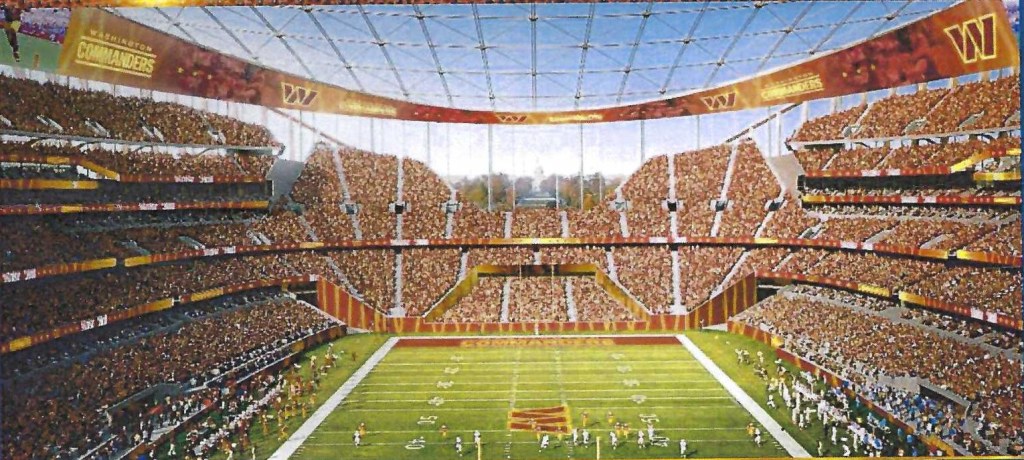
Here’s a conceptual rendering of what the proposed new stadium for the Washington Commanders would look like.
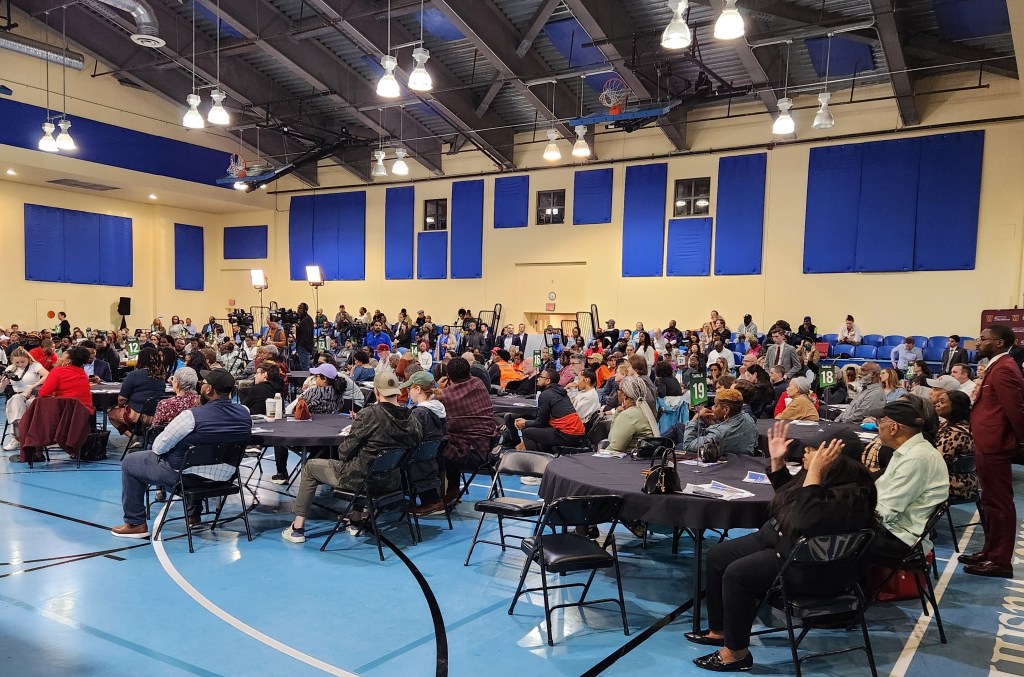
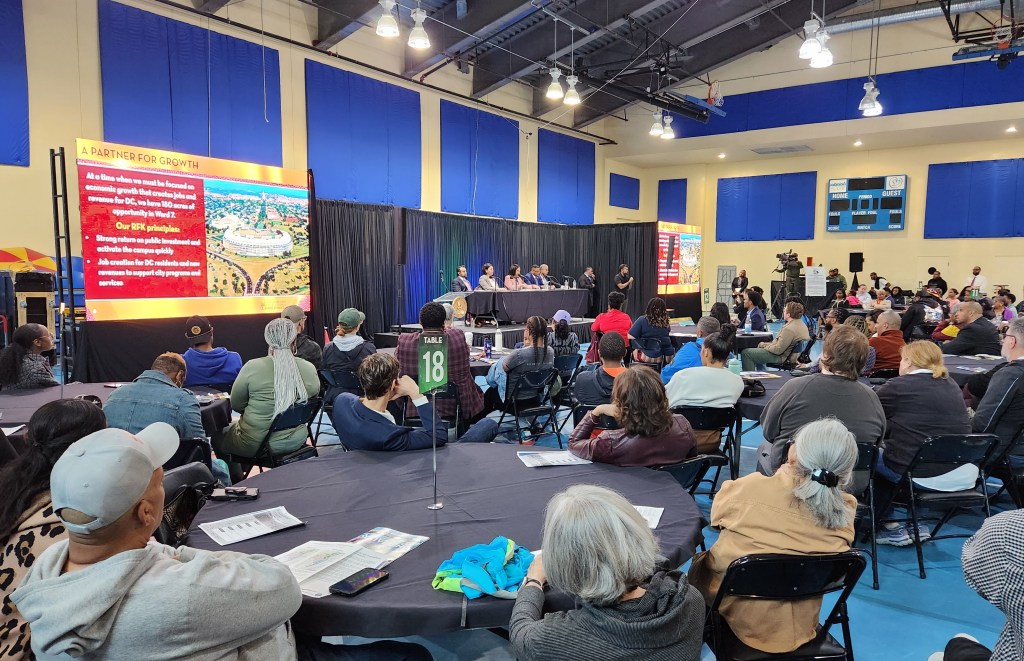
Thursday night, Mayor Bowser brought a Town Hall Meeting on development of the RFK Site to the communities most affected by it – Ward 7’s Hill East and Kingman Park. Some 350 residents turned out for the meeting near the stadium in the gymnasium of St. Coletta’s School.
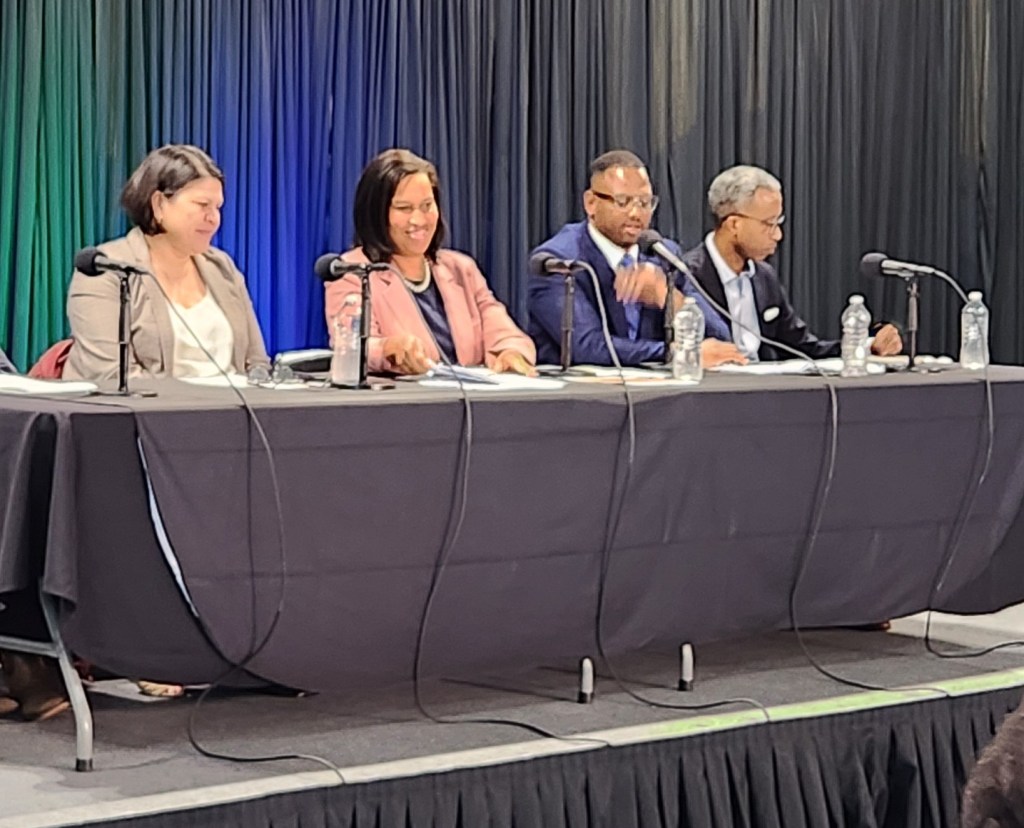
A panel comprised of Mayor Bowser, Ward 7 CM Wendell Felder, CM At-Large Kenyan McDuffie and Deputy Mayor for Planning and Development Nina Albert made presentations and took questions. The Mayor supported the current plan for a $3.7 billion development of the 65,000 seat covered stadium and the beginning of a new neighborhood on the Anacostia River. She told the attendees that the 174 acre site could hold four Wharfs. The Commanders will contribute $2.7 billion to the project for vertical construction and the DC government will pay $1 billion for infrastructure and parking.
ANC7D08 Chair Brian Alcorn (far left), whose ANC encompasses the RFK site, commented after the meeting: “I’m pleased that Councilmember Felder is appropriately focused on ensuring development at the RFK site would be consistent with the community’s wishes as well as having a positive financial impact for neighbors and the District. I also appreciate Mayor Bowser’s acknowledgement that the project is in the very early stages and community-driven modifications are both possible and expected. As ANC7D hosts nearly 75% of the overall RFK campus, our Commission and residents look to closely coordinate with officials from the District, the Commanders, WMATA and all other stakeholders to ensure that the results, whatever they may be, support and enhance our many neighborhoods.
ANC7D05 Commissioner Ebony Payne (seated behind Alcorn), whose Single Member District borders the north edge of the RFK Campus commented: “I am encouraged that we finally have a firm commitment from the Mayor that the Fields at RFK will be maintained – the number one concern I am hearing now from my constituents is about the two massive parking garages planned for Oklahoma Avenue. This is the main thoroughfare to our community and people want to see a new map that does not burden Kingman Park with the bulk of the heavy traffic.
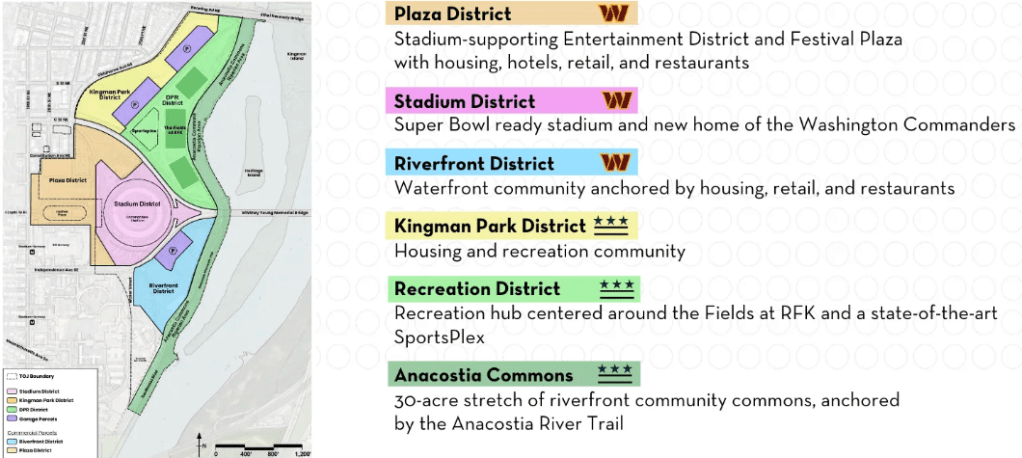
Here’s the site plan for dividing the development into six districts. The Commanders will oversee the development of the Plaza District, the Stadium District, and the Riverfront District, while the city will take charge of development of the Kingman Park District, the Recreational District and the Anacostia Commons. The city will also fund a $89 million SportsPlex providing indoor track and gymnastic facilities not available in other District recreation centers.
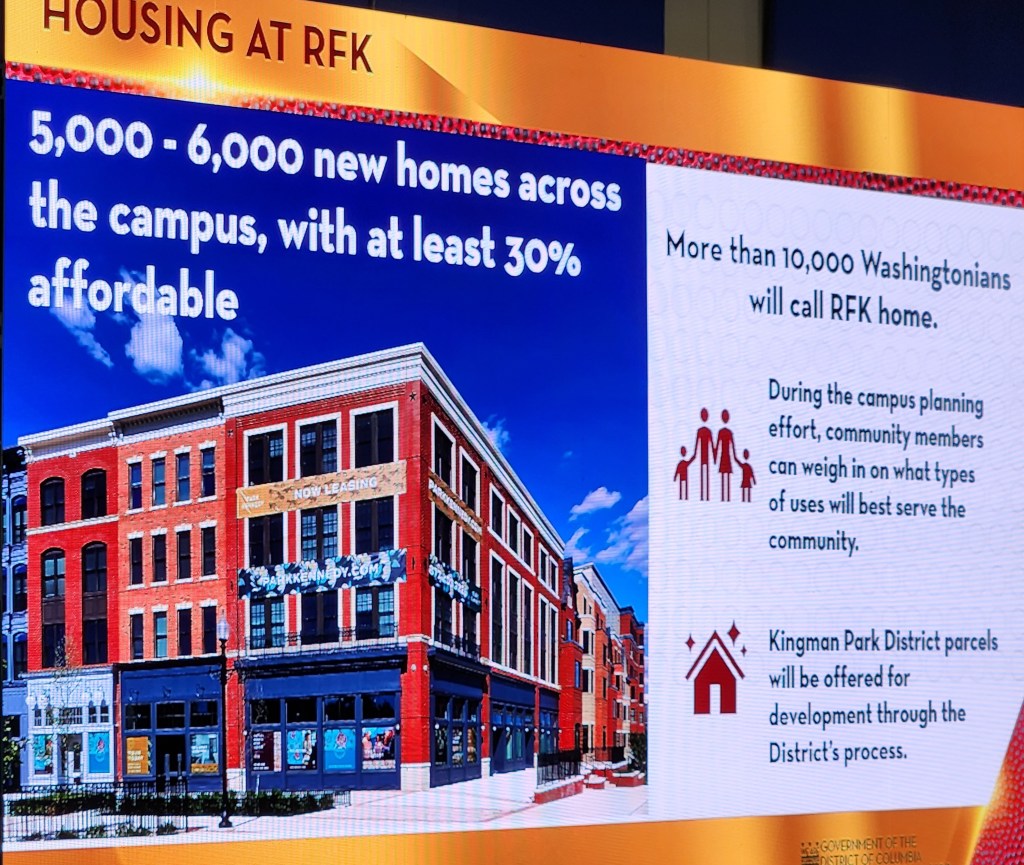
The vision includes 6,000 new homes – 30% affordable housing – for 10,000 new residents.
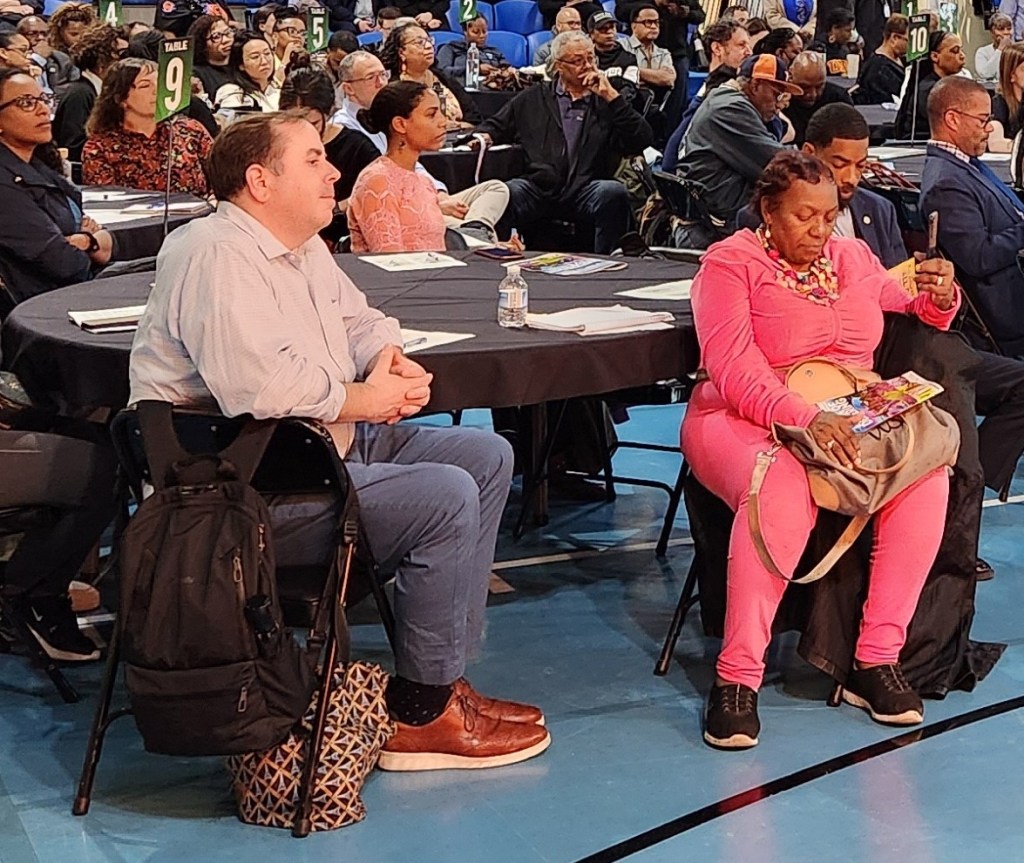
The crowd was mostly supportive of the development, but the occasion fell short of exuberant enthusiasm, perhaps over concerns about how the proposed development would change the community. Questions from the audience reflected worries about parking, traffic, public safety, jobs for community members, funding for education, property taxes, and community benefits.
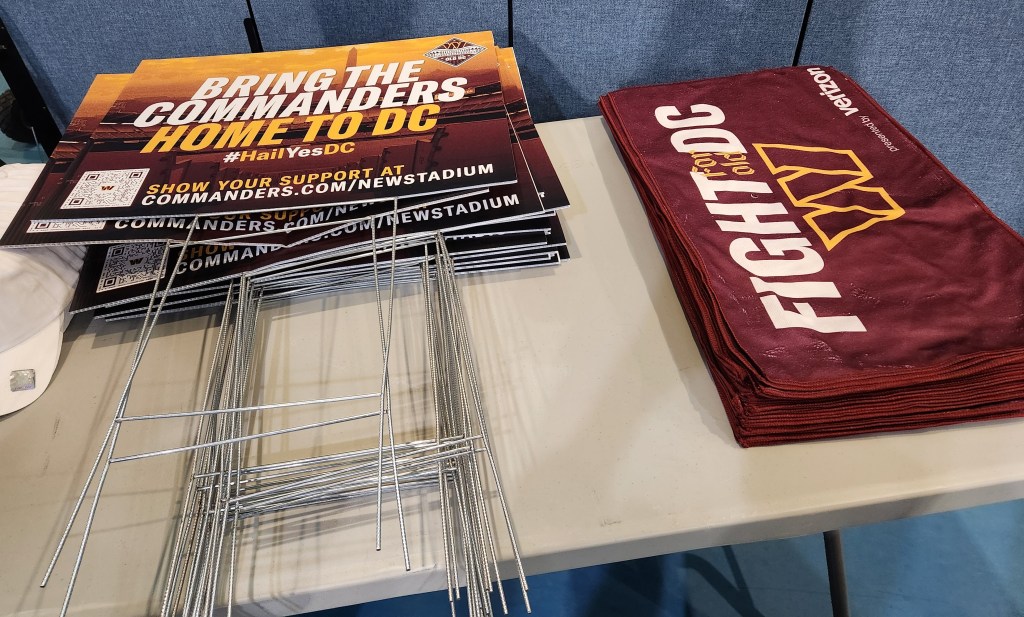
There were caps and signs for residents to indicate support the new development – the caps went pretty fast.
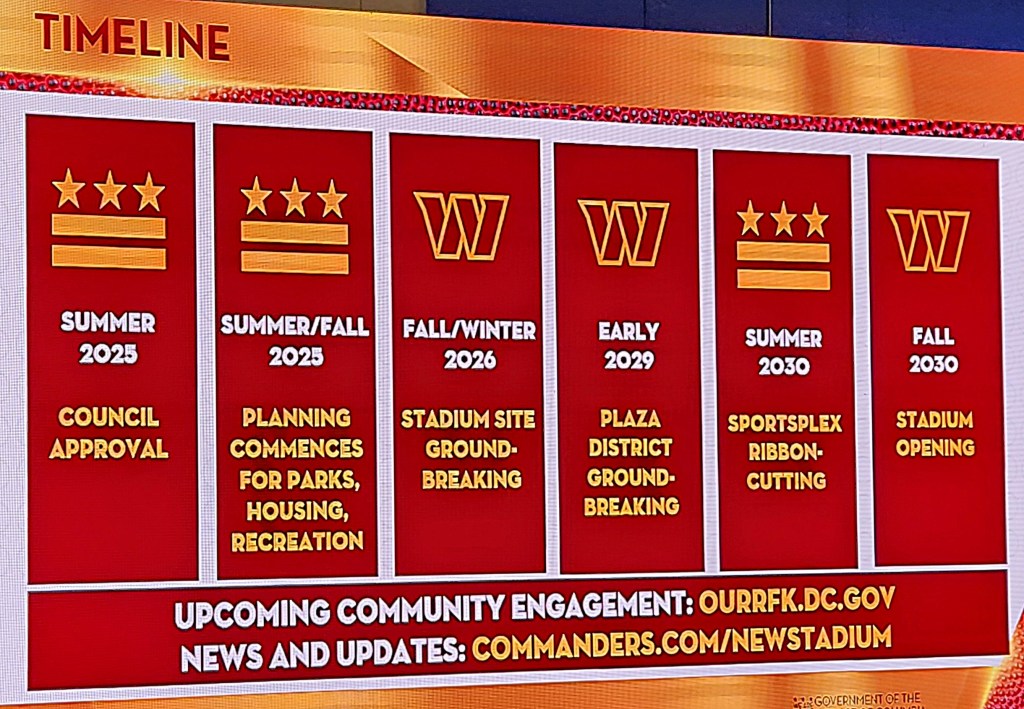
Here’s an image reflecting the timeline for the project. The Mayor is hoping for the City Council approval this summer, groundbreaking for the new stadium in late 2006, and opening of the stadium in the fall of 2030.
While many in Ward 7 have reservations about the effects of the proposed development, the focus now – in the face of a full court press by the Mayor’s office and public support for a new stadium – seems to by focusing on addressing concerns of the nearby residents and getting the best deal possible for the city. And despite the aggressive promotion, the Mayor and her supporters have not addressed the well-documented assertions of respected economic analysts that sports stadiums are not economic generators for a city. The Mayor points to potential some 200 events annually, including 20-30 major events. Perhaps, but how many Beyoncé or Taylor Swifts are there who can fill a 65,000 seat stadium? It’s uncertain whether the city will make money from the new stadium – it’s more certain that the developers will.
How to follow Capitol Hill Corner. To receive an email when an article is posted on CHC go to the homepage here: https://capitolhillcorner.org/ On the right hand side of the page there is a column below “Blog Stats.” Scroll down to the bottom of the Archives and click on the blue tab that says “Follow Capitol Hill Corner.” You will automatically be notified as soon as anything is posted. To stop following CHC go to the same blue tab which will now say “Following,” and click it again.
CM Charles Allen briefing ANC6B last night on the DC Budget.
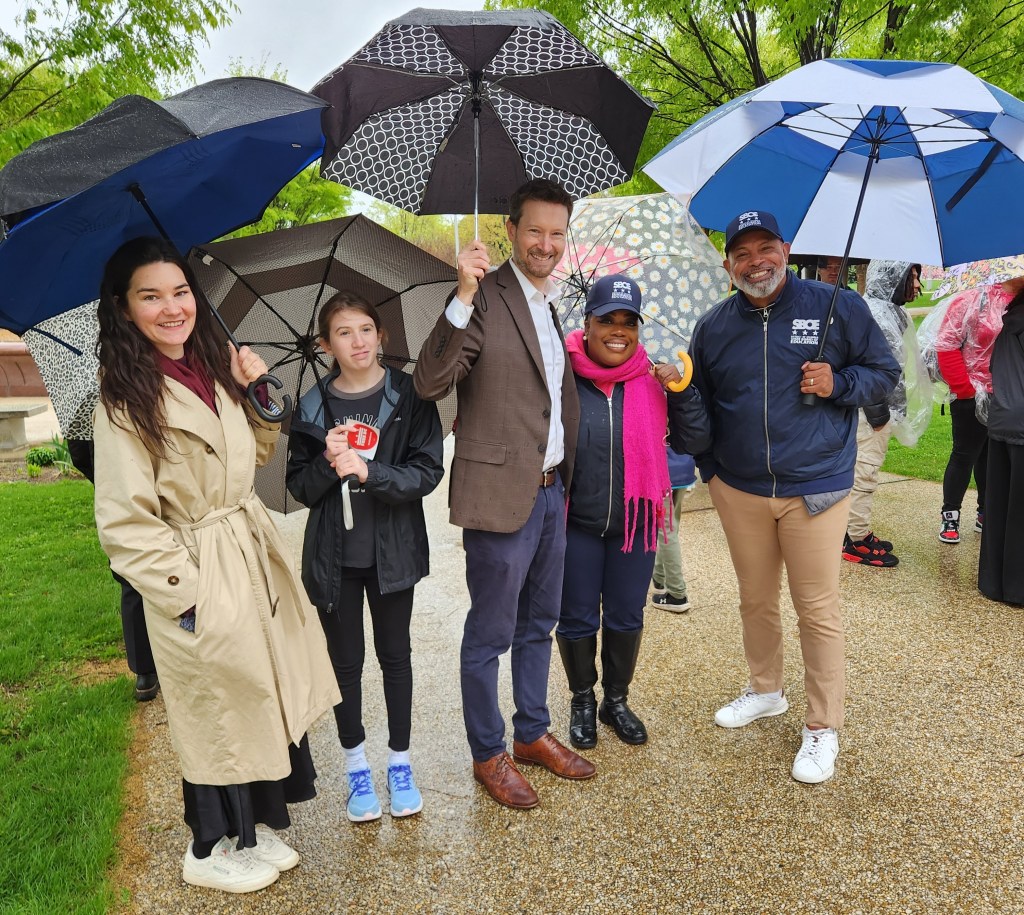
CM Charles Allen on Monday morning in Spirit of Justice Park behind the Longworth House Office Building where FreeDC volunteers gathered before heading inside to lobby Members of Congress. On Allen’s left are LaJoy Johnson-Law, Ward 8 State Board of Education member and Jacque Patterson, President of the State Board of Education.
CM Allen Says City Faces Tough Economic Choices
by Larry Janezich
Posted April 9, 2025
Tuesday night, Council Member Charles Allen gave ANC6B a sobering report on the current economic situation facing the city.
The city is facing two pressure points: The inability of the US House of Representatives to fix their mistake in forgetting to authorize DC to spend $1 billion of its own to fund its operational budget for personnel and city services. (If DC just went ahead and spent the money which has not been authorized it would be breaking the law.) Second, the projected $1 billion shortfall in revenues over the next three years resulting from the thousands of residents who have lost their federal jobs and the economic fallout therefrom as the result of the administration’s efforts to reduce the size of the federal government.
With respect to the first pressure point, Allen says he does not foresee the House acting to fix their mistake before it leaves for a two week recess at the close of business on Thursday. Cuts in personnel and services will not start immediately but the undetermined date is fast approaching when the Chief Financial Officer (CFO) will inform the Mayor that she has to start making cuts. The Mayor will have to submit a Supplemental Budget to the city council recommending those cuts. Allen says, “To cut $1 billion from a $17 billion budget will be devastating…it will mean furloughs, personnel cuts, cuts in city operations and bus and Metro service.” The police and fire departments will suffer hiring freezes – first responders could be furloughed. Public and charter schools will be subject to staff and operational cuts – an extreme example is that the school week could be cut to 3 or four days.
On Monday, Allen was part of the local advocacy group FreeDC’s call to action to lobby members of the House to pass the Senate-passed bill to fix the spending glitch which has been held for some three weeks at the Speaker’s desk. This means under House Rules, it will take a two-thirds vote of the House (288) to take it up for consideration, and a simple majority of the House to pass it. Though the bill has the support of the President and – reportedly – the chair of the House Appropriations Committee – it appears to be stalled by members of the Freedom Caucus. Some speculate that some House members want to place conditions on DC as part of an agreement to move the bill forward.
Allen’s team visited five Congressional offices. He said the Republican offices were polite but he did not detect a sense of urgency. He said he got a “warmer response from Democratic offices, but none of them felt like their hair was on fire about how this was a crushing and urgent problem”. By the end of the day, FreeDC volunteers had visited 283 members’ offices.
Regarding the second pressure point, Allen noted that the FY 2026 Budget process – which should have launched at the beginning of April – has not, because the Mayor is waiting on a resolution regarding the $1 billion being held up in the House which otherwise will have to be taken into consideration in the budget for the next fiscal year.
Assuming that gets resolved and the 2026 FY Budget process moves forward, it will have to take into account the CFO’s projection of $1 billion in lower revenue over the next three years resulting from a reduction in the federal workforce. That will amount to a cut of around $300 million in each of the next three fiscal years. Those cuts will come in the face of increasing costs. Allen said, “We are facing a difficult budgeting…..We will be reducing city services and I don’t like doing that….But if the budget is balanced on the most vulnerable it is not a budget I can support. There will be a reduction in services and benefits and every part of the city will have to be a part of what this tough moment will realize.”
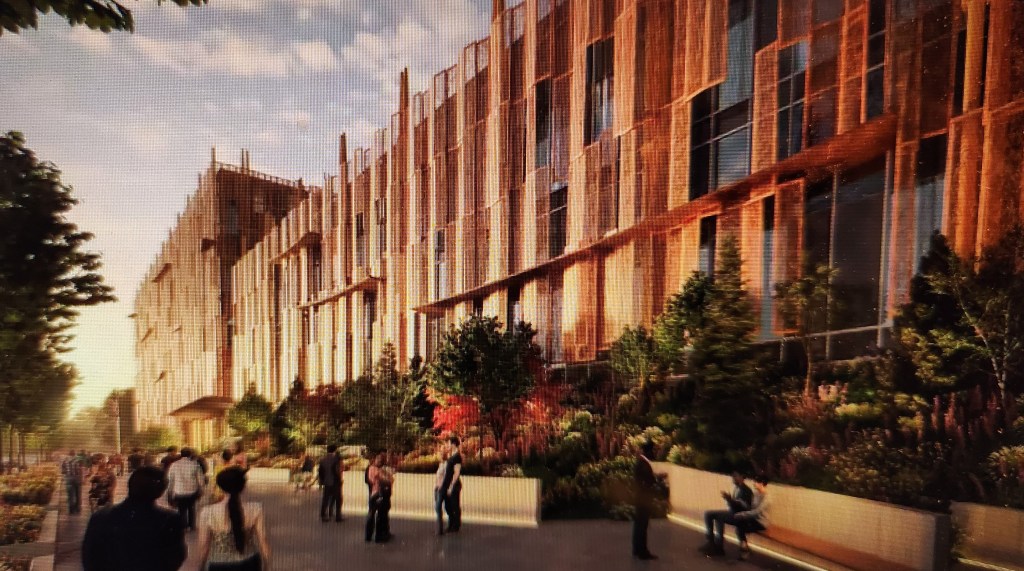
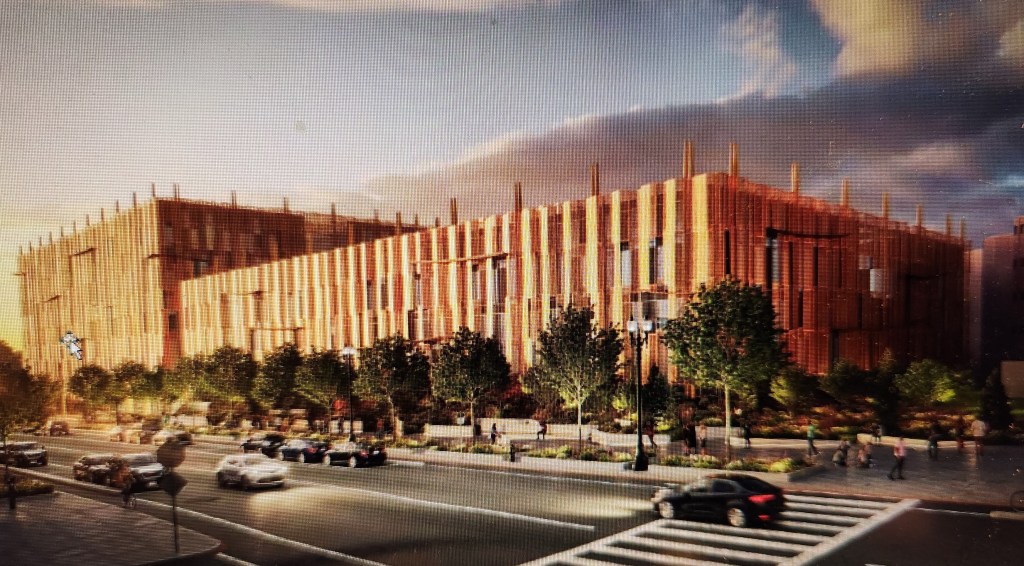
Design team rendering of the new DC Jail at 1900 Massachusetts Avenue, SE.
Last Thursday night, Meridith Moldenhauer, Zoning Counsel for the DC Correctional Treatment Facility Project, presented current renderings of the new jail being built in Hill East to ANC6B’s Planning and Zoning Committee, chaired by Commissioner Vince Mareino. The new jail is in Ward 7, but Ward Six and ANC6B border Ward 7 so it has a say in how the new jail will affect the Ward 6 community. The correctional campus is located at 1900 Massachusetts Avenue, SE.
Moldenhauer’s task was to present a request for zoning waivers having to do with the setback from the property line and use of materials on the exterior façade of the structure.
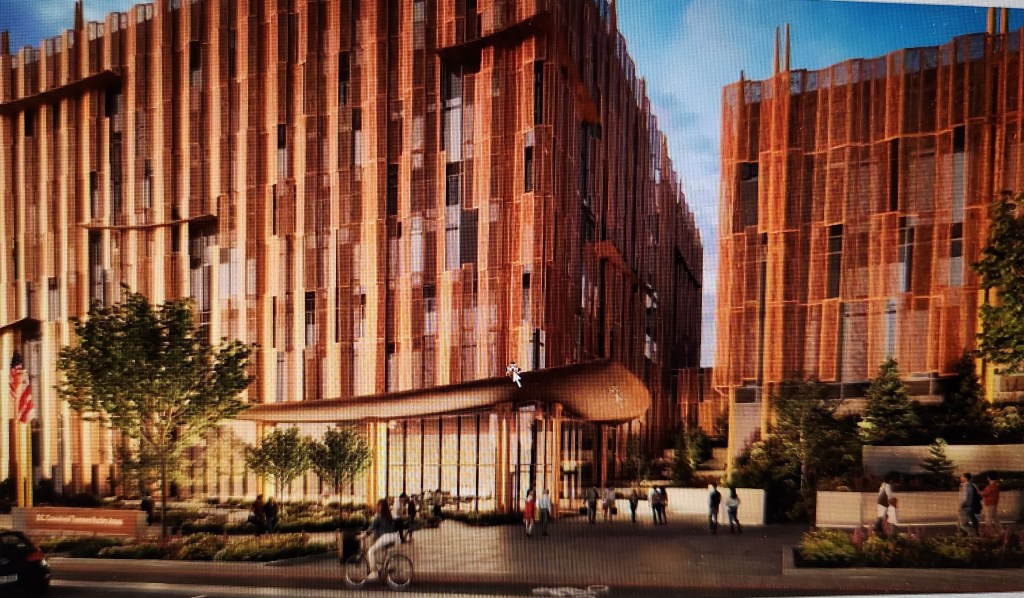
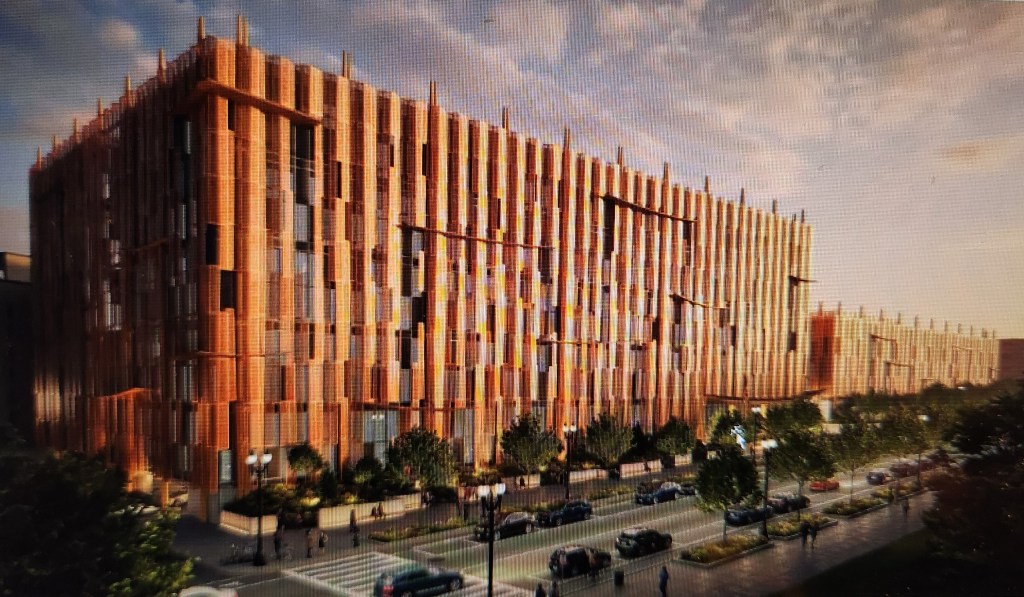
This rendering shows the main entrance to the institution on Massachusetts Avenue. The renderings in Moldenhauer’s PowerPoint presentation included here are those presented to the Zoning Commission in preparation for a hearing on the project’s design and zoning changes scheduled for March 17. But those drawings from the design team of CGL Companies, CORE architecture + design and Neoscape, Inc., are currently being revised in response to a critical review by the DC Commission on Fine Arts (CFA) last November.
CFA was critical of the design for not fitting well enough into the neighborhood (specifically the materials of the exterior) and for looking too much like a carceral institution.
Currently, the façade has three layers – a security barrier, an opaque window wall system, with the exterior covered by a decorative perforated screen or “scrim” of pre-weathered Corten steel panels. Moldenhauer said the intent was to make the façade look like “leaves and trees with a ‘scrim’ over the top.” One of the critiques from CFA was that the Coren steel might darken over time presenting a more threatening visage to the community.
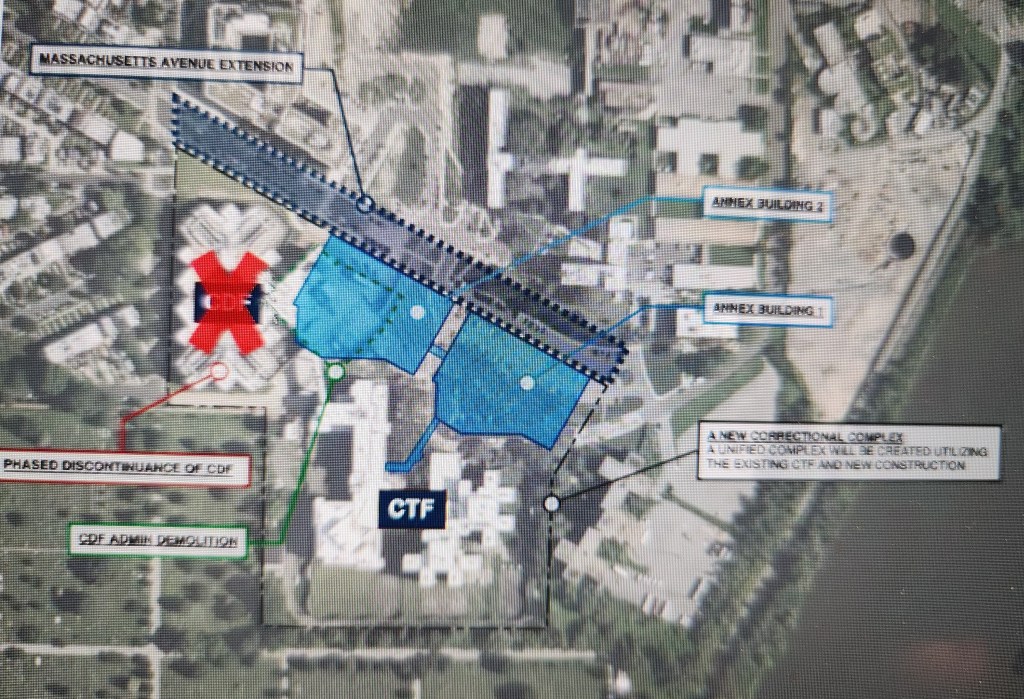
Here’s a schematic of the footprint of the new structures. What will emerge on the opposite side of Massachusetts Avenue remains to be seen, since that will be up to private developers.
The timeline for the project anticipates construction beginning in 2027 and completion in 2034. So far, only the first phase of the project has been funded by the Mayor’s budget, at $463 million. An estimate for the final cost of the project has not yet been released.
For an earlier CHC report, go here: Update & Timeline for New DC Jail and the Correctional Treatment Facility https://bit.ly/3XG5T9J
 CAPITOL HILL CORNER